Charles W. Chesnutt to Judson Douglas Wetmore, September 8, 1924
Key
| Textual Feature | Appearance |
|---|---|
| alterations to base text (additions or deletions) | added or deleted text |
| passage deleted with a strikethrough mark | |
| passage deleted by overwritten added text | Deleted text Added text |
| position of added text (if not added inline) | [right margin] text added in right margin; [above line] text added above the line |
| proofreading mark | ‸ |
| page number, repeated letterhead, etc. | page number or repeated letterhead |
| supplied text | [supplied text] |
| archivist note | archivist note |
 [1]
September 8, 1924
J. Douglas Wetmore, Esq.,
World Building,
63 Park Row,
New York City.
My dear Douglas,
[1]
September 8, 1924
J. Douglas Wetmore, Esq.,
World Building,
63 Park Row,
New York City.
My dear Douglas,
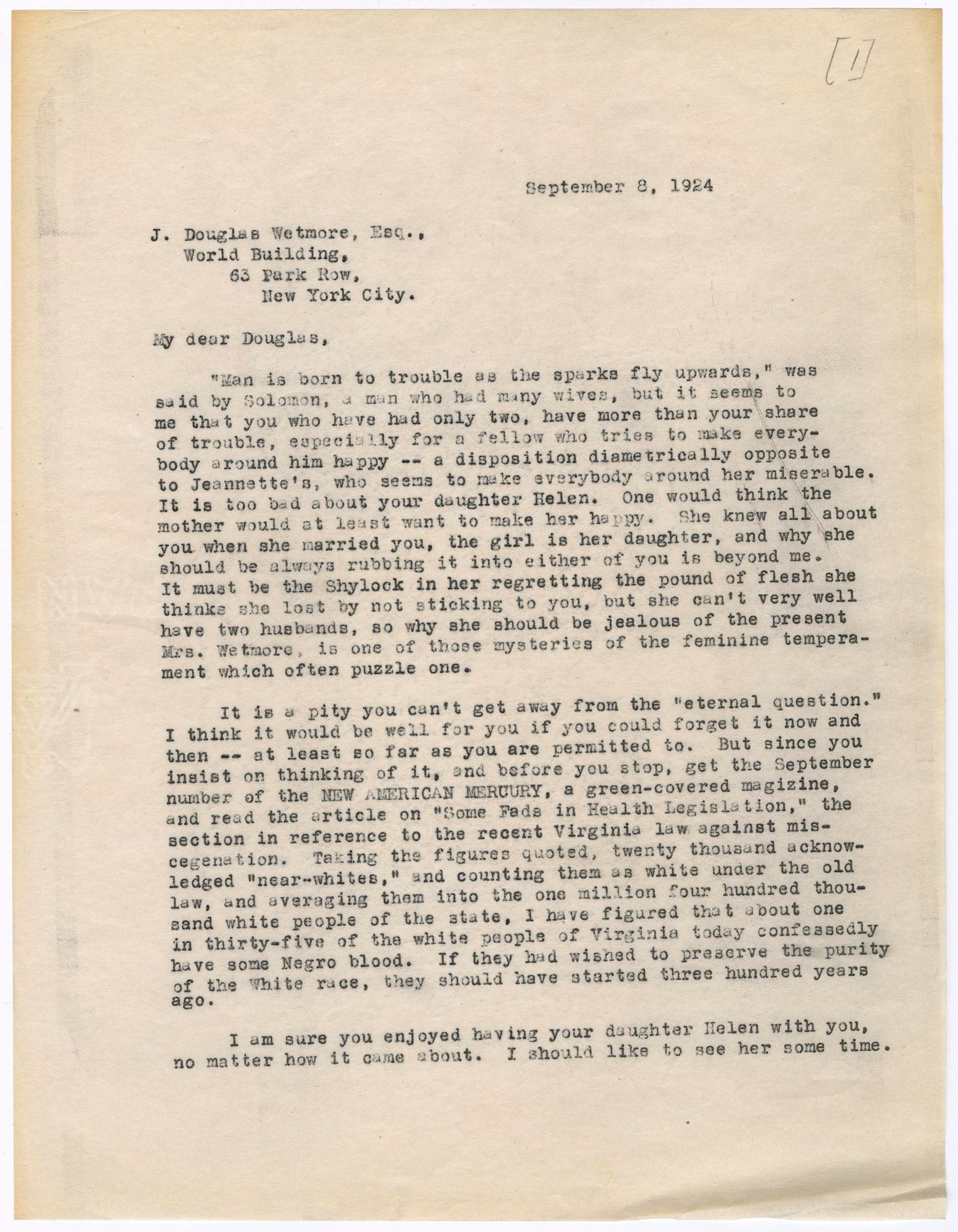
“Man is born to trouble as the sparks fly upwards,” was said by Solomon, a man who had many wives,1 but it seems to me you who have had only two, have more than your share of trouble, especially for a fellow who tries to make everybody around him happy -- a disposition diametrically opposite to Jeannette’s, who seems to make everybody around her miserable. It is too bad about your daughter Helen.2 One would think the mother would at least want to make her happy. She knew all about you when she married you, the girl is her daughter, and why she should be rubbing it into either of you is beyond me. It must be the Shylock in her regretting the pound of flesh3 she thinks she lost by not sticking to you, but she can’t very well have two husbands, so why she should be jealous of the present Mrs. Wetmore,4 is one of those mysteries of the feminine temperament which often puzzle one.
It is a pity you can’t get away from the “eternal question.”5 I think it would be well for you if you could forget it now and then -- at least so far as you are permitted to. But since you insist on thinking of it, and before you stop, get the September number of the NEW AMERICAN MERCURY, a green-covered magazine, and read the article on “Some Fads in Health Legislation,” the section in reference to the recent Virginia law against miscegenation.6 Taking the figures quoted, twenty thousand acknowledged “near-whites,” and counting them as white under the old law, and averaging them into the one million four hundred thousand white people of the state, I have figured that about one in thirty-five of the white people of Virginia today confessedly have some Negro blood. If they had wished to preserve the purity of the White race, they should have started three hundred years ago.
I am sure you enjoyed having your daughter Helen with you, no matter how it came about. I should like to see her some time.
 [2]
J. D. W. #2
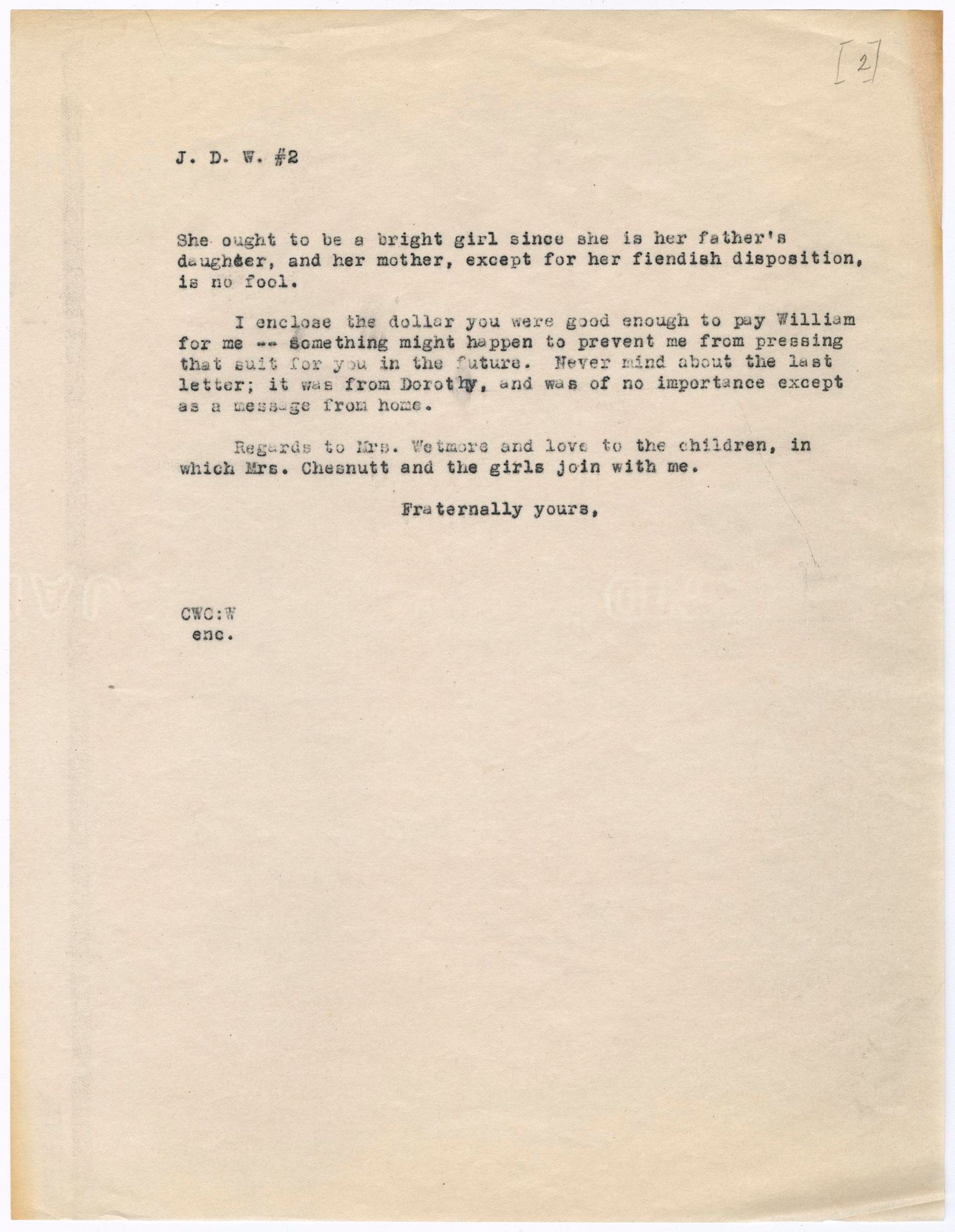
She ought to be a bright girl since she is her father’s daughter, and her mother, except for her fiendish disposition, is no fool.
[2]
J. D. W. #2
She ought to be a bright girl since she is her father’s daughter, and her mother, except for her fiendish disposition, is no fool.
I enclose a dollar you were good enough to pay William for me -- something might happen to prevent me from pressing that suit for you in the future.7 Never mind about the last letter; it was from Dorothy, and was of no importance except as a message from home.8
Regards to Mrs. Wetmore and love to the children, in which Mrs. Chesnutt9 and the girls join with me.10
Fraternally yours, CWC:WCorrespondent: Judson Douglas Wetmore (1871–1930) was a mixed-race lawyer who grew up in Jacksonville, Florida, and was a childhood friend of James Weldon Johnson, who might have introduced Wetmore to Chesnutt. After getting a law degree at Michigan Law School in 1897, Wetmore worked in Jacksonville, but moved to New York City in 1906 to open a law practice. In 1907, he married and later divorced a White Jewish woman, Jeanette Gross (1888–?), with whom he had a daughter, Helen Mable (1908–?). In 1921, he married another White woman named Lucile (or Lucille) Pipes (1894–1966), with whom he had two children. Wetmore died by suicide in July 1930. Both of his wives were aware of his mixed-race status. In official records, he and his children consistently are listed as White, but it was not a secret he was Black (see "Cremate Body of New York Lawyer Whom Many Mistook for White," Afro-American [Baltimore, MD], August 9, 1930, 7; and James Weldon Johnson, Along This Way: The Autobiography of James Weldon Johnson [New York: Viking Press, 1968; orig. pub. 1933], 252).
1. Spoken not by Solomon, but by Eliphaz the Temanite, a friend of the Biblical Job, to comfort him (Job 5:7), but Chesnutt's priority was likely the joke about Solomon's "many wives" (seven hundred according to 1 Kings 11:3). [back]
2. Judson Douglas Wetmore's first wife, Jeanette (or Jeannette) Gross (1888–?) was a White Jewish woman whom he married in 1907, and with whom he had a daughter, Helen Mable Wetmore (1908–?). According to James Weldon Johnson, Jeannette was always aware that Wetmore was mixed-race, but her family was not (Along This Way: The Autobiography of James Weldon Johnson [New York: The Viking Press, 1968; orig.pub.1933], 251). After the couple began divorce proceedings in 1917, Helen seems to have lived with her mother, who had remarried by 1924, although she clearly spent time with her father and stepmother as a 16-year-old as well. In May 1930, shortly before her father's suicide, Helen married Earl J. Robinson (1884–1973), a White investment banker from Iowa. The couple lived in Chicago and had a son in 1931, but nothing further is known about either the mother's or the daughter's life. Contact the Charles W. Chesnutt Archive if you have further information. [back]
3. An allusion to Shakespeare's comedy The Merchant of Venice, 1.3.161–62. Shylock (who is Jewish) demands a "pound of flesh" as security for a loan. [back]
4. Judson Douglas Wetmore's second wife, Lucile (or Lucille) Pipes Wetmore (1894–1966), was a White woman, originally from Louisiana and widowed in 1918 after a very brief first marriage. The couple married in 1921 and had two children: Frances Lucile (1922–1993) and Judson Douglas, Jr. ("Junior," 1923–1995). After Wetmore's suicide, Lucile remarried in 1931 and again in 1945. [back]
5. The "eternal question" relates to the mixed-race identity of people who, like Judson Douglas Wetmore and his children (and Chesnutt himself), looked "White" even though they had African Americn ancestry. Wetmore clearly neither fully concealed nor fully disclosed his mixed-race background, and did "pass" for White in many social and professional contexts. Disclosing mixed-race ancestry meant, for him and potentially for his daughter Helen, not only social and financial disadvantages, but made the marriage to a White partner illegal "miscegenation" in many states. Chesnutt showed a life-long interest in this question in his fiction and non-fiction. See for example "What is a White Man?" and the first part of the 1901 essay series "The Future American". [back]
6. Part III of an essay by Morris Fishbein (1889-1976; editor of the Journal of the American Medical Association, 1924–1950). The essay, "Fads in Health Legislation" in The American Mercury 3, no. 9 (September 1924), 50–56, explored the absurdities of a bill passed in the Virginia House on March 8, 1924, that enabled citizens to apply for a "registration of color and birth" to prove that they had "no intermixture of colored blood" (54, 53), noting that science would be unable to assist in any effort to prove racial purity. [back]
7. The context suggests William was a domestic servant in the Wetmore household (see Helen Moore's August 12, 1924, letter to Chesnutt). He could not be further identified. Contact the Charles W. Chesnutt Archive if you have further information. [back]
8. Dorothy Katherine Chesnutt Slade (1890–1954) was the youngest child of Charles and Susan Chesnutt. After attending the women's college at Western Reserve University from 1909 to 1913 and working as a probation officer for two years, she began teaching junior high school French and English at Willson Junior High School in Cleveland. She married John G. Slade (1890–1976) on March 29, 1924; they had one child, John C. Slade (1925–2011), known as Johnnie. [back]
9. Susan Perry Chesnutt (1861–1940) was from a well-established Black family in Fayetteville, North Carolina, and worked as a teacher at Fayetteville's Howard School before marrying Chesnutt. They were married from 1878 until his death in 1932 and had four children: Ethel, Helen, Edwin, and Dorothy. Susan led an active life in Cleveland. [back]
10. In 1922, two of Chesnutt's daughters, Helen and Dorothy, were living with their parents while pursuing their careers. After finishing college in 1904, Helen had returned to Cleveland to work as a secondary-school teacher, and she continued to live at the house until her mother's death in 1940. Dorothy lived with her parents as a student, probation officer, and eventually junior-high teacher, until her husband completed his medical degree in 1931. [back]