Judson Douglas Wetmore to Charles W Chesnutt, 2 December 1924
Key
| Textual Feature | Appearance |
|---|---|
| alterations to base text (additions or deletions) | added or deleted text |
| passage deleted with a strikethrough mark | |
| passage deleted by overwritten added text | Deleted text Added text |
| position of added text (if not added inline) | [right margin] text added in right margin; [above line] text added above the line |
| proofreading mark | ‸ |
| page number, repeated letterhead, etc. | page number or repeated letterhead |
| supplied text | [supplied text] |
| archivist note | archivist note |
 TELEPHONE 8457-8 BEEKMAN
CABLE ADDRESS JUDOWET
J. D. WETMORE
ATTORNEY AT LAW
WORLD BUILDING
63 PARK ROW
NEW YORK
December 2nd, 1924.
Mr. Charles W. Chesnutt,
8719 Lamont Ave., N. E.,
Cleveland, Ohio
My dear Chesnutt,
TELEPHONE 8457-8 BEEKMAN
CABLE ADDRESS JUDOWET
J. D. WETMORE
ATTORNEY AT LAW
WORLD BUILDING
63 PARK ROW
NEW YORK
December 2nd, 1924.
Mr. Charles W. Chesnutt,
8719 Lamont Ave., N. E.,
Cleveland, Ohio
My dear Chesnutt,
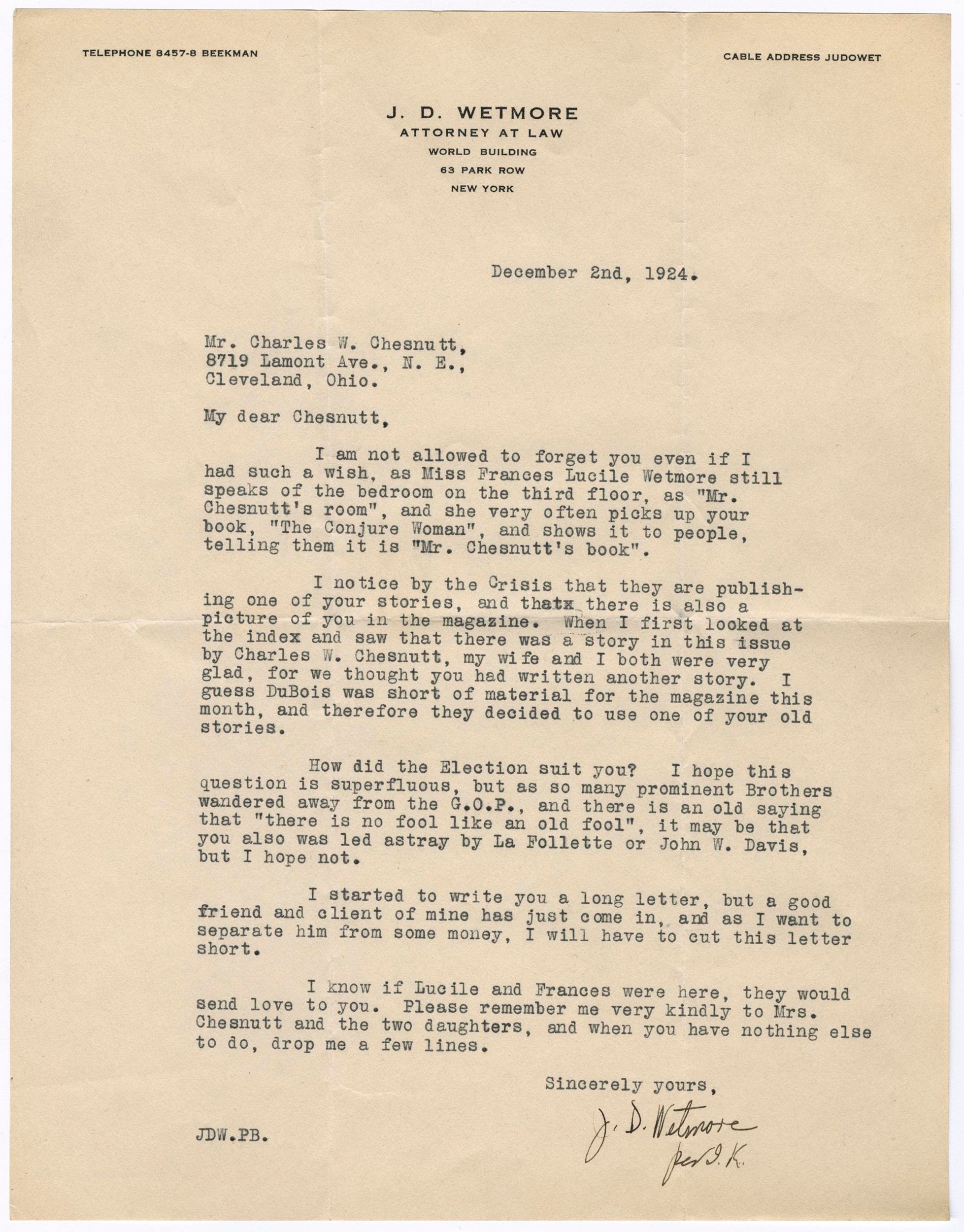
I am not allowed to forget you even if I had such a wish, as Miss Frances Lucile Wetmore1 still speaks of the bedroom on the third floor, as "Mr. Chesnutt's room", and she very often picks up your book, "The Conjure Woman",2 and shows it to people, telling them it is "Mr. Chesnutt's book".
I notice by the Crisis that they are publishing one of your stories, and that[illegible] there is also a picture of you in the magazine.3 When I first looked at the index and saw that there was a story in this issue by Charles W. Chesnutt, my wife and I both were very glad, for we thought you had written another story. I guess Dubois4 was short of material for the magazine this month, and therefore they decided to use one of your old stories.5
How did the Election suit you?6 I hope this question is superfluous, but as so many prominent Brothers wandered away from the G.O.P., and there is an old saying that "there is no fool like an old fool", it may be that you also was led astray by La Follette or John W. Davis, but I hope not.7
I started to write you a long letter, but a good friend and client of mine has just come in, and as I want to separate him from some money, I will have to cut out this letter short.
I know if Lucile and Frances8 were here, they would send love to you. Please remember me very kindly to Mrs. Chesnutt9 and the two daughters,10 and when you have nothing else to do, drop me a few lines.
Sincerely yours, J.D. Wetmore per I.[?] K. JDW.PB.Correspondent: Judson Douglas Wetmore (1871–1930) was a mixed-race lawyer who grew up in Jacksonville, Florida, and was a childhood friend of James Weldon Johnson, who might have introduced Wetmore to Chesnutt. After getting a law degree at Michigan Law School in 1897, Wetmore worked in Jacksonville, but moved to New York City in 1906 to open a law practice. In 1907, he married and later divorced a White Jewish woman, Jeanette Gross (1888–?), with whom he had a daughter, Helen Mable (1908–?). In 1921, he married another White woman named Lucile (or Lucille) Pipes (1894–1966), with whom he had two children. Wetmore died by suicide in July 1930. Both of his wives were aware of his mixed-race status. In official records, he and his children consistently are listed as White, but it was not a secret he was Black (see "Cremate Body of New York Lawyer Whom Many Mistook for White," Afro-American [Baltimore, MD], August 9, 1930, 7; and James Weldon Johnson, Along This Way: The Autobiography of James Weldon Johnson [New York: Viking Press, 1968; orig. pub. 1933], 252).
1. Judson Douglas Wetmore's daughter Frances Lucile (1922–1993) was not quite three years old at the time; Chesnutt had visited the family in the summer of 1924 (see letter to Chesnutt by Helen Moore from August 12, 1924). [back]
2. Chesnutt's collection of short stories, The Conjure Woman, was published by Houghton, Mifflin & Company in March 1899. [back]
3. "The Marked Tree" was the third of four short stories by Chesnutt published in The Crisis. It was published in two installments (vol. 29, no. 2 [December 1924]: 59–64 and vol. 29, no. 3 [January 1925]: 110–113). The story featured the character of Uncle Julius, Chesnutt's famous Black storyteller from The Conjure Woman (1899), who had not appeared in a story since "Tobe's Tribulations" in 1900. "The Marked Tree" was to be the last Uncle Julius story. [back]
4. William Edward Burghardt Du Bois (1868–1963) was a sociologist, historian, and world-renowned civil rights activist. After completing coursework at the University of Berlin and Harvard University, Du Bois became the first African American to earn a doctorate from Harvard in 1895. He was a professor of history, sociology, and economics at Atlanta University (1897–1910 and again in the 1930s). He was a prominent leader of the Niagara Movement and helped found the NAACP in 1909. As the editor of the NAACP's journal, The Crisis, from 1910 to 1931, Du Bois published four of Chesnutt's short stories as well as two of his essays. See "The Doll" (April 1912), "Mr. Taylor's Funeral" (April/May 1915), "The Marked Tree" (Dec 1924/Jan 1925), and "Concerning Father" (May 1930); and "Women's Rights" (August 1915) and "The Negro in Art" (November 1926). [back]
5. Wetmore erroneously assumed that "The Marked Tree" was an already-published story, but corrects his error in a December 30 letter to Chesnutt. [back]
6. The presidential election of 1924 was held on November 4, 1924, and the incumbent President, the Republican Calvin Coolidge (1872–1933), won 54% of the popular vote. His opponents, Democrat John W. Davis (1873–1955) and Progressive Robert M. La Follette (1855–1925), received 28.8% and 16.6% of the vote, respectively. [back]
7. The vast majority of Black voters traditionally voted Republican until the 1930s (Chesnutt was a life-long Republican). An estimated 90% of Black voters voted for Republican incumbent Calvin Coolidge in the 1924 Presidential election, but several prominent Black leaders, including the Black Republican lawyer and former Coolidge supporter, William Henry Lewis (1868–1949), criticized Coolidge's failure to denounce the Ku Klux Klan publicly and endorsed Democrat John W. Davis, who had explicitly condemned the KKK. There are no reliable exit polls, but Progressive candidate Robert La Follette, who also denounced the KKK, possibly received more of the remaining 10% of the Black vote than Davis. [back]
8. Judson Douglas Wetmore's second wife, Lucile (or Lucille) Pipes Wetmore (1894–1966), was a White woman, originally from Louisiana and widowed in 1918 after a very brief first marriage. The couple married in 1921 and had two children: Frances Lucile (1922–1993) and Judson Douglas, Jr. ("Junior," 1923–1995). After Wetmore's suicide, Lucile remarried in 1931 and again in 1945. [back]
9. Susan Perry Chesnutt (1861–1940) was from a well-established Black family in Fayetteville, North Carolina, and worked as a teacher at Fayetteville's Howard School before marrying Chesnutt. They were married from 1878 until his death in 1932 and had four children: Ethel, Helen, Edwin, and Dorothy. Susan led an active life in Cleveland. [back]
10. In 1922, two of Chesnutt's daughters, Helen and Dorothy, were living with their parents while pursuing their careers. After finishing college in 1904, Helen had returned to Cleveland to work as a secondary-school teacher, and she continued to live at the house until her mother's death in 1940. Dorothy lived with her parents as a student, probation officer, and eventually junior-high teacher, until her husband completed his medical degree in 1931. [back]