Helen C. Moore to Charles W. Chesnutt, 12 August 1924
Key
| Textual Feature | Appearance |
|---|---|
| alterations to base text (additions or deletions) | added or deleted text |
| passage deleted with a strikethrough mark | |
| passage deleted by overwritten added text | Deleted text Added text |
| position of added text (if not added inline) | [right margin] text added in right margin; [above line] text added above the line |
| proofreading mark | ‸ |
| page number, repeated letterhead, etc. | page number or repeated letterhead |
| supplied text | [supplied text] |
| archivist note | archivist note |
 CHAS W. CHESNUTT
HELEN C. MOORE
CHESNUTT & MOORE
SHORTHAND REPORTERS
1106 WILLIAMSON BUILDING
CLEVELAND
1646 UNION TRUST BLDG.
August 12, 1924
Dear Mr. Chesnutt,
CHAS W. CHESNUTT
HELEN C. MOORE
CHESNUTT & MOORE
SHORTHAND REPORTERS
1106 WILLIAMSON BUILDING
CLEVELAND
1646 UNION TRUST BLDG.
August 12, 1924
Dear Mr. Chesnutt,
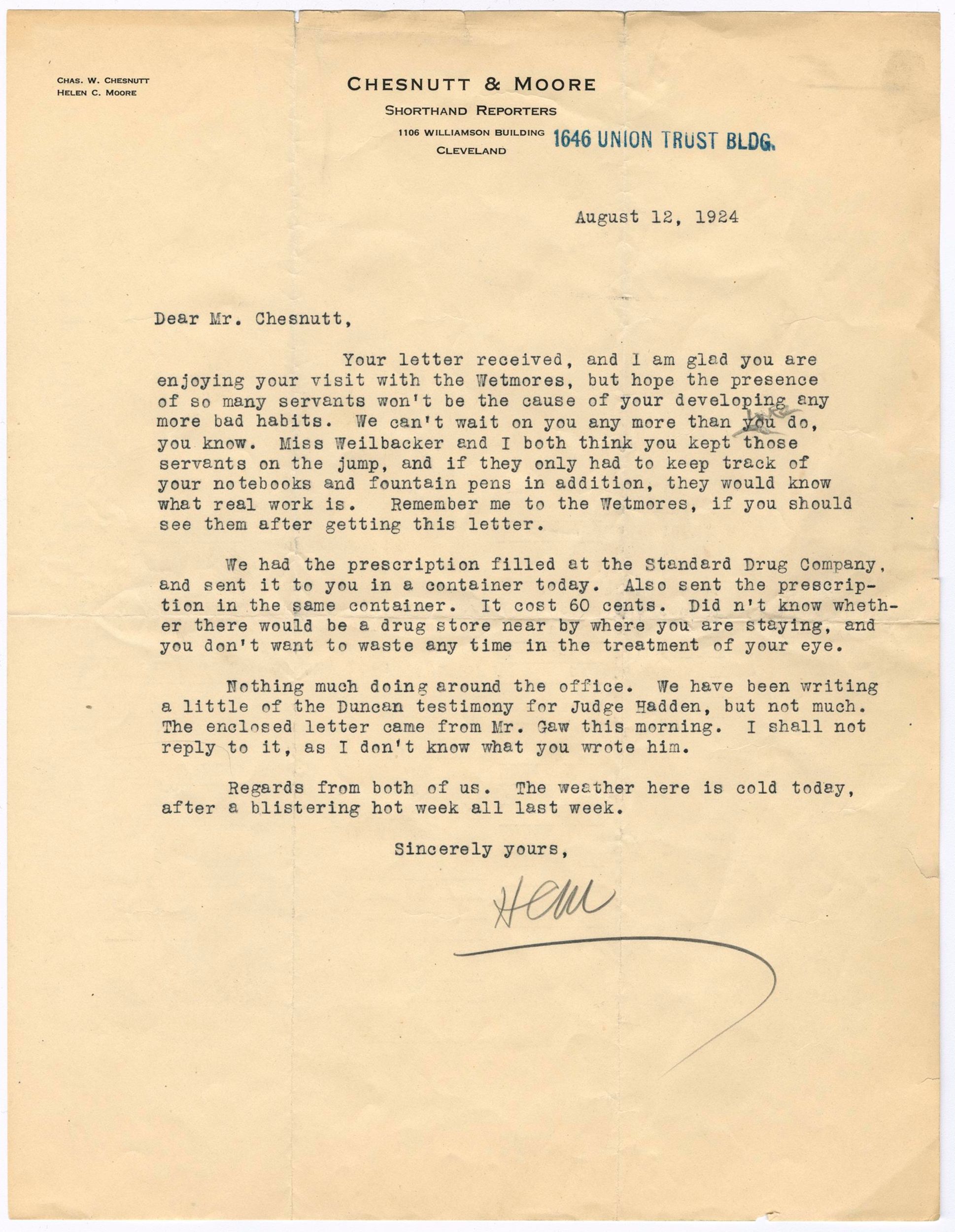
Your letter received, and I am glad you are enjoying your visit with the Wetmores,1 but hope the presence of so many servants won't be the cause of your developing any more bad habits. We can't wait on you any more than youwe[?] do, you know. Miss Weilbacker2 and I both think you kept those servants on the jump, and if they only had to keep track of your notebooks and fountain pens in addition, they would know what real work is. Remember me to the Wetmores, if you should see them after getting this letter.
We had the prescription filled at the Standard Drug Company, and sent it to you in a container today.3 Also sent the prescription in the same container. It cost 60 cents. Did n't know whether there would be a drug store near by where you are staying, and you don't want to waste any time in the treatment of your eye.
Nothing much doing around the office. We have been writing a little of the Duncan testimony for Judge Hadden,4 but not much. The enclosed letter came from Mr. Gaw5 this morning. I shall not reply to it, as I don't know what you wrote him.
Regards from both of us. The weather here is cold today, after a blistering hot week all last week.
Sincerely yours, HCMCorrespondent: Helen C. Moore (1881–1963) was a White shorthand reporter who began working with Chesnutt in 1918. Moore graduated from Cleveland Law College in 1925, earned her Bachelor of Laws from Baldwin-Wallace, and later, at the age of 58, obtained a Bachelor of Arts from The Ohio State University. During the last years of Chesnutt's life, she managed their firm, Chesnutt & Moore, and upon his death in 1932, she founded her own firm, Helen Moore & Associates ("Memorial Resolutions," Journal of the Cleveland Bar Association 35 [1964]: 81–100). Most of their surviving correspondence consists of summer updates during periods when either she or Chesnutt were away from the office on their summer vacations.
1. Judson Douglas Wetmore (1871–1930) was a mixed-race lawyer who grew up in Jacksonville, Florida, and was a childhood friend of James Weldon Johnson, who might have introduced Wetmore to Chesnutt. After getting a law degree at Michigan Law School in 1897, Wetmore worked in Jacksonville, but moved to New York City in 1906 to open a law practice. In 1907, he married and later divorced a White Jewish woman, Jeanette Gross (1888–?), with whom he had a daughter, Helen Mable (1908–?). In 1921, he married another White woman named Lucile (or Lucille) Pipes (1894–1966), with whom he had two children. Wetmore died by suicide in July 1930. Both of his wives were aware of his mixed-race status. In official records, he and his children consistently are listed as White, but it was not a secret he was Black (see "Cremate Body of New York Lawyer Whom Many Mistook for White," Afro-American [Baltimore, MD], August 9, 1930, 7; and James Weldon Johnson, Along This Way: The Autobiography of James Weldon Johnson [New York: Viking Press, 1968; orig. pub. 1933], 252). [back]
2. Most likely Dorothy Weilbacher Metcalf (1906–?), who at seventeen or eighteen years old might have been one of several junior office staff that worked for Chesnutt & Moore in 1923–1924; her sisters Barbara Weilbacher Newcomb (1902–?) and Bernadine Weilbacher Campbell ("Dena," 1903–1978) were bank clerks at the Union Trust Bank in the early 1920s. All three lived with their parents and younger siblings throughout the 1920s, but the father, Gerhard William Weilbacher, moved the entire family to Miami, Florida, in 1925. [back]
3. The Standard Drug Company was a Cleveland drugstore chain founded in 1899 by two drug salesmen and incorporated in 1906. By 1921, it had sixteen stores across the city. [back]
4. Alexander Hadden (1850–1926), a White lawyer originally from West Virginia, was trained at Oberlin College, admitted to the Ohio bar in 1875, and was a member of a series of law firms in Cleveland before he became a probate judge for the Cuyahoga County Court (1905–1926). Neither the legal case nor "Duncan" could be further identified. Contact the Charles W. Chesnutt Archive if you have further information [back]
5. Likely Albert Cornelius Gaw (1875–1939), a White court stenographer in Elkhart, Indiana. He was elected as the Secretary of the National Shorthand Reporters Association in 1924 and served until 1939, shortly before his death; he also edited the association's magazine, The Shorthand Reporter. He most likely wrote Chesnutt in connection with the Association's upcoming convention, held August 18–22, 1924, in Washington, DC, which Chesnutt and Moore both attended. [back]