Judson Douglas Wetmore to Charles W. Chesnutt, 29 August 1924
Key
| Textual Feature | Appearance |
|---|---|
| alterations to base text (additions or deletions) | added or deleted text |
| passage deleted with a strikethrough mark | |
| passage deleted by overwritten added text | Deleted text Added text |
| position of added text (if not added inline) | [right margin] text added in right margin; [above line] text added above the line |
| proofreading mark | ‸ |
| page number, repeated letterhead, etc. | page number or repeated letterhead |
| supplied text | [supplied text] |
| archivist note | archivist note |
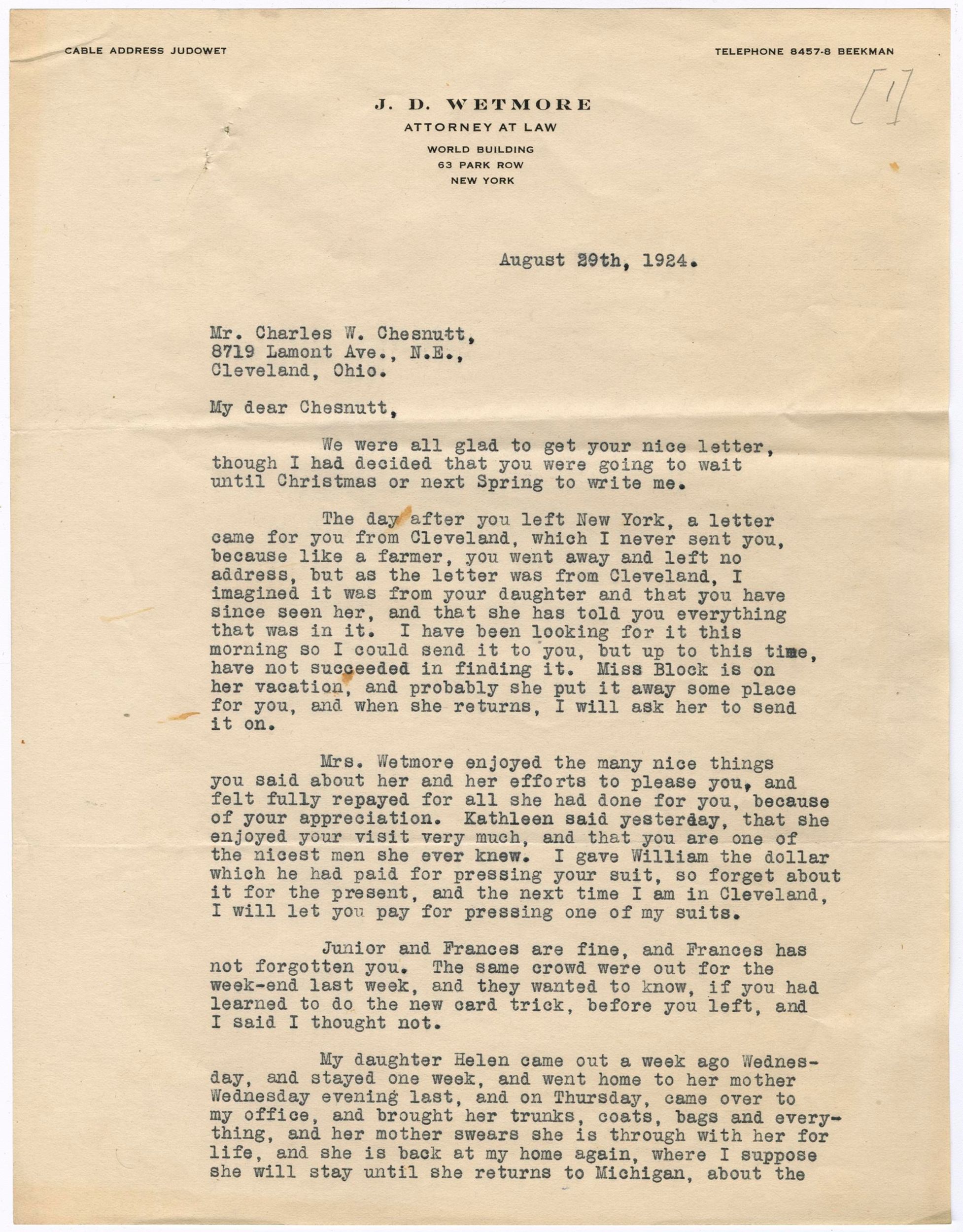 [1]
CABLE ADDRESS JUDOWET
TELEPHONE 8457-8 BEEKMAN
J. D. WETMORE
ATTORNEY AT LAW
WORLD BUILDING
63 PARK ROW
NEW YORK
August 29th, 1924.
Mr. Charles W. Chesnutt,
8719 Lamont Ave., N.E.,
Cleveland, Ohio.
My dear Chesnutt,
[1]
CABLE ADDRESS JUDOWET
TELEPHONE 8457-8 BEEKMAN
J. D. WETMORE
ATTORNEY AT LAW
WORLD BUILDING
63 PARK ROW
NEW YORK
August 29th, 1924.
Mr. Charles W. Chesnutt,
8719 Lamont Ave., N.E.,
Cleveland, Ohio.
My dear Chesnutt,
We were all glad to get your nice letter, though I had decided that you were going to wait until Christmas or next Spring to write me.
The day after you left New York,1 a letter came for you from Cleveland, which I never sent you, because like a farmer, you went away and left no address, but as the letter was from Cleveland, I imagined it was from your daughter2 and that you have since seen her, and that she has told you everything that was in it. I have been looking for it this morning so I could send it to you, but up to this time, have not succeeded in finding it. Miss Block is on her vacation, and probably she put it away some place for you, and when she returns, I will ask her to send it on.
Mrs. Wetmore3 enjoyed the many nice things you said about her and her efforts to please you, and felt fully repayed for all she had done for you, because of your appreciation. Kathleen said yesterday, that she enjoyed your visit very much, and that you are one of the nicest men she ever knew. I gave William4 the dollar which he had paid for pressing your suit, so forget about it for the present, and the next time I am in Cleveland, I will let you pay for pressing one of my suits.
Junior and Frances are fine, and Frances has not forgotten you. The same crowd were out for the week-end last week, and they wanted to know, if you had learned to do the new card trick, before you left, and I said I thought not.
My daughter Helen came out a week ago Wednesday, and stayed one week, and went home to her mother Wednesday evening last, and on Thursday, came over to my office, and brought her trunks, coats, bags and everything, and her mother swears she is through with her for life, and she is back at my home again, where I suppose she will stay until she returns to Michigan, about the
 [2]
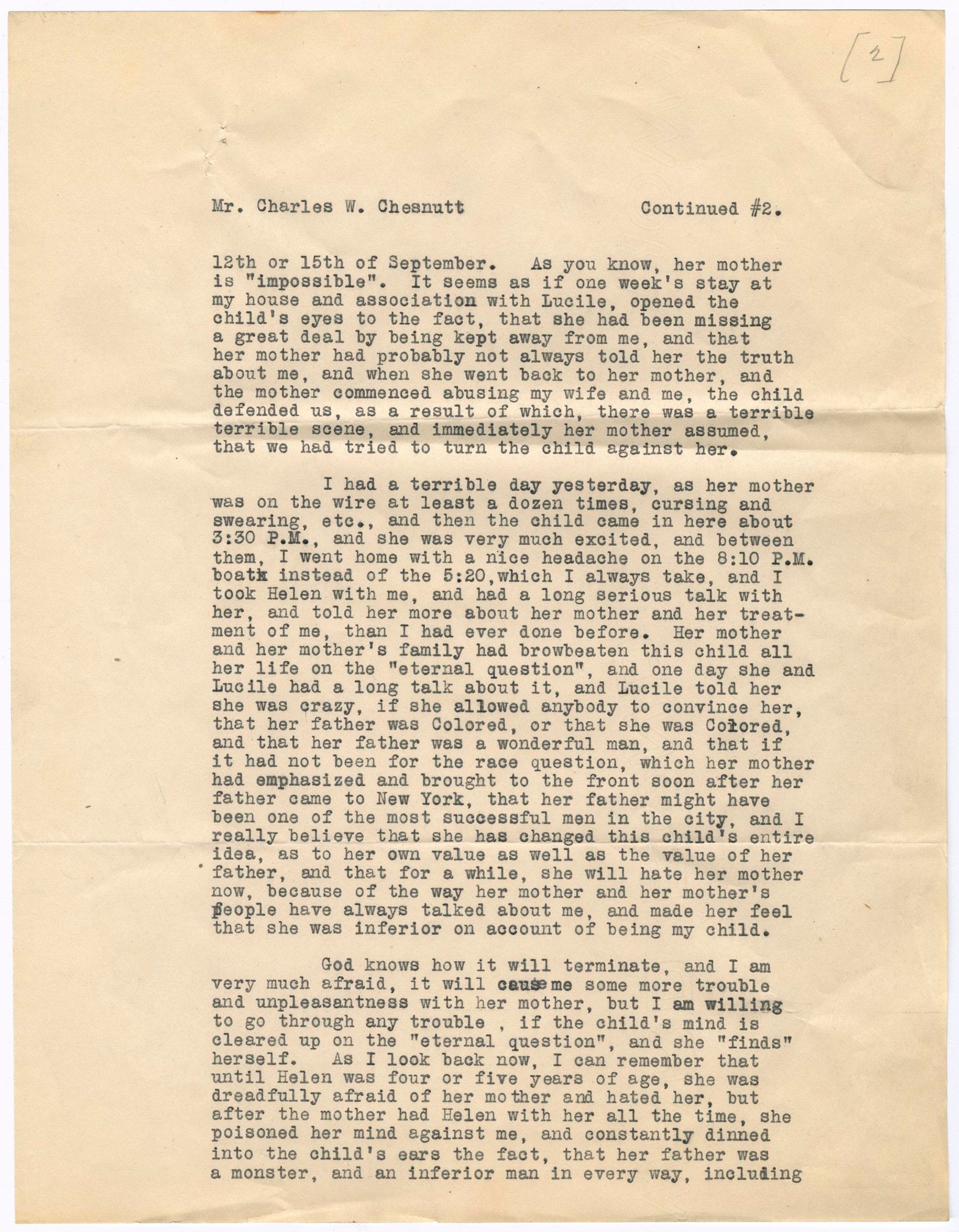
12th or 15th of September. As you know, her mother is "impossible".5 It seems as if one week's stay at my house and association with Lucile, opened the child's eyes to the fact, that she had been missing a great deal by being kept away from me, and that her mother had probably not always told her the truth about me, and when she went back to her mother, and the mother commenced abusing my wife and me, the child defended us, as a result of which, there was a terrible terrible scene, and immediately her mother assumed, that we had tried to turn the child against her.
[2]
12th or 15th of September. As you know, her mother is "impossible".5 It seems as if one week's stay at my house and association with Lucile, opened the child's eyes to the fact, that she had been missing a great deal by being kept away from me, and that her mother had probably not always told her the truth about me, and when she went back to her mother, and the mother commenced abusing my wife and me, the child defended us, as a result of which, there was a terrible terrible scene, and immediately her mother assumed, that we had tried to turn the child against her.
I had a terrible day yesterday, as her mother was on the wire at least a dozen times, cursing and swearing, etc., and then the child came in here about 3:30 P.M., and she was very much excited, and between them, I went home with a nice headache on the 8:10 P.M. boath instead of the 5:20, which I always take, and I took Helen with me, and had a long serious talk with her, and told her more about her mother and her treatment of me, than I had ever done before. Her mother and her mother's family had browbeaten this child all her life on the "eternal question",6 and one day she and Lucile had a long talk about it, and Lucile told her she was crazy, if she allowed anybody to convince her, that her father was Colored, or that she was Colored, and that her father was a wonderful man, and that if it had not been for the race question, which her mother had emphasized and brought to the front soon after her father came to New York, that her father might have been one of the most successful men in the city, and I really believe that she has changed this child's entire idea, as to her own value as well as the value of her father, and that for a while, she will hate her mother now, because of the way her mother and her mother's people have always talked about me, and made her feel that she was inferior on account of being my child.
God knows how it will terminate, and I am very much afraid, it will cause me some more trouble and unpleasantness with her mother, but I am willing to go through any trouble, if the child's mind is cleared up on the "eternal question", and she "finds" herself. As I look back now, I can remember that until Helen was four or five years of age, she was dreadfully afraid of her mother and hated her, but after the mother had Helen with her all the time, she poisoned her mind against me, and constantly dinned into the child's ears the fact, that her father was a monster, and an inferior man in every way, including
 [3]
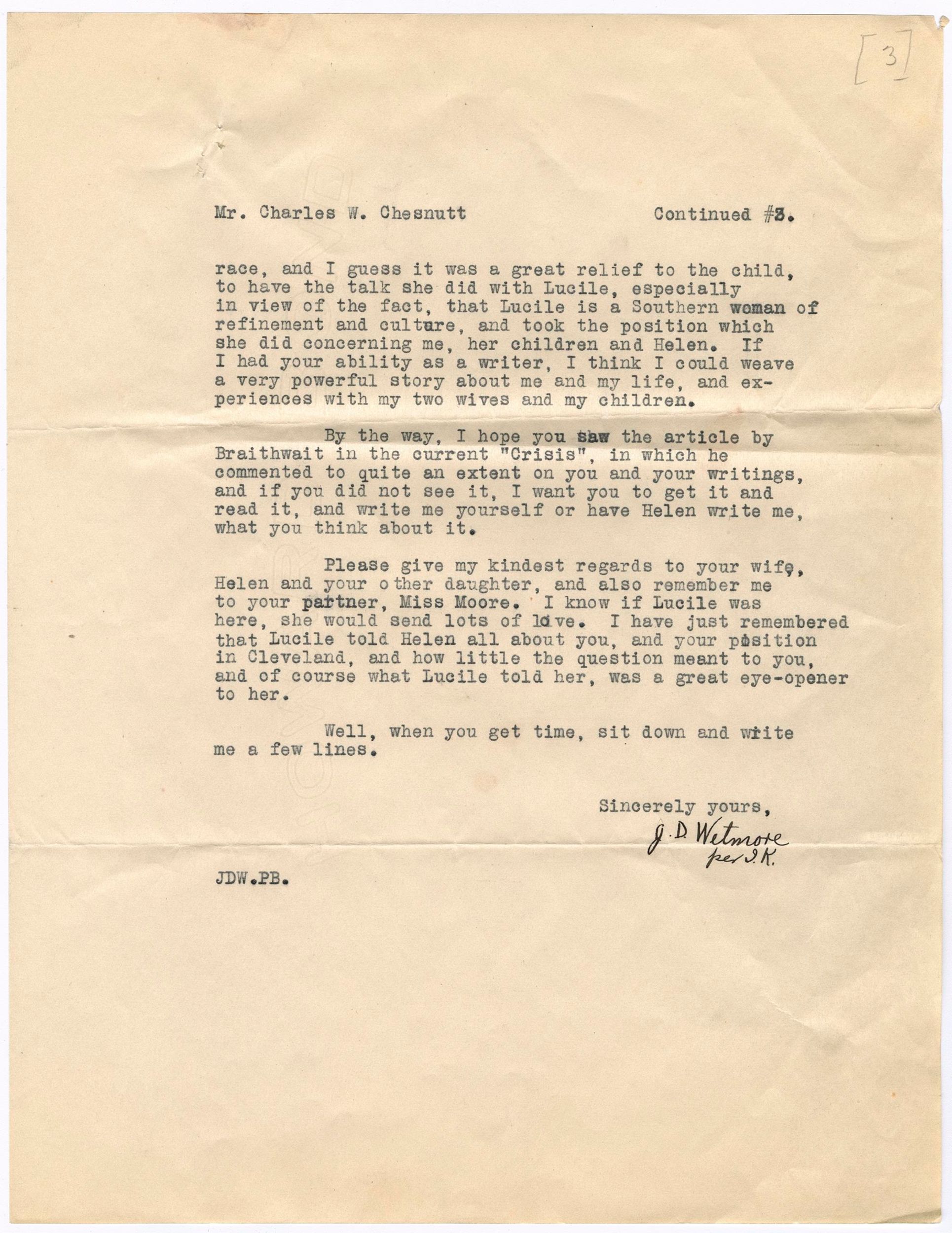
race, and I guess it was a great relief to the child, to have the talk she did with Lucile, especially in view of the fact, that Lucile is a Southern woman of refinement and culture, and took the position which she did concerning me, her children and Helen. If I had your ability as a writer, I think I could weave a very powerful story about me and my life, and experiences with my two wives and my children.
[3]
race, and I guess it was a great relief to the child, to have the talk she did with Lucile, especially in view of the fact, that Lucile is a Southern woman of refinement and culture, and took the position which she did concerning me, her children and Helen. If I had your ability as a writer, I think I could weave a very powerful story about me and my life, and experiences with my two wives and my children.
By the way, I hope you saw the article by Braithwait7 in the current "Crisis", in which he commented to quite an extent on you and your writings,8 and if you did not see it, I want you to get it and read it, and write me yourself or have Helen9 write me, what you think about it.
Please give my kindest regards to your wife,10 Helen and your other daughter, and also remember me to your partner, Miss Moore.11 I know if Lucile was here, she would send lots of love. I have just remembered that Lucile told Helen all about you, and your position in Cleveland, and how little the question meant to you, and of course what Lucile told her, was a great eye-opener to her.
Well, when you get time, sit down and write me a few lines.
Sincerely yours, J. D. Wetmore per I. K. JDW.PB.Correspondent: Judson Douglas Wetmore (1871–1930) was a mixed-race lawyer who grew up in Jacksonville, Florida, and was a childhood friend of James Weldon Johnson, who might have introduced Wetmore to Chesnutt. After getting a law degree at Michigan Law School in 1897, Wetmore worked in Jacksonville, but moved to New York City in 1906 to open a law practice. In 1907, he married and later divorced a White Jewish woman, Jeanette Gross (1888–?), with whom he had a daughter, Helen Mable (1908–?). In 1921, he married another White woman named Lucile (or Lucille) Pipes (1894–1966), with whom he had two children. Wetmore died by suicide in July 1930. Both of his wives were aware of his mixed-race status. In official records, he and his children consistently are listed as White, but it was not a secret he was Black (see "Cremate Body of New York Lawyer Whom Many Mistook for White," Afro-American [Baltimore, MD], August 9, 1930, 7; and James Weldon Johnson, Along This Way: The Autobiography of James Weldon Johnson [New York: Viking Press, 1968; orig. pub. 1933], 252).
1. Chesnutt visited the Wetmore in New York in the summer of 1924. See Helen Moore's August 12, 1924, letter to Chesnutt. [back]
2. Dorothy Katherine Chesnutt Slade (1890–1954) was the youngest child of Charles and Susan Chesnutt. After attending the women's college at Western Reserve University from 1909 to 1913 and working as a probation officer for two years, she began teaching junior high school French and English at Willson Junior High School in Cleveland. She married John G. Slade (1890–1976) on March 29, 1924; they had one child, John C. Slade (1925–2011), known as Johnnie. [back]
3. Judson Douglas Wetmore's second wife, Lucile (or Lucille) Pipes Wetmore (1894–1966), was a White woman, originally from Louisiana and widowed in 1918 after a very brief first marriage. The couple married in 1921 and had two children: Frances Lucile (1922–1993) and Judson Douglas, Jr. ("Junior," 1923–1995). After Wetmore's suicide, Lucile remarried in 1931 and again in 1945. [back]
4. The context suggests William and Kathleen are domestic servants in the Wetmore household (see Helen Moore's August 12, 1924, letter to Chesnutt), and that Miss Block was Wetmore's secretary. None of them could be further identified. Contact the Charles W. Chesnutt Archive if you have further information about any of these individuals. [back]
5. Judson Douglas Wetmore's first wife, Jeanette (or Jeannette) Gross (1888–?) was a White Jewish woman whom he married in 1907, and with whom he had a daughter, Helen Mable Wetmore (1908–?). According to James Weldon Johnson, Jeannette was always aware that Wetmore was mixed-race, but her family was not (Along This Way: The Autobiography of James Weldon Johnson [New York: The Viking Press, 1968; orig.pub.1933], 251). After the couple began divorce proceedings in 1917, Helen seems to have lived with her mother, who had remarried by 1924, although she clearly spent time with her father and stepmother as a 16-year-old as well. In May 1930, shortly before her father's suicide, Helen married Earl J. Robinson (1884–1973), a White investment banker from Iowa. The couple lived in Chicago and had a son in 1931, but nothing further is known about either the mother's or the daughter's life. Contact the Charles W. Chesnutt Archive if you have further information. [back]
6. The "eternal question" relates to the mixed-race identity of people who, like Judson Douglas Wetmore and his children (and Chesnutt himself), looked "White" even though they had African Americn ancestry. Wetmore clearly neither fully concealed nor fully disclosed his mixed-race background, and did "pass" for White in many social and professional contexts. Disclosing mixed-race ancestry meant, for him and potentially for his daughter Helen, not only social and financial disadvantages, but made the marriage to a White partner illegal "miscegenation" in many states. Chesnutt showed a life-long interest in this question in his fiction and non-fiction. See for example "What is a White Man?" and the first part of the 1901 essay series "The Future American". [back]
7. William Stanley Braithwaite (1878–1962) was a self-educated Black literary critic, writer, and publisher from Boston. After an apprenticeship in a publishing house, he began to write poetry and was briefly the book critic for The Colored American Magazine (1901–02). He became the literary critic of the Boston Evening Transcript (1906–1931), and published criticism, poetry, and fiction. He was best known for his anthologies, most notably the Anthology of Magazine Verse and Yearbook of American Poetry (1913–1939). He contributed to Alain Locke's anthology The New Negro (1925), but usually wrote about White authors, a fact that sometimes drew criticism. Ten years before Chesnutt, Braithwaite received the Spingarn Medal, the NAACP's highest honor. [back]
8. In his essay "The Negro in Literature," (The Crisis 28, no. 5 [September 1924]: 200–210), Braithwaite dedicated a long paragraph to praising Chesnutt's fiction. [back]
9. Helen Maria Chesnutt (1880–1969) was Chesnutt's second child. She earned degrees from Smith College and Columbia University, taught Latin (including to Langston Hughes) at Cleveland's Central High School for more than four decades starting in 1904, co-authored a Latin textbook, The Road to Latin, in 1932, and served on the executive committee of the American Philological Association in 1920. She became her father's literary executor and first biographer. [back]
10. Susan Perry Chesnutt (1861–1940) was from a well-established Black family in Fayetteville, North Carolina, and worked as a teacher at Fayetteville's Howard School before marrying Chesnutt. They were married from 1878 until his death in 1932 and had four children: Ethel, Helen, Edwin, and Dorothy. Susan led an active life in Cleveland. [back]
11. Helen C. Moore (1881–1963) was a White shorthand reporter who began working with Chesnutt in 1918. Moore graduated from Cleveland Law College in 1925, earned her Bachelor of Laws from Baldwin-Wallace, and later, at the age of 58, obtained a Bachelor of Arts from The Ohio State University. During the last years of Chesnutt's life, she managed their firm, Chesnutt & Moore, and upon his death in 1932, she founded her own firm, Helen Moore & Associates ("Memorial Resolutions," Journal of the Cleveland Bar Association 35 [1964]: 81–100). Most of their surviving correspondence consists of summer updates during periods when either she or Chesnutt were away from the office on their summer vacations. [back]