Charles W. Chesnutt to J.D. Wetmore, Esq., 25 July 1924
Key
| Textual Feature | Appearance |
|---|---|
| alterations to base text (additions or deletions) | added or deleted text |
| passage deleted with a strikethrough mark | |
| passage deleted by overwritten added text | Deleted text Added text |
| position of added text (if not added inline) | [right margin] text added in right margin; [above line] text added above the line |
| proofreading mark | ‸ |
| page number, repeated letterhead, etc. | page number or repeated letterhead |
| supplied text | [supplied text] |
| archivist note | archivist note |
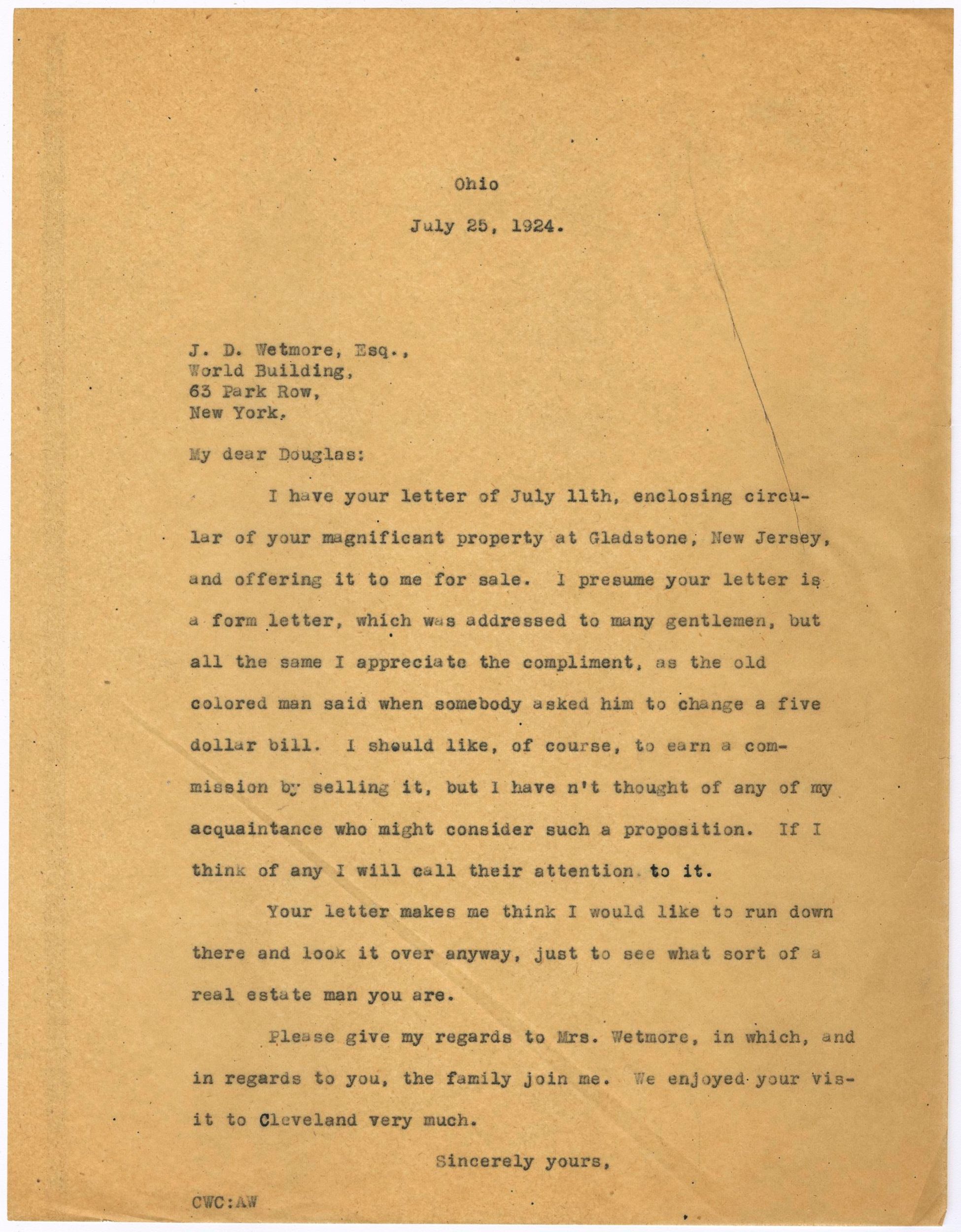 J. D. Wetmore, Esq.,
World Park Building
63 Park Row
New York
My dear Douglas:
J. D. Wetmore, Esq.,
World Park Building
63 Park Row
New York
My dear Douglas:
I have your letter of July 11th, enclosing circular of your magnificant property at Gladstone, New Jersey, and offering it to me for sale. I presume your letter is a form letter, which was addressed to many gentlemen, but all the same I appreciate the compliment, as the old colored man said when somebody asked him to change a five dollar bill. I should like, of course, to earn a commission by selling it, but I haven't thought of any of my acquaintance who might consider such a proposition. If I think of any I will Call their attention to it.
Your letter makes me think I would like to run down there and look it over anyway, just to see what sort of a real estate man you are.
Please give my regards to Mrs. Wetmore, in which, in regards to you, the family join me. We enjoyed your visit to Cleveland very much.
Sincerely yours, CWC:AWCorrespondent: