Charles W. Chesnutt to Harry C. Smith, 17 May 1922
Key
| Textual Feature | Appearance |
|---|---|
| alterations to base text (additions or deletions) | added or deleted text |
| passage deleted with a strikethrough mark | |
| passage deleted by overwritten added text | Deleted text Added text |
| position of added text (if not added inline) | [right margin] text added in right margin; [above line] text added above the line |
| proofreading mark | ‸ |
| page number, repeated letterhead, etc. | page number or repeated letterhead |
| supplied text | [supplied text] |
| archivist note | archivist note |
 May 17, 1922.
Honorable Harry C. Smith,
Care The Cleveland Gazette,
Blackstone Building,
City.
Dear Mr. Smith:
May 17, 1922.
Honorable Harry C. Smith,
Care The Cleveland Gazette,
Blackstone Building,
City.
Dear Mr. Smith:
I enclose you copy of the pamphlet1 of which I spoke to you, and also a suggestion of the sort of a letter I would write to Senator Willis2 if I were in your place. I am not trying to write your letter for you, and I have no doubt you will write a very different and a much better one, but this is merely a suggestion. If you could comment on the matter in the Gazette and send the Senator a marked copy, I have no doubt that your letter and editorial would have a great deal of influence.3 We have got to bring some pressure to bear down there if we want to save the only free colored nations of the western continent.4
Very truly yours, CWC/FL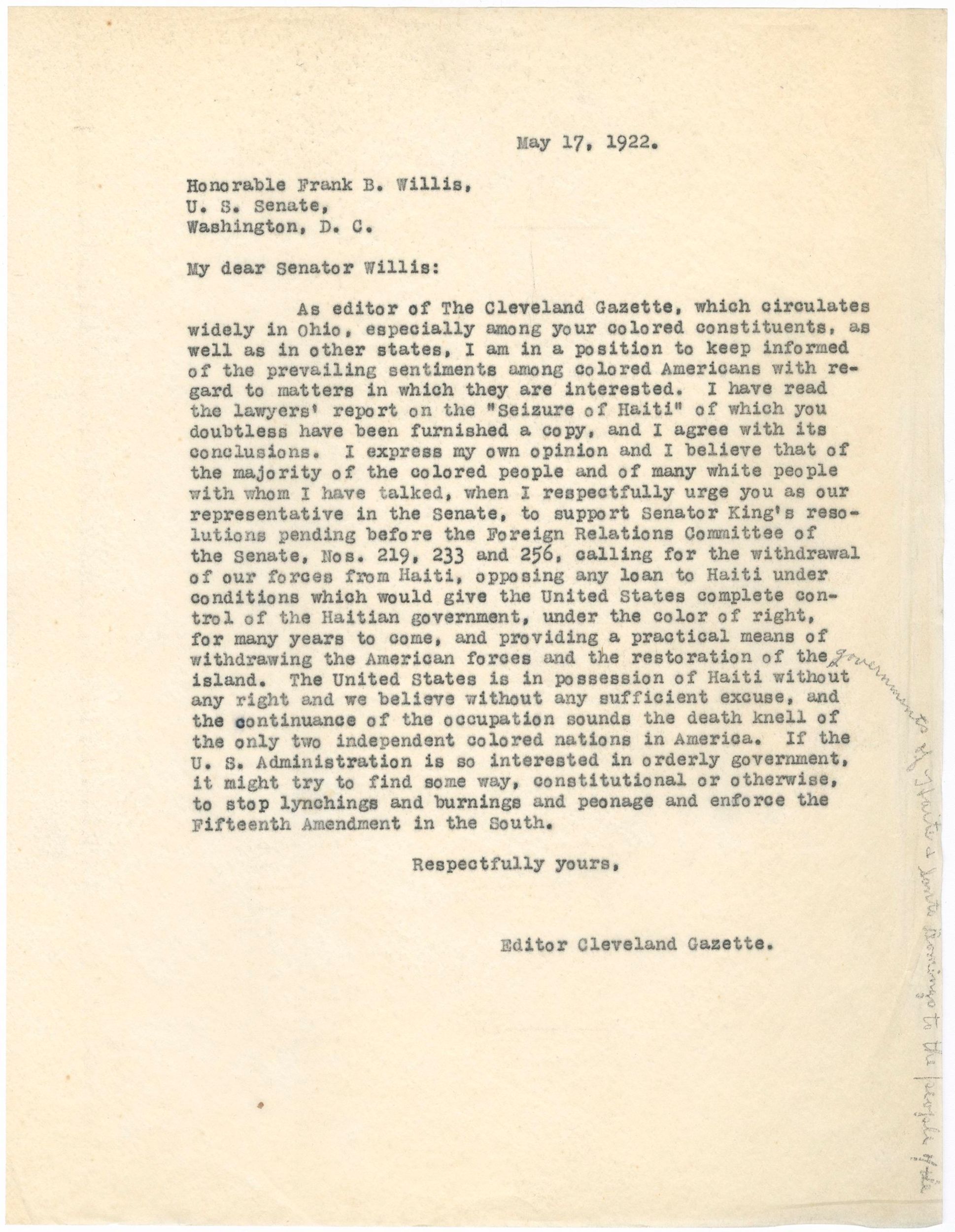 May 17, 1922.
Honorable Frank B. Willis,
U. S. Senate,
Washington, D. C.
My dear Senator Willis:
May 17, 1922.
Honorable Frank B. Willis,
U. S. Senate,
Washington, D. C.
My dear Senator Willis:
As editor of The Cleveland Gazette, which circulates widely in Ohio, especially among your colored constituents, as well as in other states, I am in a position to keep informed of the prevailing sentiments among colored Americans with regard to matters in which they are interested. I have read the lawyers' report on the "Seizure of Haiti" of which you doubtless have been furnished a copy, and I agree with its conclusions. I express my own opinion and I believe that of the majority of the colored people and of many white people with whom I have talked, when I respectfully urge you as our representative in the Senate, to support Senator King's resolutions pending before the Foreign Relations Committee of the Senate, Nos. 219, 233 and 256, calling for the withdrawal of our forces from Haiti, opposing any loan to Haiti under conditions which would give the United States complete control of the Haitain government, under the color of right, for many years to come, and providing a practical means of withdrawing the American forces and the restoration of the government of Haiti & Santo Domingo to the people of the island.5 The United States is in possession of Haiti without any right and we believe without any sufficient excuse, and the continuance of the occupation sounds the death knell of the only two independent colored nations in America. If the U. S. Administration is so interested in orderly government, it might try to find some way, constitutional or otherwise, to stop lynchings6 and burnings and peonage7 and enforce the Fifteenth Amendment8 in the South.
Respectfully yours, Editor Cleveland Gazette.Correspondent: Harry C. Smith (1863–1941) was a Black journalist, editor, and politician. Born in West Virginia, his family moved to Cleveland after the Civil War. While attending Cleveland's Central High School, he wrote for several newspapers. In 1883, along with three others, he founded the Cleveland Gazette, a weekly newspaper, and within three years became the sole proprietor. He edited the newspaper until his death. His political career included three terms in the Ohio General Assembly (1893–99). He introduced and played a major role in the passage of the Ohio Civil Rights Law (1894) and an anti-lynching law, the Smith Act (1896). He also sought other Ohio offices: Secretary of State (1920) and Governor (1926 and 1928).
1. The sixteen-page report, entitled "The Seizure of Haiti by the United States: A Report on the Military Occupation of the Republic of Haiti and the History of the Treaty Forced Upon Her," was published by the Foreign Policy Association (New York) and distributed by the National Popular Government League (Washington, D.C.) with twenty-four signatures. It called for the U.S. to abrogate the treaty that was the basis of the occupation, for election of a new government in Haiti, and for new treaty negotiations between "free and independent sovereign states" (p. 15). [back]
2. Frank Bartlett Willis (1871–1928) was a White Republican politician from Ohio. Trained as a lawyer, he served in the Ohio House (1900–1904) before becoming a U.S. Congressman (1911–1915) and then governor of Ohio (1915–1917). From 1921 to 1928 he represented Ohio in the U.S. Senate, where he served alongside his Democratic rival, Atlee Pomerene, for the first two years. [back]
3. Urged by Ernest Angell on March 20, 1922, to reach out to his connections, Chesnutt contacted several Black Clevelanders with the same request: See his template letter addressed to "leading colored citizens" of May 6, 1922, and the May 17, 1922, letters to Rev. H. C. Bailey of the Antioch Baptist Church and businessman George P. Hinton [back]
4. The National Association for the Advancement of Colored People (NAACP) joined with many Black activists in opposing the U.S. occupation of Haiti (1915–1934), publicized failings of U.S. policy, and published Haitian news, poetry, and books about Haiti in its monthly magazine, The Crisis. NAACP Executive Secretary James Weldon Johnson traveled to Haiti in 1920 to investigate conditions, and White’s trip in 1931 was a mix of work and vacation. Chesnutt, a founding member of the NAACP, shared the concerns about the occupation of Haiti. [back]
5. Senate Resolution 256, introduced by Democratic Senator William H. King (Utah, 1863–1949) on March 10, 1922, called for the U.S. to withdraw from Haiti and to oversee democratic elections. (See "Would Evacuate Haiti," New York Times, March 11, 1922, 8.) [back]
6. Black activists of the 1910s and 1920s, including the NAACP, were actively involved in advocating for anti-lynching legislation at the federal level, both before and after the failure of the Dyer Anti-Lynching Bill in December of 1922, and looked primarily (but not always successfully) to Republican legislators for support. [back]
7. Peonage, a system of debt imprisonment that allowed for widespread continuation of enslaved labor for Black people, had become widespread across the South in the 1890s. An important grand jury trial, under the auspices of federal district Judge Thomas G. Jones (1844–1914) about a peonage machine in Alabama's Coosa and Tallapoosa counties, occurred in the summer of 1903 and was widely covered in the press. Chesnutt addressed peonage most directly in his 1905 novel The Colonel's Dream. [back]
8. The Fourteenth Amendment to the Constitution (1868) grants citizenship to all people born in the United States, including the formerly enslaved, and prevents individual states from abridging the constitutional rights of U.S. citizens. The Fifteenth Amendment (1870) grants male citizens the right to vote; it came under attack in the South at the end of Reconstruction, as voter suppression strategies proliferated (property tests, literacy stipulations, grandfather clauses) in the 1890s. Chesnutt discussed these amendments and the Supreme Court decisions that had limited their impact in "The Negro's Franchise" (1901), in "The Disfranchisement of the Negro" (1903), and in an essay that remained unpublished in his lifetime, "Liberty and the Franchise" (Charles W. Chesnutt: Essays and Speeches, ed. Joseph R. McElrath, Jr., Robert C. Leitz, III, Jesse S. Crisler [Stanford: Stanford University Press, 1999], 101–107). [back]