Charles W. Chesnutt to Horace C. Bailey, 17 May 1922
Key
| Textual Feature | Appearance |
|---|---|
| alterations to base text (additions or deletions) | added or deleted text |
| passage deleted with a strikethrough mark | |
| passage deleted by overwritten added text | Deleted text Added text |
| position of added text (if not added inline) | [right margin] text added in right margin; [above line] text added above the line |
| proofreading mark | ‸ |
| page number, repeated letterhead, etc. | page number or repeated letterhead |
| supplied text | [supplied text] |
| archivist note | archivist note |
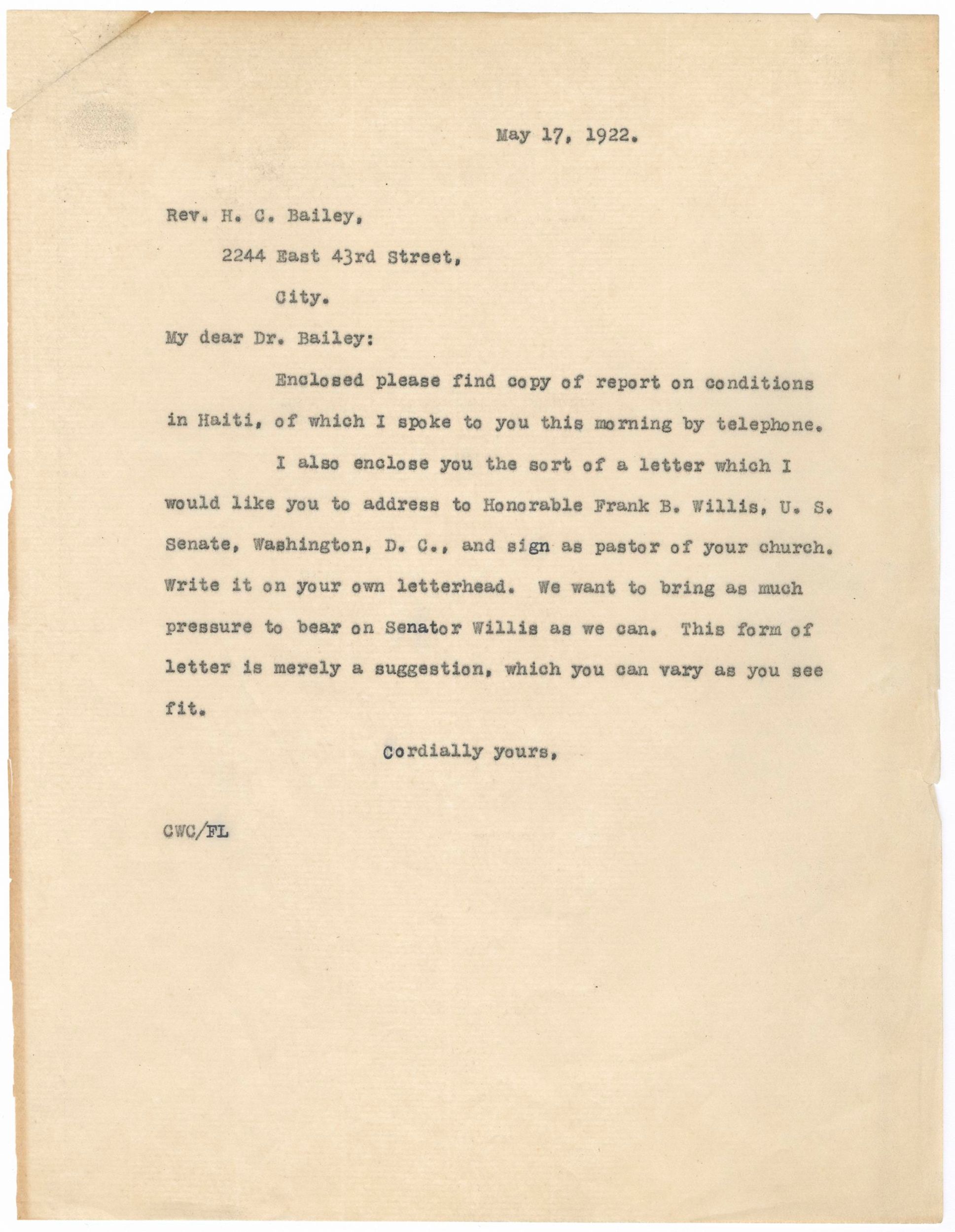 May 17, 1922.
Rev. H. C. Bailey,
2244 East 43rd Street,
City.
My dear Dr. Bailey:
May 17, 1922.
Rev. H. C. Bailey,
2244 East 43rd Street,
City.
My dear Dr. Bailey:
Enclosed please find copy of report on conditions in Haiti,1 of which I spoke to you this morning by telephone.
I also enclose you the sort of a letter which I would like you to address to Honorable Frank B. Willis,2 U. S. Senate, Washington, D. C., and sign as pastor of your church. Write it on your own letterhead. We want to bring as much pressure to bear on Senator Willis as we can.3 This form of letter is merely a suggestion, which you can vary as you see fit.4
Cordially yours, CWC/FL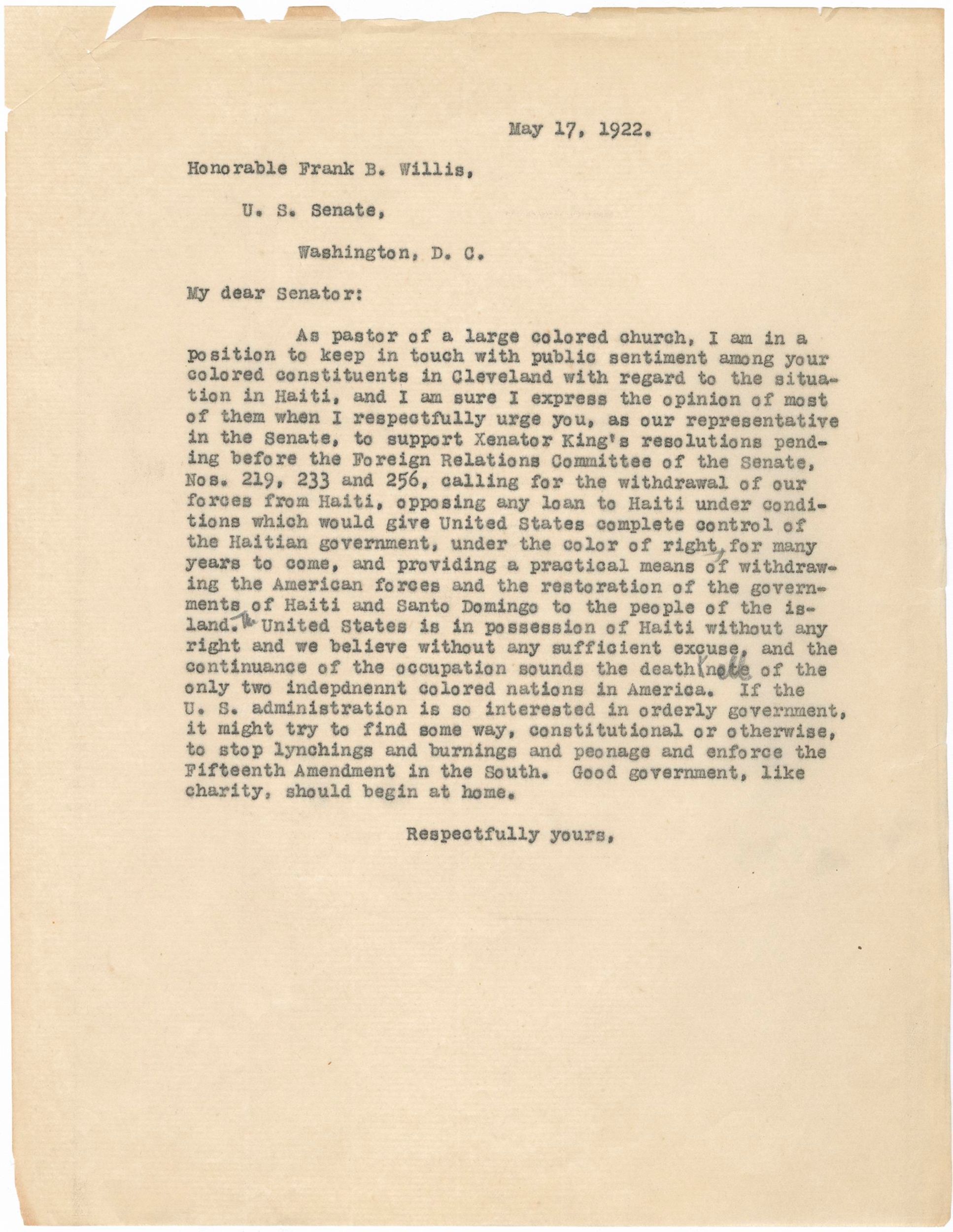 May 17, 1922.
Honorable Frank B. Willis,
U. S. Senate,
Washington, D. C.
My dear Senator:
May 17, 1922.
Honorable Frank B. Willis,
U. S. Senate,
Washington, D. C.
My dear Senator:
As pastor of a large colored church, I am in a position to keep in touch with public sentiment among your colored constituents in Cleveland with regard to the situation in Haiti, and I am sure I express the opinion of most of them when I respectfully urge you, as our representative in the Senate, to support Xenator King's resolutions pending before the Foreign Relations Committee of the Senate, Nos. 219, 233 and 256, calling for the withdrawal of our forces from Haiti, opposing any loan to Haiti under conditions which would give United States complete control of the Haitian government, under the color of right, for many years to come, and providing a practical means of withdrawing the American forces and the restoration of the governments of Haiti and Santo Domingo to the people of the island.5 The United States is in possession of Haiti without any right and we believe without any sufficient excuse, and the continuance of the occupation sounds the death knoteell of the only two indepdnennt colored nations in America. If the U. S. administration is so interested in orderly government, it might try to find some way, constitutional or otherwise, to stop lynchings6 and burnings and peonage7 and enforce the Fifteenth Amendment in the South. Good government, like charity, should begin at home.
Correspondent: Horace Charles Bailey (1860–1942) was the first minister at the (Black) Antioch Baptist Church in Cleveland (1903–1923), founded in 1893. Originally from Mississippi, he was a pastor in the South and in Xenia, Ohio, before coming to Cleveland to expand Antioch Baptist Church and make it an important hub for interracial activism on behalf of Cleveland's growing Black community. He was briefly the president of the Cleveland NAACP (1916) and of the Independent Colored Voters League in the 1920s.
1. The sixteen-page report, entitled "The Seizure of Haiti by the United States: A Report on the Military Occupation of the Republic of Haiti and the History of the Treaty Forced Upon Her," was published by the Foreign Policy Association (New York) and distributed by the National Popular Government League (Washington, D.C.) with twenty-four signatures. It called for the U.S. to abrogate the treaty that was the basis of the occupation, for election of a new government in Haiti, and for new treaty negotiations between "free and independent sovereign states" (p. 15). [back]
2. Frank Bartlett Willis (1871–1928) was a White Republican politician from Ohio. Trained as a lawyer, he served in the Ohio House (1900–1904) before becoming a U.S. Congressman (1911–1915) and then governor of Ohio (1915–1917). From 1921 to 1928 he represented Ohio in the U.S. Senate, where he served alongside his Democratic rival, Atlee Pomerene, for the first two years. [back]
3. The National Association for the Advancement of Colored People (NAACP) joined with many Black activists in opposing the U.S. occupation of Haiti (1915–1934), publicized failings of U.S. policy, and published Haitian news, poetry, and books about Haiti in its monthly magazine, The Crisis. NAACP Executive Secretary James Weldon Johnson traveled to Haiti in 1920 to investigate conditions, and White’s trip in 1931 was a mix of work and vacation. Chesnutt, a founding member of the NAACP, shared the concerns about the occupation of Haiti. [back]
4. Compare the nearly identical letters Chesnutt drafted that day for Harry C. Smith and George P. Hinton, also influential Black Clevelanders. All are revisions of his letter template addressed to "leading colored citizens" dated May 6, 1922, which in turn uses language from Ernest Angell's letter to Chesnutt of March 20, 1922. [back]
5. Senate Resolution 256, introduced by Democratic Senator William H. King (Utah, 1863–1949) on March 10, 1922, called for the U.S. to withdraw from Haiti and to oversee democratic elections. (See "Would Evacuate Haiti," New York Times, March 11, 1922, 8.) [back]
6. Black activists of the 1910s and 1920s, including the NAACP, were actively involved in advocating for anti-lynching legislation at the federal level, both before and after the failure of the Dyer Anti-Lynching Bill in December of 1922, and looked primarily (but not always successfully) to Republican legislators for support. [back]
7. Peonage, a system of debt imprisonment that allowed for widespread continuation of enslaved labor for Black people, had become widespread across the South in the 1890s. An important grand jury trial, under the auspices of federal district Judge Thomas G. Jones (1844–1914) about a peonage machine in Alabama's Coosa and Tallapoosa counties, occurred in the summer of 1903 and was widely covered in the press. Chesnutt addressed peonage most directly in his 1905 novel The Colonel's Dream. [back]