Ernest Angell to Charles W. Chesnutt, 20 March 1922
Key
| Textual Feature | Appearance |
|---|---|
| alterations to base text (additions or deletions) | added or deleted text |
| passage deleted with a strikethrough mark | |
| passage deleted by overwritten added text | Deleted text Added text |
| position of added text (if not added inline) | [right margin] text added in right margin; [above line] text added above the line |
| proofreading mark | ‸ |
| page number, repeated letterhead, etc. | page number or repeated letterhead |
| supplied text | [supplied text] |
| archivist note | archivist note |
 [1]
HARDIN & HESS
JEROME S. HESS
HAROLD B. ELGAR
JAMES M. HOGAN
[1]
HARDIN & HESS
JEROME S. HESS
HAROLD B. ELGAR
JAMES M. HOGANRESIDENT PARTNER CALLE CAPUCHINAS NO. 48 MEXICO CITY, D. F. CABLE ADDRESS: "ADELASTER" 50 PINE STREET NEW YORK March 20, 1922. My dear Mr. Chestnutt:
I am today in receipt of your kind letter of March 18th with enclosure of copy of the Haiti brief1 signed by yourself and Judge Henry.2 We are most grateful for your support and we want to use it to the fullest extent possible. We already have the signatures of about twenty other lawyers all over the country and we feel sure that this brief, when released at the right moment, will have a considerable bearing on the final outcome of the fight in the Senate and possibly a similar influence on the State Department.3
Although the brief is not officially my work, I am in effect directing the work of obtaining signatories and am to decide upon the propitious moment for giving it publicity. I am particularly pleased with your support and very anxious to have your name and your influence used in the most effective manner. I find myself in some doubt at the moment whether your influence will be greater as a signatory to the brief or in some other way, and am inclined to think that your influence will be greater if brought to bear directly on Senator Willis.4 Senator Pomerene5 who is, as you know, the political opponent of Willis, is a member of the Special Committee investigating this Haiti question,6 and while I have no desire to inject into the fight a purely political element, I am nevertheless perfectly willing to use this factor, if it can be of advantageous use to us. If I am not mistaken, Willis counts on the support of
 [2]
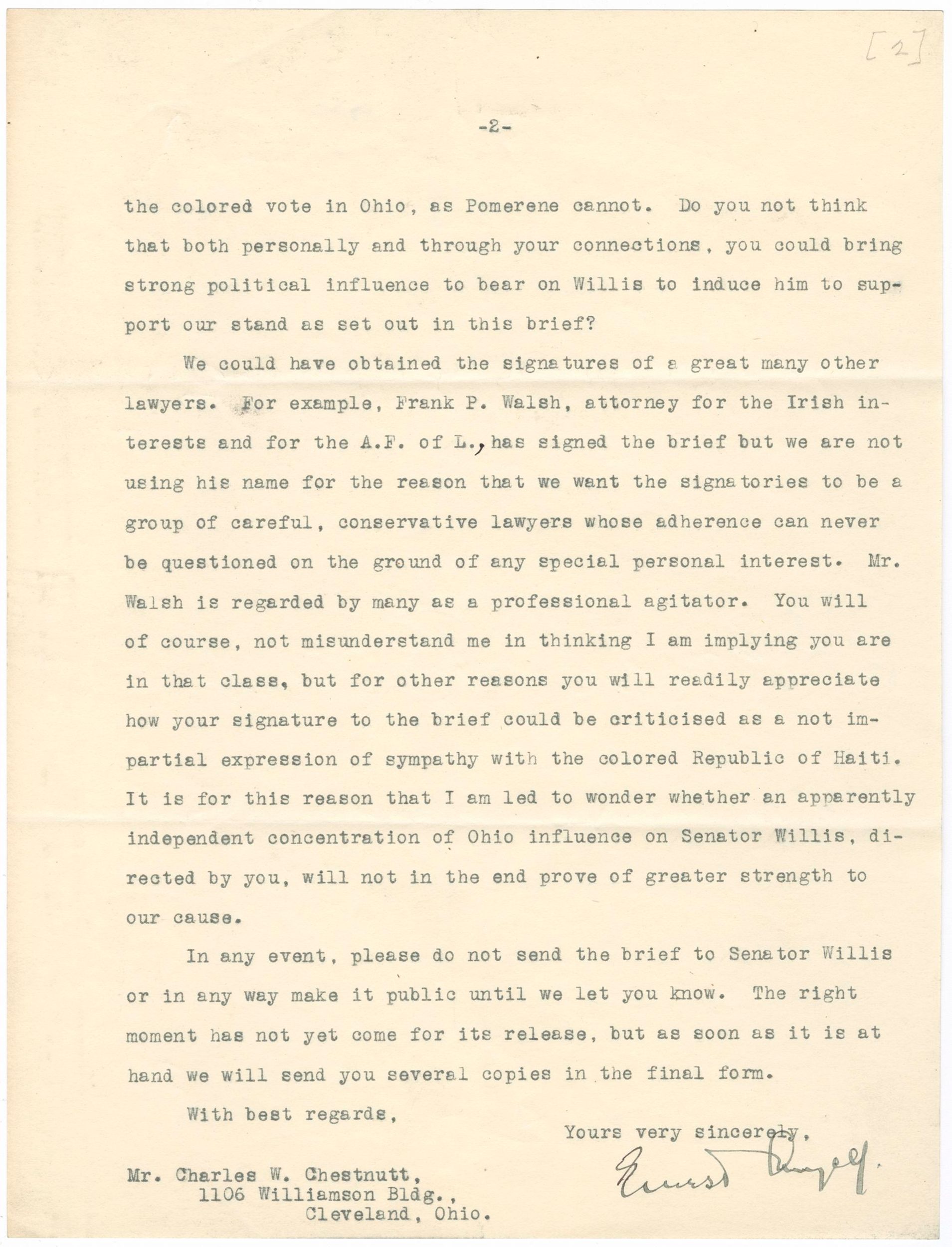
the colored vote in Ohio, as Pomerene cannot.7 Do you not think that both personally and through your connections, you could bring strong political influence to bear on Willis to induce him to support our stand as set out in this brief?8
[2]
the colored vote in Ohio, as Pomerene cannot.7 Do you not think that both personally and through your connections, you could bring strong political influence to bear on Willis to induce him to support our stand as set out in this brief?8
We could have obtained the signature of a great many other lawyers. For example, Frank P. Walsh, attorney for the Irish interests and for the A. F. of L.,9 has signed the brief but we are not using his name for the reason that we want the signatories to be a group of careful, conservative lawyers whose adherence can never be questioned on the ground of any special personal interest. Mr. Walsh is regarded by many as a professional agitator.10 You will of course, not misunderstand me in thinking I am implying you are in that class, but for other reasons you will readily appreciate how your signature to the brief could be criticised as a not impartial expression of sympathy with the colored Republic of Haiti.11 It is for this reason that I am led to wonder whether an apparently independent concentration of Ohio influence on Senator Willis, directed by you, will not in the end prove of greater strength to our cause.
In any event, please do not send the brief to Senator Willis or in any way make it public until we let you know.The right moment has not yet come for its release, but as soon as it is at hand we will send you several copies in the final form.
With best regards, Yours very sincerely, Ernest Angell Mr. Charles W. Chestnutt 1106 Williamson Bldg., Cleveland, Ohio.Correspondent: Ernest Angell (1889–1973) was a White lawyer, originally from Cleveland, who worked for a prominent Cleveland law firm after service in World War I and by 1920 was working in corporate law for the firm of Hardin & Hess in New York. He represented the Haiti-Santo Domingo Independence Society (founded in 1921) at the hearings of the 1921–22 Senate investigation on the U.S. occupation of Haiti.
1. The sixteen-page report, entitled "The Seizure of Haiti by the United States: A Report on the Military Occupation of the Republic of Haiti and the History of the Treaty Forced Upon Her," was published by the Foreign Policy Association (New York) and distributed by the National Popular Government League (Washington, D.C.) with twenty-four signatures. It called for the U.S. to abrogate the treaty that was the basis of the occupation, for election of a new government in Haiti, and for new treaty negotiations between "free and independent sovereign states" (p. 15). [back]
2. Frederick Augustus Henry (1867–1949) was a White Republican lawyer in Cleveland. By 1918, he was partner in a prominent local law firm then called Snyder, Henry, Thomsen, Ford & Seagrave. Like Chesnutt, he was a member of the Cleveland Bar Association and the Chamber of Commerce; he was also a trustee of nearby Hiram College. His is one of the twenty-four signatures on the Haiti brief as published in April 1922. [back]
3. As eventually published, the brief appeared with the signatures of twenty-four well-known laywers and law professors, but did not include Chesnutt's. [back]
4. Frank Bartlett Willis (1871–1928) was a White Republican politician from Ohio. Trained as a lawyer, he served in the Ohio House (1900–1904) before becoming a U.S. Congressman (1911–1915) and then governor of Ohio (1915–1917). From 1921 to 1928 he represented Ohio in the U.S. Senate, where he served alongside his Democratic rival, Atlee Pomerene, for the first two years. [back]
5. Atlee Pomerene (1863–1937) was a Democratic U.S. Senator for Ohio (1911–1923) and sat on the Senate committee that, from August 5, 1921 to June 1, 1922, investigated the U.S. occupation of Haiti. [back]
6. In July 1915, U.S. forces invaded Haiti after the collapse of the Haitian government. Although initial resolutions to investigate had failed in both houses of Congress, in July 1921 the Senate passed a resolution and a committee was formed. Following hearings between August 1921 and June 1922, it eventually concluded that the occupation should continue. The official records of the hearings appeared in two parts, and those from October to early November 1921 served as the basis of Ernest Angell's brief shared with Chesnutt and others. [back]
7. From the Civil War to the time of the New Deal, Black voters in Ohio and nationwide mostly voted Republican because the party stood for emancipation and equal rights for Blacks, while the Democrats were associated with the segregated Jim Crow South. This was the case even when Black civil rights were repeatedly sidelined by leading politicians. Chesnutt was a lifelong Republican; see his speech "Why I Am a Republican" from 1892 (Charles W. Chesnutt: Essays and Speeches, ed. Joseph R. McElrath, Jr., Robert C. Leitz, III, Jesse S. Crisler [Stanford: Stanford University Press, 1999]: 95–101). [back]
8. See Ernest Angell's follow-up letter of April 26, 1922, and Chesnutt's letter to Frank B. Willis of May 6, 1922, as well as several letters dated May 17, 1922, in which Chesnutt urged other Black Clevelanders to write to Willis: Harry C. Smith, Rev. H. C. Bailey of the Antioch Baptist Church, George P. Hinton, and possibly other "leading colored citizens" (see letter template of May 6, 1922.) [back]
9. The American Federation of Labor (or A.F. of L.) was founded in the 1880s as an umbrella organization for U.S. unions. While it gained many member organizations in the years after World War I (partly because it had supported the war effort, while several more left-leaning labor organizations had not), in the boom years of the 1920s it was weakened by a very strong business lobby. It allowed for segregated unions and had a history of discrimination against Black workers. [back]
10. Frank Patrick Walsh (1864-1939) was a White American lawyer who was known a pro-union political progressive. Originally from Missouri, he practiced in Kansas City before becoming a major labor attorney in New York, eventually serving as the legal counsel for many of the unions that belonged to the American Federation of Labor (AF of L or AFL). Of Irish ancestry, he also supported the Irish nationalist movement and the newly founded Republic of Ireland. [back]
11. The National Association for the Advancement of Colored People (NAACP) joined with many Black activists in opposing the U.S. occupation of Haiti (1915–1934), publicized failings of U.S. policy, and published Haitian news, poetry, and books about Haiti in its monthly magazine, The Crisis. NAACP Executive Secretary James Weldon Johnson traveled to Haiti in 1920 to investigate conditions, and White’s trip in 1931 was a mix of work and vacation. Chesnutt, a founding member of the NAACP, shared the concerns about the occupation of Haiti. [back]