Ernest Angell to Charles W. Chesnutt, 26 April 1922
Key
| Textual Feature | Appearance |
|---|---|
| alterations to base text (additions or deletions) | added or deleted text |
| passage deleted with a strikethrough mark | |
| passage deleted by overwritten added text | Deleted text Added text |
| position of added text (if not added inline) | [right margin] text added in right margin; [above line] text added above the line |
| proofreading mark | ‸ |
| page number, repeated letterhead, etc. | page number or repeated letterhead |
| supplied text | [supplied text] |
| archivist note | archivist note |
 [1]
HARDIN & HESS
JEROME S. HESS
HAROLD B. ELGAR
ERNEST ANGELL
HENRY D. BULKLEY
HOWARD F. R. MULLIGAN
JAMES M. HOGAN
RESIDENT PARTNER
CALLE CAPUCHINAS NO. 48
MEXICO CITY, D. F.
BARTHOLOMEW CARBAJAL Y ROSAS
CABLE ADDRESS, "ADELASTER"
50 PINE STREET
NEW YORK
April 26, 1922
Charles W. Chestnutt, Esq.,
Messrs. Chestnutt & Moore,
No. 1106 Williamson Bldg.,
Cleveland, O.
My dear Mr. Chestnutt:
[1]
HARDIN & HESS
JEROME S. HESS
HAROLD B. ELGAR
ERNEST ANGELL
HENRY D. BULKLEY
HOWARD F. R. MULLIGAN
JAMES M. HOGAN
RESIDENT PARTNER
CALLE CAPUCHINAS NO. 48
MEXICO CITY, D. F.
BARTHOLOMEW CARBAJAL Y ROSAS
CABLE ADDRESS, "ADELASTER"
50 PINE STREET
NEW YORK
April 26, 1922
Charles W. Chestnutt, Esq.,
Messrs. Chestnutt & Moore,
No. 1106 Williamson Bldg.,
Cleveland, O.
My dear Mr. Chestnutt:
I am sending you under separate cover a number of copies of the lawyers' report on Haiti.1 This will be presented to Secretary Hughes2 on April 27th by a delegation of representatives of various bodies such as the Foreign Policy Association, the National Popular Government League,3 the Federated Council of the Churches of Christ in America,4 the A. F. of L., etc.5
I see a real opportunity for you to bring pressure to bear in a way which no one else can do. In an earlier letter I outlined my suggestions to you and I hope that you approved of them. Senator Willis6 is an unknown quantity to us on this question, and I should think you could call this forcibly to his attention by demanding that he [ support the conclusions set out at the end of this report, and specifically that he support the three resolutions introduced into the Senate by Senator King and now pending before the Foreign Relations Committee. These are numbers 219, 233 and 256.7 They call for withdrawal of our forces from Haiti and Santo Domingo, for opposition to any loan to Haiti at the present time (the
 [2]
-2-
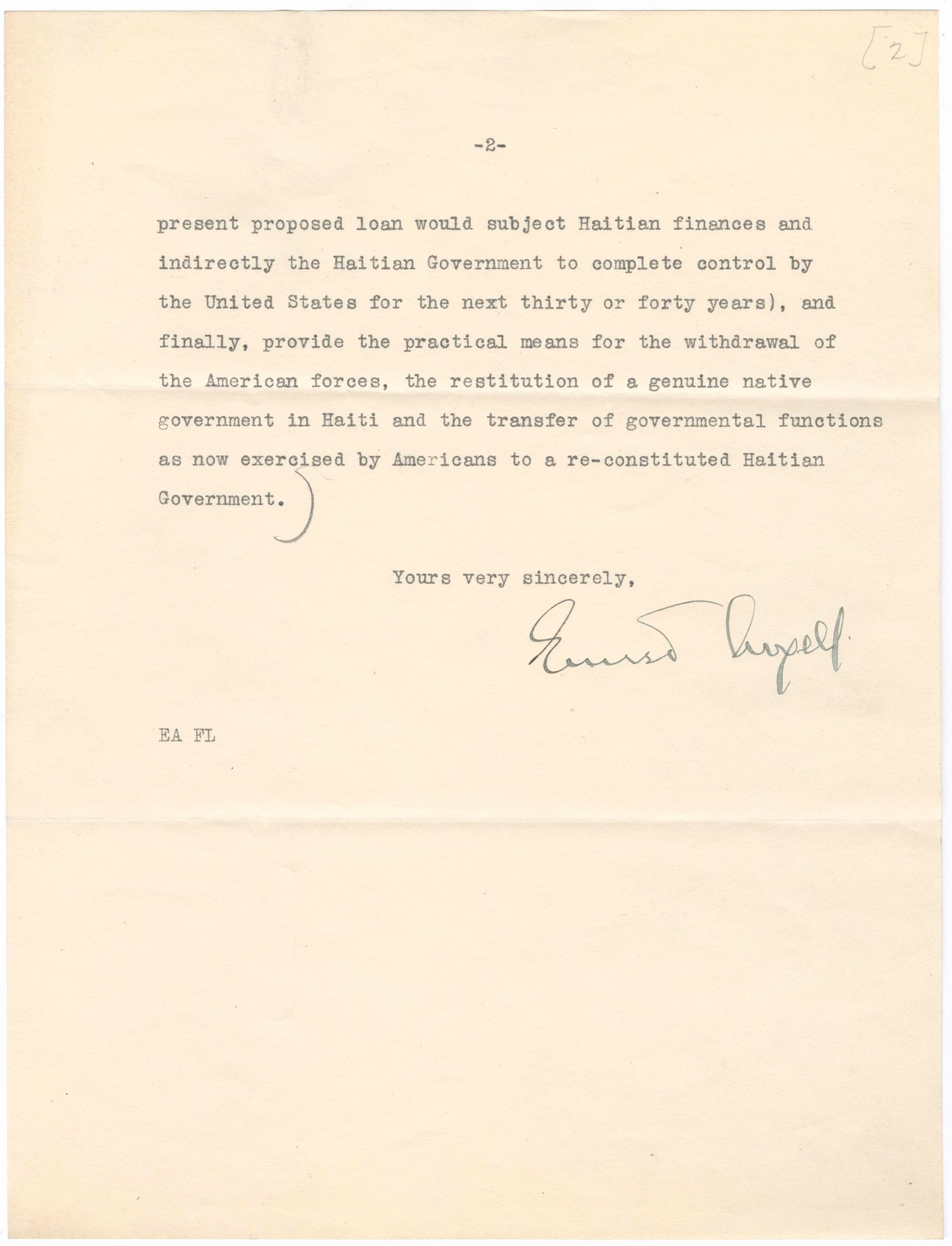
present proposed loan would subject Haitian finances and indirectly the Haitian Government to complete control by the United States for the next thirty or forty years), and finally, provide the practical means for the withdrawal of the American forces, the restitution of a genuine native government in Haiti and the transfer of governmental functions as now exercised by Americans to a re-constituted Haitian Government. )8
[2]
-2-
present proposed loan would subject Haitian finances and indirectly the Haitian Government to complete control by the United States for the next thirty or forty years), and finally, provide the practical means for the withdrawal of the American forces, the restitution of a genuine native government in Haiti and the transfer of governmental functions as now exercised by Americans to a re-constituted Haitian Government. )8
Correspondent: Ernest Angell (1889–1973) was a White lawyer, originally from Cleveland, who worked for a prominent Cleveland law firm after service in World War I and by 1920 was working in corporate law for the firm of Hardin & Hess in New York. He represented the Haiti-Santo Domingo Independence Society (founded in 1921) at the hearings of the 1921–22 Senate investigation on the U.S. occupation of Haiti.
1. The sixteen-page report, entitled "The Seizure of Haiti by the United States: A Report on the Military Occupation of the Republic of Haiti and the History of the Treaty Forced Upon Her," was published by the Foreign Policy Association (New York) and distributed by the National Popular Government League (Washington, D.C.) with twenty-four signatures. It called for the U.S. to abrogate the treaty that was the basis of the occupation, for election of a new government in Haiti, and for new treaty negotiations between "free and independent sovereign states" (p. 15). [back]
2. Charles Evans Hughes, Sr. (1862–1948) was a White Republican politican and lawyer who served in a variety of positions, including governor of New York (1906–1910), U.S. Supreme Court justice (1910–1916), and U.S. Chief Justice (1930–1941). As the Republican candidate for President in 1916 he garnered significant but uneven Black support, losing to Woodrow Wilson. While serving as Secretary of State from 1921 to 1925 he expressed support for the withdrawal U.S. troops from Haiti, though he never ordered it. [back]
3. These two organizations are named, respectively, as publisher and distributor of the pamphlet on Haiti. The nonpartisan Foreign Policy Association was founded in 1918 (as the League of Free Nations Association, renamed 1921) to study U.S.-international relations. It announced publication of the pamphlet in its weekly Foreign Policy Bulletin ("A Demand for Justice to Haiti," News Bulletin of the Foreign Policy Association 1, no. 24 [April 28, 1922]: n.p.). The National Popular Government League, founded in 1913, was a nonpartisan organization that promoted progressive ideas about good government. [back]
4. Officially named the Federal Council of Churches of Christ in America, this progressive ecumenical organization of Christian denominations was founded in 1908. It emphasized democratic government and social justice, especially workers' rights. The pamphlet on Haiti does not mention the Federal Council or the A. F. of L. as responsible organizations. [back]
5. The American Federation of Labor (or A.F. of L.) was founded in the 1880s as an umbrella organization for U.S. unions. While it gained many member organizations in the years after World War I (partly because it had supported the war effort, while several more left-leaning labor organizations had not), in the boom years of the 1920s it was weakened by a very strong business lobby. It allowed for segregated unions and had a history of discrimination against Black workers. [back]
6. Frank Bartlett Willis (1871–1928) was a White Republican politician from Ohio. Trained as a lawyer, he served in the Ohio House (1900–1904) before becoming a U.S. Congressman (1911–1915) and then governor of Ohio (1915–1917). From 1921 to 1928 he represented Ohio in the U.S. Senate, where he served alongside his Democratic rival, Atlee Pomerene, for the first two years. [back]
7. Senate Resolution 256, introduced by Democratic Senator William H. King (Utah, 1863–1949) on March 10, 1922, called for the U.S. to withdraw from Haiti and to oversee democratic elections. (See "Would Evacuate Haiti," New York Times, March 11, 1922, 8.) [back]
8. Chesnutt quoted the passage he marked here, with only minor revisions, in his letter to Frank B. Willis of May 6, 1922, and in letters he sent to several other prominent Black Cleveland residents, requesting that they contact Willis. [back]