Harry C. Smith to Charles W. Chesnutt, 18 May 1922
Key
| Textual Feature | Appearance |
|---|---|
| alterations to base text (additions or deletions) | added or deleted text |
| passage deleted with a strikethrough mark | |
| passage deleted by overwritten added text | Deleted text Added text |
| position of added text (if not added inline) | [right margin] text added in right margin; [above line] text added above the line |
| proofreading mark | ‸ |
| page number, repeated letterhead, etc. | page number or repeated letterhead |
| supplied text | [supplied text] |
| archivist note | archivist note |
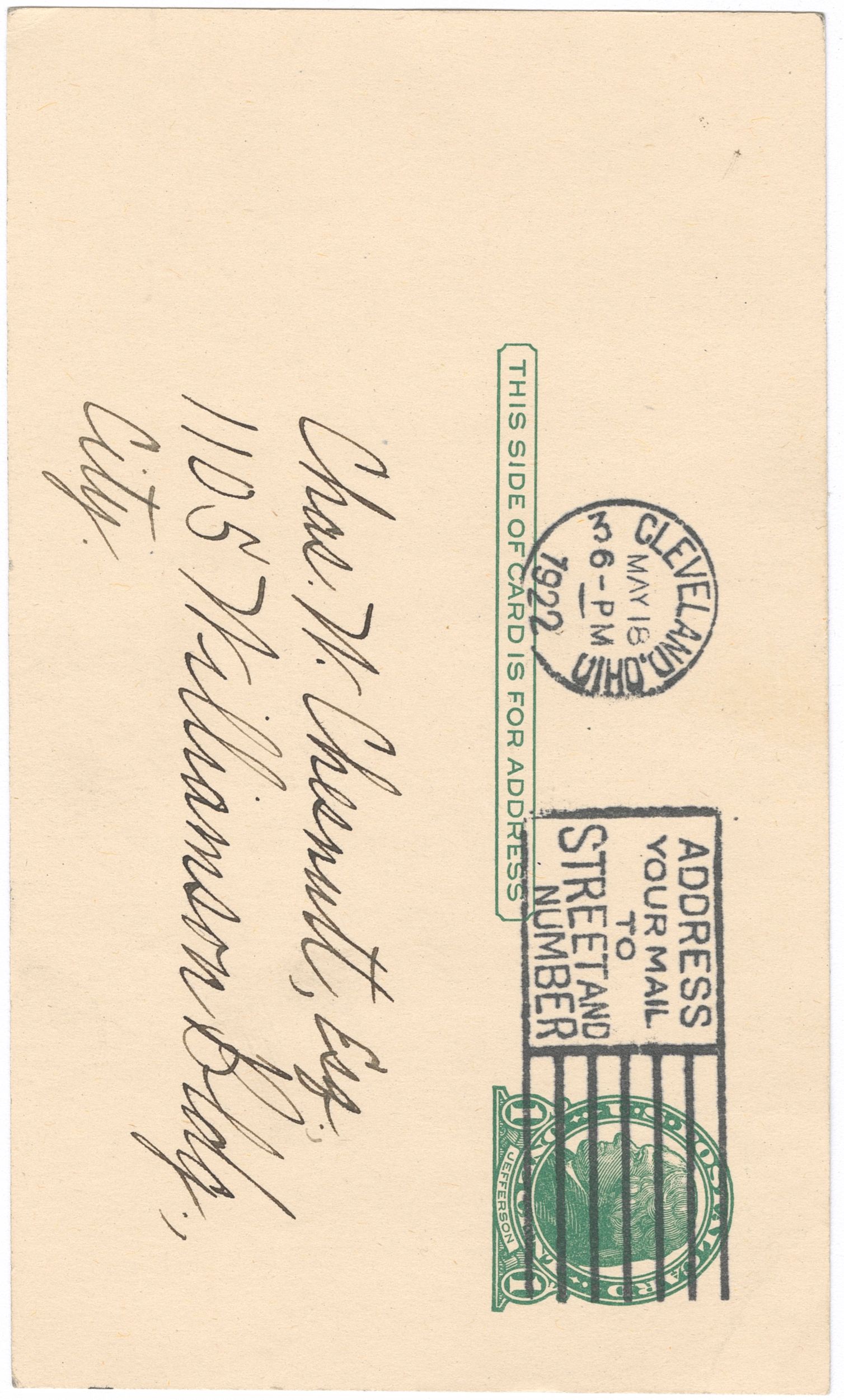 THIS SIDE OF CARD IS FOR ADDRESS
Chas. W. Chesnutt, Esq.
1105 Williamson Bldg.,
City.
THIS SIDE OF CARD IS FOR ADDRESS
Chas. W. Chesnutt, Esq.
1105 Williamson Bldg.,
City.
 THE GAZETTE
BLACKSTONE BLDG.
CLEVELAND, OHIO
HARRY C. SMITH, PROP'R
5-18-22.
Dear Charley:
THE GAZETTE
BLACKSTONE BLDG.
CLEVELAND, OHIO
HARRY C. SMITH, PROP'R
5-18-22.
Dear Charley:
Your letter with enclosure just rec'd. The latter is excellent, only a few minor changes being necessary I am having it re-written now and will forward it immediately. "The Gazette" has published a number of editorial and news notices of the Haitian and Santo Domingo-U.S. matters, including the lawyers' statement referred to.1 Will write more as requested.
Yours for the Race, H.C. Smith per A.D.Correspondent: Harry C. Smith (1863–1941) was a Black journalist, editor, and politician. Born in West Virginia, his family moved to Cleveland after the Civil War. While attending Cleveland's Central High School, he wrote for several newspapers. In 1883, along with three others, he founded the Cleveland Gazette, a weekly newspaper, and within three years became the sole proprietor. He edited the newspaper until his death. His political career included three terms in the Ohio General Assembly (1893–99). He introduced and played a major role in the passage of the Ohio Civil Rights Law (1894) and an anti-lynching law, the Smith Act (1896). He also sought other Ohio offices: Secretary of State (1920) and Governor (1926 and 1928).
1. The sixteen-page report, entitled "The Seizure of Haiti by the United States: A Report on the Military Occupation of the Republic of Haiti and the History of the Treaty Forced Upon Her," was published by the Foreign Policy Association (New York) and distributed by the National Popular Government League (Washington, D.C.) with twenty-four signatures. It called for the U.S. to abrogate the treaty that was the basis of the occupation, for election of a new government in Haiti, and for new treaty negotiations between "free and independent sovereign states" (p. 15). [back]