Harry C. Smith to Charles W. Chesnutt, 25 May 1922
Key
| Textual Feature | Appearance |
|---|---|
| alterations to base text (additions or deletions) | added or deleted text |
| passage deleted with a strikethrough mark | |
| passage deleted by overwritten added text | Deleted text Added text |
| position of added text (if not added inline) | [right margin] text added in right margin; [above line] text added above the line |
| proofreading mark | ‸ |
| page number, repeated letterhead, etc. | page number or repeated letterhead |
| supplied text | [supplied text] |
| archivist note | archivist note |
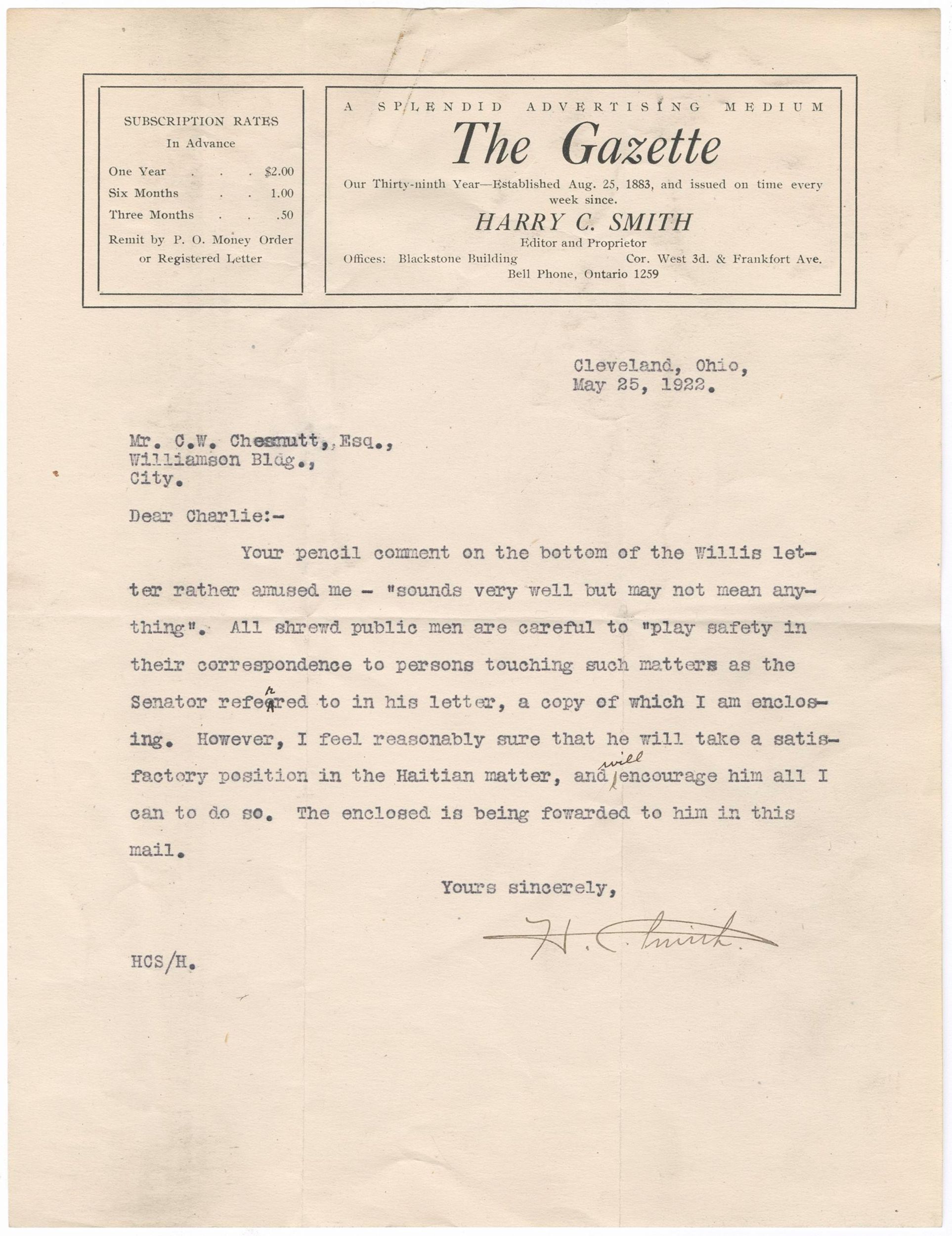 A SPLENDID ADVERTISING MEDIUM
The Gazette
Our Thirty-ninth Year—Established Aug. 25, 1883, and issued on time every week since.
HARRY C. SMITH
Editor and Proprietor
Offices: Blackstone Building Cor. West 3d. & Frankfort Ave.
Bell Phone, Ontario 12591
Cleveland, Ohio,
May 25, 1922.
Mr. C.W. Chesnutt, Esq.,
Williamson Bldg.,
City.
Dear Charlie:-
A SPLENDID ADVERTISING MEDIUM
The Gazette
Our Thirty-ninth Year—Established Aug. 25, 1883, and issued on time every week since.
HARRY C. SMITH
Editor and Proprietor
Offices: Blackstone Building Cor. West 3d. & Frankfort Ave.
Bell Phone, Ontario 12591
Cleveland, Ohio,
May 25, 1922.
Mr. C.W. Chesnutt, Esq.,
Williamson Bldg.,
City.
Dear Charlie:-
Your pencil comment on the bottom of the Willis letter rather amused me - "sounds very well but may not mean anything".2 All shrewd public men are careful to "play safety in their correspondence to persons touching such matters as the Senator refeerred to in his letter,3 a copy of which I am enclosing. However, I feel reasonably sure that he will take a satisfactory position in the Haitian matter, and will encourage him all I can to do so. The enclosed is being forwarded to him in this mail.
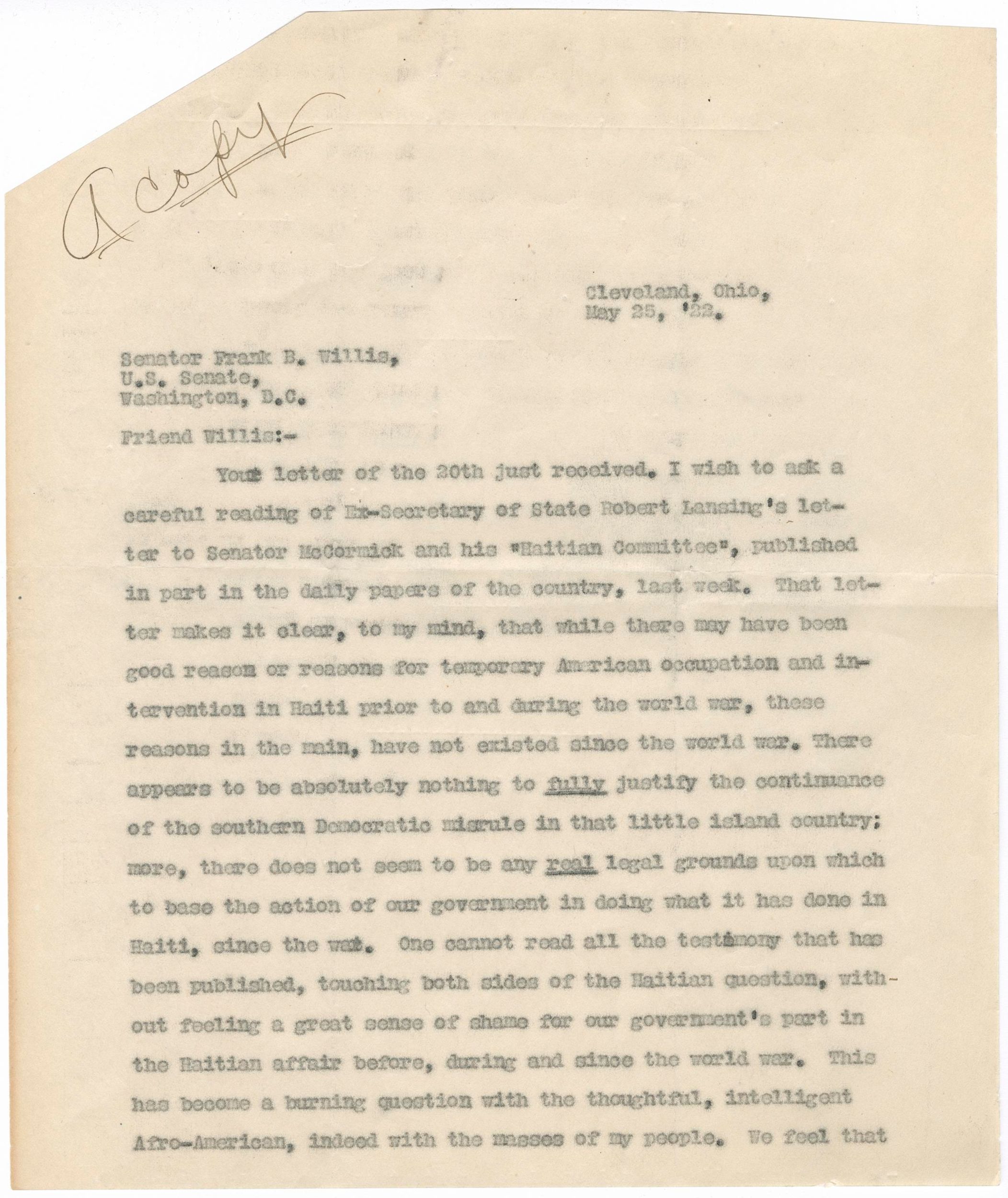
Your letter of the 20th just received. I wish to ask a careful reading of Ex-Secretary of State Robert Lansing's letter to Senator McCormick and his "Haitian Committee",4 published in part in the daily papers of the country, last week.5 That letter makes it clear, to my mind, that while there may have been good reason or reasons for temporary American occupation and intervention in Haiti prior to and during the world war, these reasons in the main, have not existed since the world war. There appears to be absolutely nothing to fully justify the continuance of the southern Democratic misrule in that little island country; more, there does not seem to be any real legal grounds upon which to base the action of our government in doing what it has done in Haiti, since the war. One cannot read all the testimony that has been published, touching both sides of the Haitian question, without feeling a great sense of shame for our government's part in the Haitian affair before, during and since the world war. This has become a burning question with the thoughtful, intelligent Afro-American, indeed with the masses of my people.6 We feel that
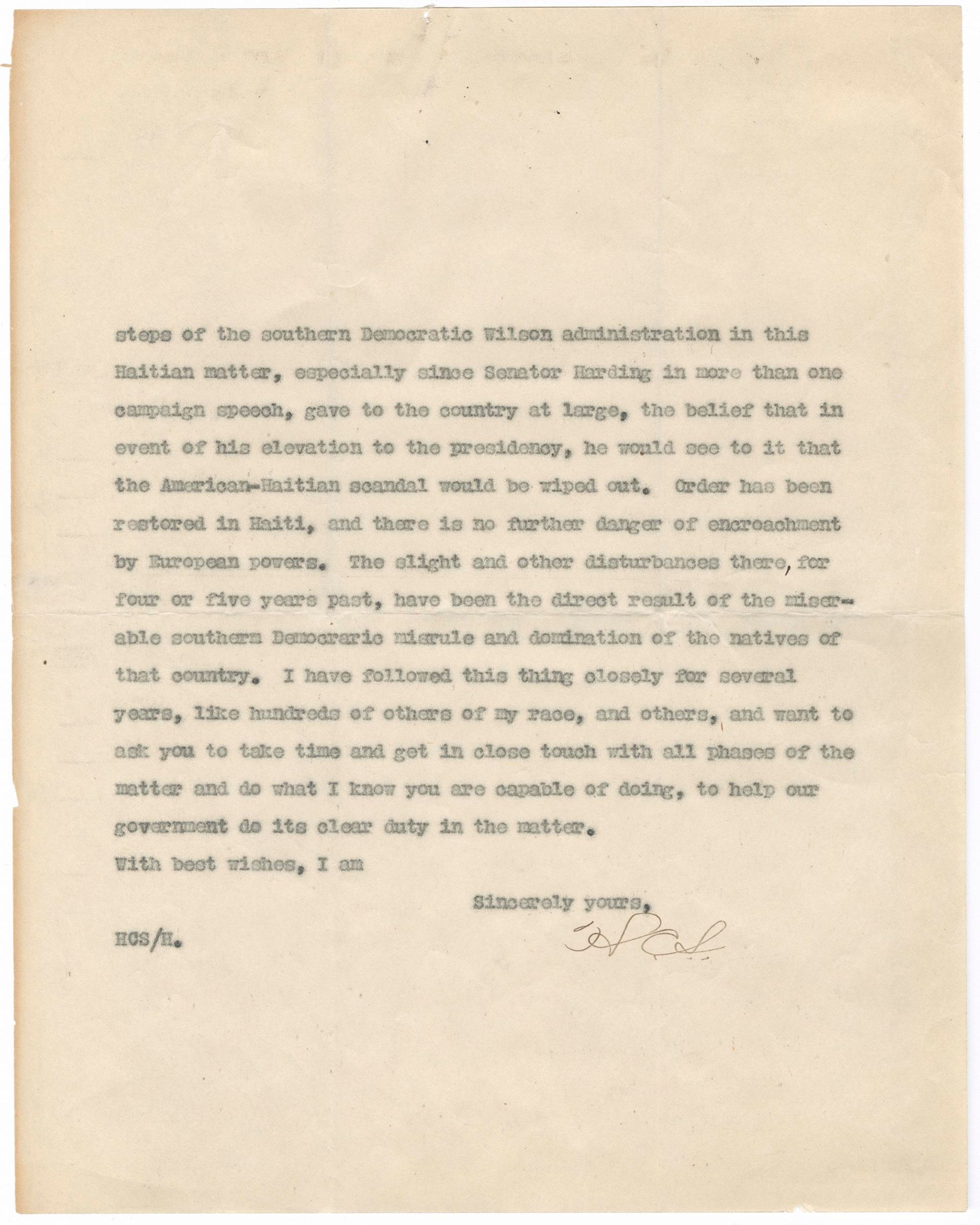 steps of the southern Democratic Wilson administration in this Haitian matter, especially since Senator Harding in more than one campaign speech, gave to the country at large, the belief that in event of his elevation to the presidency, he would see to it that the American-Haitian scandal would be wiped out.7 Order has been restored in Haiti, and there is no further danger of encroachment by European powers. The slight and other disturbances there, for four or five years past, have been the direct result of the miserable southern Democraric misrule and domination of the natives of that country. I have followed this thing closely for several years, like hundreds of others of my race, and others, and want to ask you to take time and get in close touch with all phases of the matter and do what I know you are capable of doing, to help our government do its clear duty in the matter.
Correspondent: Harry C. Smith (1863–1941) was a Black journalist, editor, and politician. Born in West Virginia, his family moved to Cleveland after the Civil War. While attending Cleveland's Central High School, he wrote for several newspapers. In 1883, along with three others, he founded the Cleveland Gazette, a weekly newspaper, and within three years became the sole proprietor. He edited the newspaper until his death. His political career included three terms in the Ohio General Assembly (1893–99). He introduced and played a major role in the passage of the Ohio Civil Rights Law (1894) and an anti-lynching law, the Smith Act (1896). He also sought other Ohio offices: Secretary of State (1920) and Governor (1926 and 1928).
1. For readability, the remainder of the letterhead is not transcribed in the body of the letter but is included in this footnote as unformatted text. The letterhead can be seen in its entirety in the accompanying image of the letter. The text of the remainder of the letterhead is as follows: "SUBSCRIPTION RATES In Advance One Year . . . $2.00 Six Months . . 1.00 Three Months . . .50 Remit by P. O. Money Order or Registered Letter" [back]
2. Harry C. Smith may be referring to Frank Bartlett Willis's letter to him of May 20, 1922 (referenced in the enclosure; not located), or Chesnutt may have sent Smith a copy of the May 8, 1922, letter he had received from Willis. [back]
3. Frank Bartlett Willis (1871–1928) was a White Republican politician from Ohio. Trained as a lawyer, he served in the Ohio House (1900–1904) before becoming a U.S. Congressman (1911–1915) and then governor of Ohio (1915–1917). From 1921 to 1928 he represented Ohio in the U.S. Senate, where he served alongside his Democratic rival, Atlee Pomerene, for the first two years. [back]
4. Robert Lansing (1864–1928), a White Democrat, had served as Secretary of State from 1915 to 1920 under President Woodrow Wilson; he was practicing law in New York City by the time he wrote to Medill McCormick, chair of the Senate Committee investigating the Haitian occupation, to claim that President Wilson's decision to occupy Haiti in 1915 was meant to prevent Germany from gaining access to the Caribbean early in World War I. The letter was covered widely in the papers; see "Blocked German Designs on Haiti," New York Times, May 8, 1922, 19. [back]
5. In July 1915, U.S. forces invaded Haiti after the collapse of the Haitian government. Although initial resolutions to investigate had failed in both houses of Congress, in July 1921 the Senate passed a resolution and a committee was formed. Following hearings between August 1921 and June 1922, it eventually concluded that the occupation should continue. The official records of the hearings appeared in two parts, and those from October to early November 1921 served as the basis of Ernest Angell's brief shared with Chesnutt and others. [back]
6. The National Association for the Advancement of Colored People (NAACP) joined with many Black activists in opposing the U.S. occupation of Haiti (1915–1934), publicized failings of U.S. policy, and published Haitian news, poetry, and books about Haiti in its monthly magazine, The Crisis. NAACP Executive Secretary James Weldon Johnson traveled to Haiti in 1920 to investigate conditions, and White’s trip in 1931 was a mix of work and vacation. Chesnutt, a founding member of the NAACP, shared the concerns about the occupation of Haiti. [back]
7. President Warren G. Harding (1865–1923) was a Republican U.S. Senator for Ohio (1914–1920) when he ran for president in 1920, and while campaigning criticized President Woodrow Wilson's decision to send troops to Haiti, partly in an attempt to appeal to Black voters, who (like Chesnutt) generally voted Republican. In a widely covered Constitution Day speech, he attacked Franklin Delano Roosevelt, then Assistant Secretary of the Navy and vice presidential running mate of James Cox, for his paternalistic attitude toward Haiti (see "'Merest Dribble,' Roosevelt Answers," New York Times [September 18, 1920]: 11). [back]