Lila May Barnett to Charles W. Chesnutt, 23 April 1924
Key
| Textual Feature | Appearance |
|---|---|
| alterations to base text (additions or deletions) | added or deleted text |
| passage deleted with a strikethrough mark | |
| passage deleted by overwritten added text | Deleted text Added text |
| position of added text (if not added inline) | [right margin] text added in right margin; [above line] text added above the line |
| proofreading mark | ‸ |
| page number, repeated letterhead, etc. | page number or repeated letterhead |
| supplied text | [supplied text] |
| archivist note | archivist note |
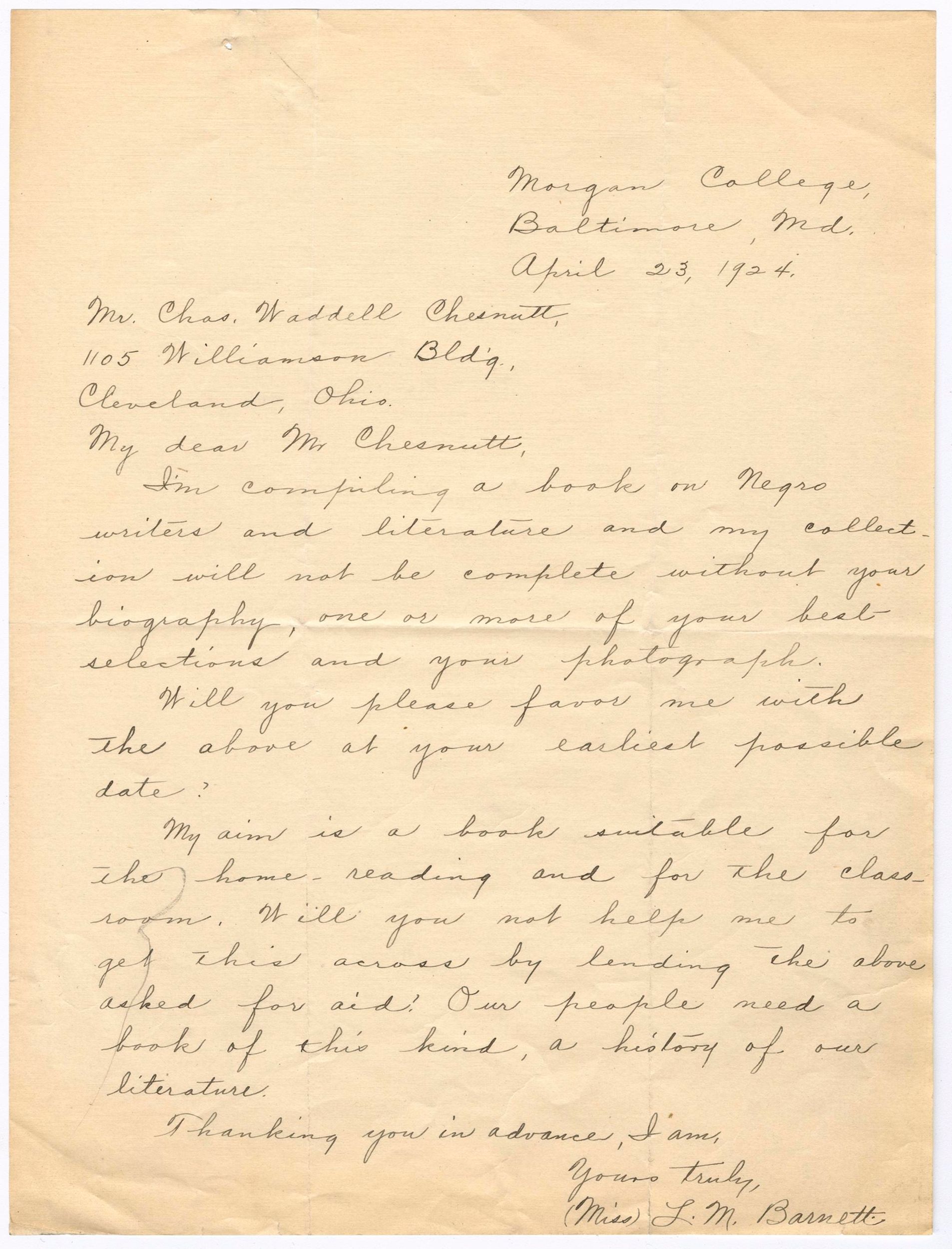 Morgan College,1
Baltimore, Md.
April 23, 1924.
Mr. Chas. Waddell Chesnutt,
1105 Williamson Bld'g.,
Cleveland, Ohio.
My dear Mr. Chesnutt,
Morgan College,1
Baltimore, Md.
April 23, 1924.
Mr. Chas. Waddell Chesnutt,
1105 Williamson Bld'g.,
Cleveland, Ohio.
My dear Mr. Chesnutt,
I am compiling a book on Negro writers and literature and my collection will not be complete without your biography, one or more of your best selections and your photograph.
Will you please favor me with the above at your earliest possible date?
My aim is a book suitable for the home-reading and for the classroom. Will you not help me to get this across by lending the above asked for aid? Our people need a book of this kind, a history of our literature.2
Thanking you in advance, I am,
Yours truly, (Miss) L. M. Barnett.Correspondent: Lila May Barnett Mitchell (1885–1937) was a Black academic educated at Rust College, the Tuskegee Institute, Columbia University, and the University of Chicago. She taught high school in Little Rock, Arkansas, before moving to Morgan College (Maryland) in 1923 to teach chemistry and math. By 1928 she had become chair of the history department at Rust College (Mississippi), like Morgan a historically Black college (HBCU). She was briefly married (1929–1930), and after her husband's death seems to have returned to the Little Rock area. Although her planned book project on Black writers seems to have been abandoned, she did complete a master's thesis (unpublished) on "History Courses in Colored Colleges and Universities" at the University of Chicago in 1936.
1. Morgan College (now Morgan State University) is a historically Black college founded in 1867 in Baltimore, Maryland, initially as a Methodist Episcopal seminary, the Centenary Bible Institute. Renamed Morgan College in 1890, it expanded to include coeducational, secular training and received major support from Andrew Carnegie in the 1910s. Morgan College was a private institution until 1939. [back]
2. While Barnett apparently did not complete her project, the first textbook along those lines was published before Chesnutt's death, edited by scholars at Howard University: Readings from Negro Authors for Schools and Colleges, edited by Otelia Cromwell, Lorenzo Dow Turner, and Eva B. Dykes (New York: Harcourt, Brace and Company, 1931). With Chesnutt's permission, it included two of his short stories and a short biographical sketch; see Cromwell's letter to Chesnutt of February 9, 1931, as well as Chesnutt's February 16 response. [back]