Charles W. Chesnutt to Otelia Cromwell, [16] February 1931
Key
| Textual Feature | Appearance |
|---|---|
| alterations to base text (additions or deletions) | added or deleted text |
| passage deleted with a strikethrough mark | |
| passage deleted by overwritten added text | Deleted text Added text |
| position of added text (if not added inline) | [right margin] text added in right margin; [above line] text added above the line |
| proofreading mark | ‸ |
| page number, repeated letterhead, etc. | page number or repeated letterhead |
| supplied text | [supplied text] |
| archivist note | archivist note |
 Miss Otelia Cromwell,
1815 Thirteenth St., N. W.,1
Washington, D. C.
February 26, 19312
My dear Miss Cromwell:
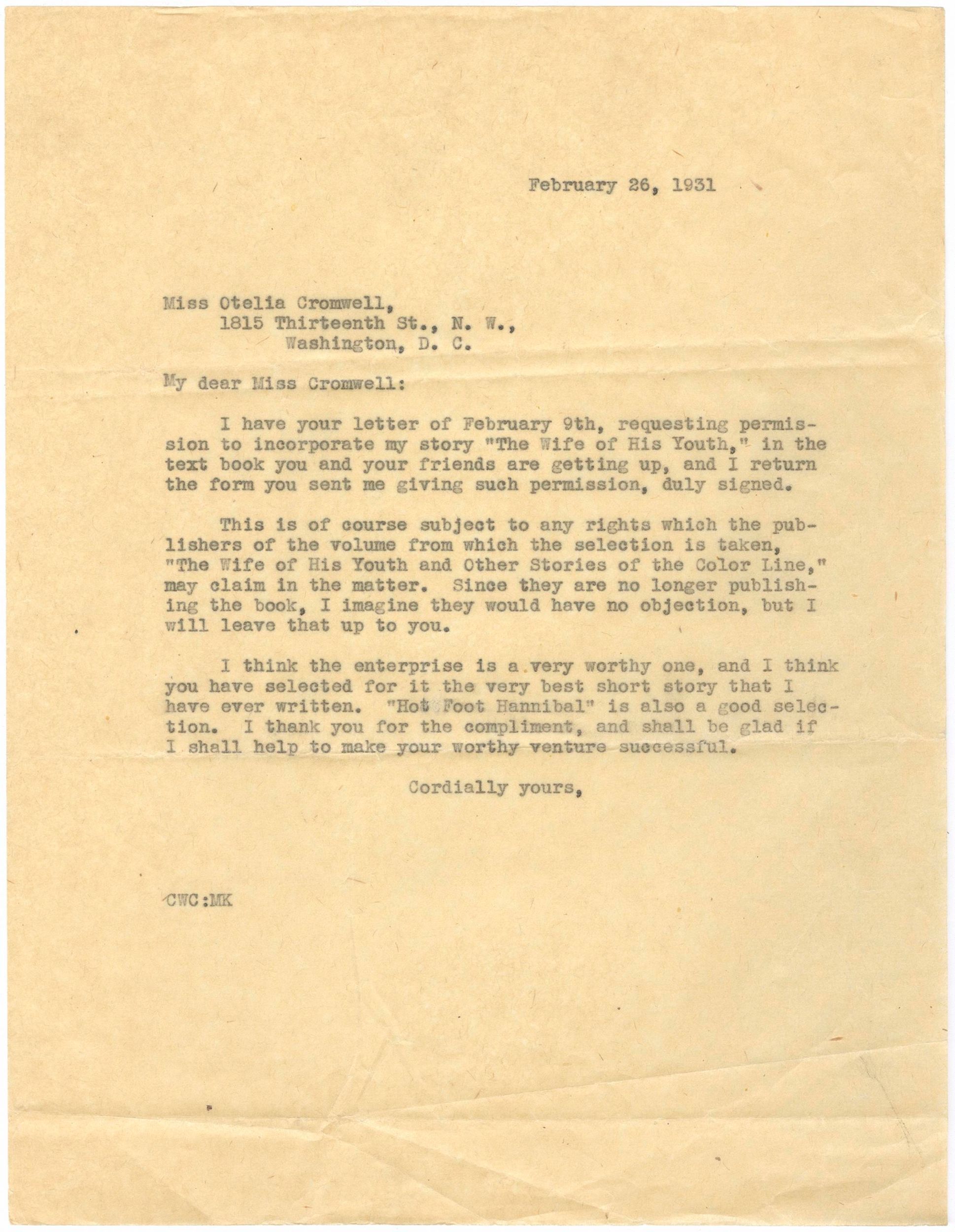
Miss Otelia Cromwell,
1815 Thirteenth St., N. W.,1
Washington, D. C.
February 26, 19312
My dear Miss Cromwell:
I have your letter of February 9th, requesting permission to incorporate my story "The Wife of His Youth," in the text book you and your friends are getting up, and I return the form you sent me giving such permission, duly signed.3
This is of course subject to any rights which the publishers of the volume from which the selection is taken, "The Wife of His Youth and Other Stories of the Color Line," may claim in the matter. Since they are no longer publishing the book, I imagine they would have no objection, but I will leave that up to you.4
I think the enterprise is a very worthy one, and I think you have selected for it the very best short story that I have ever written. "Hot Foot Hannibal" is also a good selection. I thank you for the compliment, and shall be glad if I shall help to make your worthy venture successful.
Cordially yours, CWC:MKCorrespondent: Otelia Cromwell (1874–1972) was a Black professor of English from Washington, D.C.. She graduated with a BA from Smith College in 1900, a year before Chesnutt's daughters Helen and Ethel; the three were the only Black students at Smith at the time. Cromwell taught English, German, and Latin in Washington, D.C., both at M Street High School (later Dunbar High School) and the Armstrong Manual Training School, and completed an M.A. (Columbia 1910) and a Ph.D. (Yale 1926). She was professor at Miner Teachers College (now University of the District of Columbia) from 1926 to 1944.
1. This was Otelia Cromwell's home address, a residence which she shared with her four siblings (most of them also educators) and her brother's wife and child. [back]
2. This date is most likely an error and should be February 16, 1931. Cromwell's previous letter to Chesnutt is dated February 9, and her letter from February 23, 1931, is clearly in response to the letter that Chesnutt sends here, meaning that this letter must have been sent some time between February 9 and February 23. [back]
3. Readings from Negro Authors for Schools and Colleges, edited by Otelia Cromwell, Lorenzo Dow Turner, and Eva B. Dykes (New York: Harcourt, Brace and Company, 1931), was one of the first textbooks to anthologize Black literature. It included two of Chesnutt's stories: "The Wife of His Youth," and "Hot-Foot Hannibal." "The Wife of His Youth" had initially appeared in the July 1898 Atlantic Monthly and served as the title story for The Wife of His Youth and Other Stories of the Color Line (1899). "Hot-Foot Hannibal" had been published first in the January 1899 Atlantic Monthly and was later included in The Conjure Woman (1899). [back]
4. The Wife of His Youth and Other Stories of the Color Line was published by Houghton, Mifflin & Company in December 1899. It was reprinted once in 1901; in 1924, the printing plates were melted down because of low demand. [back]