William Donahey to Charles W. Chesnutt, 7 September 1922
Key
| Textual Feature | Appearance |
|---|---|
| alterations to base text (additions or deletions) | added or deleted text |
| passage deleted with a strikethrough mark | |
| passage deleted by overwritten added text | Deleted text Added text |
| position of added text (if not added inline) | [right margin] text added in right margin; [above line] text added above the line |
| proofreading mark | ‸ |
| page number, repeated letterhead, etc. | page number or repeated letterhead |
| supplied text | [supplied text] |
| archivist note | archivist note |
 WILLIAM DONAHEY
5808 WINTHROP AVENUE
CHICAGO
Sep. 7, 1922.
Dear Mr. Chesnutt-
WILLIAM DONAHEY
5808 WINTHROP AVENUE
CHICAGO
Sep. 7, 1922.
Dear Mr. Chesnutt-
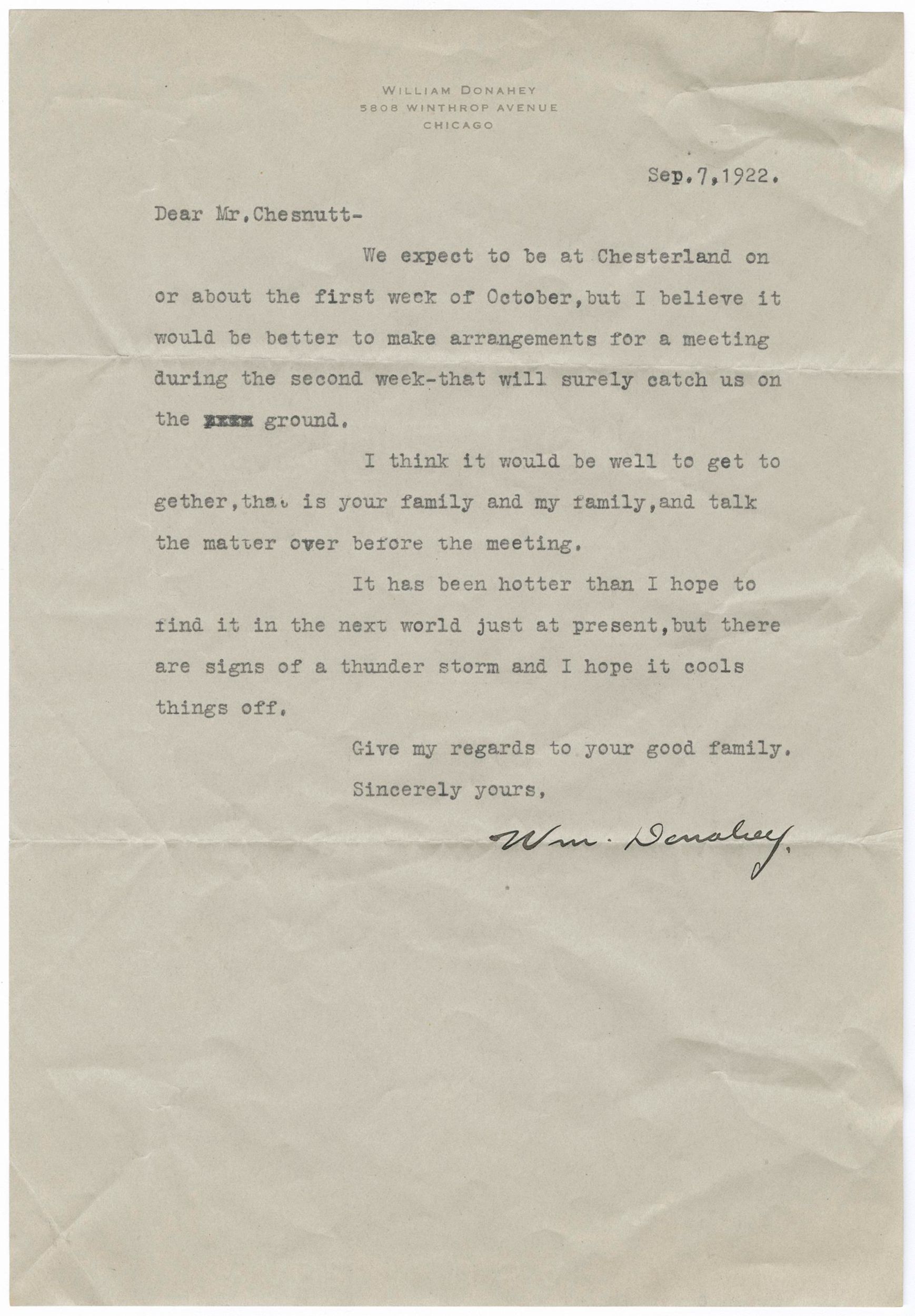
We expect to be at Chesterland1 on or about the first week of October, but I believe it would be better to make arrangements for a meeting during the second week—that will surely catch us on the [illegible] ground.2
I think it would be well to get to gether, that is your own family and my family, and talk the matter over before the meeting.
It has been hotter than I hope to find it in the next world just at present, but there are signs of a thunder storm and I hope it cools things off.
Give my regards to your good family.
Sincerely yours, Wm. Donahey.Correspondent: William (Bill) Donahey (1883–1970) was a White writer and cartoonist from Westchester, Ohio. After graduating from the Cleveland School of Art in 1903, he briefly worked for the Cleveland Plain Dealer, where he met and married Mary Dickerson Donahey (1876–1962) in 1905 and became friends with the Chesnutts. The couple joined the Chester Cliffs Club and built a cottage on the land. After 1905, the couple moved to Chicago, where he worked for the Chicago Tribune and produced a widely syndicated comic strip, the "Teenie Weenies," which ran intermittently from 1914 until his death and became the basis of an advertising campaign for a canned-goods company in the 1920s as well as for several books he co-wrote with his wife.
1. The Chester Cliffs Club or Company was a small stockholding corporation founded in September 1903 by Chesnutt and ten friends who were "stockholders," in order to purchase eleven acres of land in Chester Township near Chesterland, Ohio, and Scotland, Ohio, twenty miles from Cleveland. Summer cottages were built by three of the parties in order to spend their summers away from the city, and in 1916 the Chesnutts purchased one of these. Stockholder meetings were called every fall, even as eventually only three families seem to have remained: the Chesnutts, the Donaheys (who were living in Chicago after 1905), and the Counts. In 1921, Frank Counts (1881–1946), a Cleveland lawyer who was the longtime secretary and treasurer of the Club and his wife Eulalie (Eula) (1869–1942) sold a lot with a cottage to Mary Ellen Delahunte (1870–1951) without consulting the other members, causing conflicts about property tax and upkeep for years. Shortly afterwards, Chesnutt, as the club president, took on the responsibility of reminding members of tax payments and calling the annual meeting. Some of the property was transferred to individual owners in 1923, but the corporation was never legally dissolved. [back]
2. Typically, the Chester Cliffs Club held its annual meeting each fall, called by Chesnutt as its president, with view to the convenience of the Donaheys, who had moved to Chicago in 1905. The 1921 stockholder's meeting took place at Chesnutt's office on October 6, 1921, and despite conflicts of the sale of part of their land, A. Frank Counts continued as treasurer; see Chesnutt's letter to Counts from November 1, 1921. The October 6, 1922, meeting was also held at Chesnutt's office. [back]