Charles W. Chesnutt to L. M. (Lila May) Barnett, 7 July 1924
Key
| Textual Feature | Appearance |
|---|---|
| alterations to base text (additions or deletions) | added or deleted text |
| passage deleted with a strikethrough mark | |
| passage deleted by overwritten added text | Deleted text Added text |
| position of added text (if not added inline) | [right margin] text added in right margin; [above line] text added above the line |
| proofreading mark | ‸ |
| page number, repeated letterhead, etc. | page number or repeated letterhead |
| supplied text | [supplied text] |
| archivist note | archivist note |
 [1]
July 7, 1924.
Miss L. M. Barnett,
Morgan College,1
Baltimore, Maryland.
My dear Miss Barnett:
[1]
July 7, 1924.
Miss L. M. Barnett,
Morgan College,1
Baltimore, Maryland.
My dear Miss Barnett:
I really owe you an apology for not paying attention sooner to your letter with reference to the book you are compiling on the "History of American Negro Literature," but I have been exceedingly busy and other matters were crowding me for attention.2
I enclose you a photograph, not a very recent one, from which you might make a picture if you care to use it.
You are entirely at liberty to make any selection you choose from any of my published books, and I will not assume to make it for you. You can use a short story or a paragraph or whatever you think would be illustrative.
As to my biography, you will find a brief summary of the Xprincipal literary events of my life in Who's Who in America. In addition to that it would be enough to say that I was born in Cleveland, Ohio, June 20th, 1858, of free colored parents who had moved from North Carolina to Ohio a few years sooner.3
That in 1865 my parents returned to Fayetteville, North
 [2]
#2
7-7-24
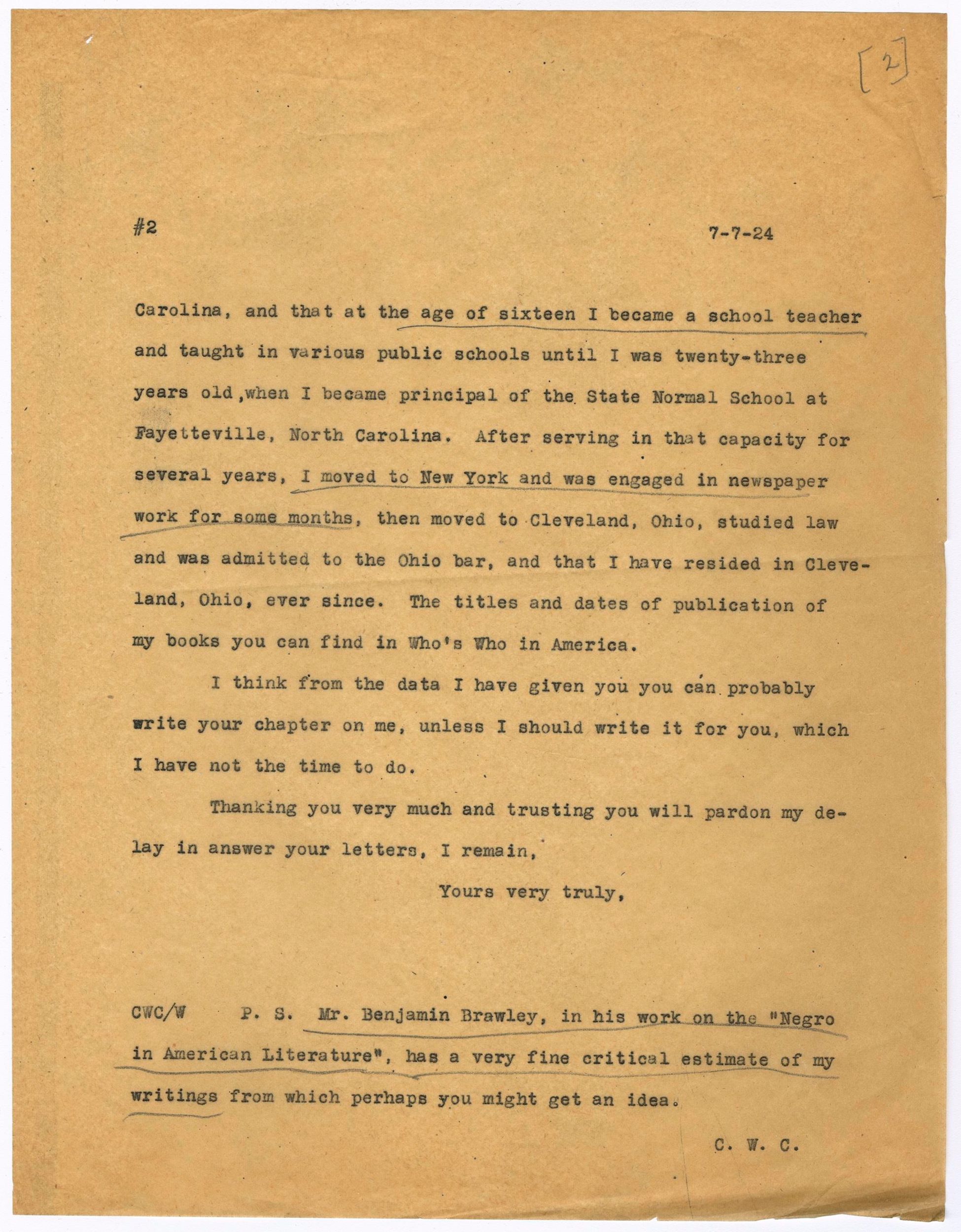
Carolina, and that at the age of sixteen I became a school teacher and taught in various public schools until I was twenty-three years old, when I became principal of the State Normal School at Fayetteville, North Carolina.4 After serving in that capacity for several years, I moved to New York and was engaged in newspaper work for some months, then moved to Cleveland, Ohio, studied law and was admitted to the Ohio bar, and that I have resided in Cleveland, Ohio, ever since.5 The titles and dates of publication of my books you can find in Who's Who in America.
[2]
#2
7-7-24
Carolina, and that at the age of sixteen I became a school teacher and taught in various public schools until I was twenty-three years old, when I became principal of the State Normal School at Fayetteville, North Carolina.4 After serving in that capacity for several years, I moved to New York and was engaged in newspaper work for some months, then moved to Cleveland, Ohio, studied law and was admitted to the Ohio bar, and that I have resided in Cleveland, Ohio, ever since.5 The titles and dates of publication of my books you can find in Who's Who in America.
I thnk from the data I have given you you can probably write your chapter on me, unless I should write it for you, which I have not the time to do.
Thanking you very much and trusting you will pardon my delay in answer your letters, I remain,
Yours very truly, CWC/WP. S. Mr. Benjamin Brawley,6 in his work on the "Negro in American Literature", has a very fine critical estimate of my writings from which perhaps you might get an idea.7
C. W. C.Correspondent: Lila May Barnett Mitchell (1885–1937) was a Black academic educated at Rust College, the Tuskegee Institute, Columbia University, and the University of Chicago. She taught high school in Little Rock, Arkansas, before moving to Morgan College (Maryland) in 1923 to teach chemistry and math. By 1928 she had become chair of the history department at Rust College (Mississippi), like Morgan a historically Black college (HBCU). She was briefly married (1929–1930), and after her husband's death seems to have returned to the Little Rock area. Although her planned book project on Black writers seems to have been abandoned, she did complete a master's thesis (unpublished) on "History Courses in Colored Colleges and Universities" at the University of Chicago in 1936.
1. Morgan College (now Morgan State University) is a historically Black college founded in 1867 in Baltimore, Maryland, initially as a Methodist Episcopal seminary, the Centenary Bible Institute. Renamed Morgan College in 1890, it expanded to include coeducational, secular training and received major support from Andrew Carnegie in the 1910s. Morgan College was a private institution until 1939. [back]
2. While Barnett apparently did not complete her project, the first textbook along those lines was published before Chesnutt's death, edited by scholars at Howard University: Readings from Negro Authors for Schools and Colleges, edited by Otelia Cromwell, Lorenzo Dow Turner, and Eva B. Dykes (New York: Harcourt, Brace and Company, 1931). With Chesnutt's permission, it included two of his short stories and a short biographical sketch; see Cromwell's letter to Chesnutt of February 9, 1931, as well as Chesnutt's February 16 response. [back]
3. Chesnutt's mother, Ann Maria Sampson (1835–1871) from Fayetteville, North Carolina, left for Ohio with her mother, Chloe, in the 1850s, married Andrew Jackson Chesnutt (1833–1920), also from Fayetteville, in 1857 in Cleveland, and did not return to North Carolina until after the Civil War. She and her mother were possibly born enslaved, but by 1850 were listed as free Blacks in the U.S. census. [back]
4. Two schools were founded in Fayetteville in 1866, the Phillips School for elementary school students and the Sumner School for intermediary grades. These were initially funded by the Freedmen's Bureau, a federal agency established in 1865 to provide for the formerly enslaved, and the American Missionary Association (AMA), a nondenominational group founded in 1846 to support abolition, racial equality, Christian principles, and Black education. In 1867, seven Black Fayetteville leaders, including Chesnutt's father, Andrew Jackson Chesnutt, purchased the land for the Howard School, which merged the Phillips and Sumner schools. It opened in 1869, primarily with support from the local African Methodist Episcopal Zion (AMEZ) church and the Peabody Education Fund, established in 1867 by a White Northern philanthropist to provide support for education in the South. Funding from the Freedmen's Bureau and the AMA for the Howard School ceased in 1870 and 1872, respectively. When it became the State Colored Normal School in 1877, state funding led to more formalized training of Black teachers. [back]
5. For Chesnutt's brief stint in New York and his initial employment in Cleveland after he left the State Colored Normal School in Fayetteville in the summer of 1883, see Helen Chesnutt, Charles Waddell Chesnutt: Pioneer of the Color Line (Chapel Hill: University of North Carolina Press, 1952), 34–35. [back]
6. Benjamin Griffith Brawley (1882–1939) was a Black writer, teacher, and clergyman from South Carolina, whose first college degree from Atlanta Baptist College (now Morehouse College) in 1901 was followed by degrees from the University of Chicago and Harvard. He taught at several historically Black colleges and universities, serving as dean at Morehouse College (1912–1920) and as chair of the English department at Howard University (1937–1939). He wrote poetry as well as many scholarly articles and books on Black history and literature, starting with A Short History of the American Negro (New York: Macmillan, 1913). [back]
7. The reference is to Brawley's The Negro in Literature and Art, likely to the revised and expanded edition (New York: Duffield & Company, 1921), chapter 4 (45–49) of which was dedicated to Chesnutt as "the best known novelist and short story writer of the race" (45). The self-published pamphlet-length first edition (1910) had included a longer section on Chesnutt that incorporated plot summaries of his three novels (21-28). [back]