Judson Douglas Wetmore to Charles W. Chesnutt, 11 July 1924
Key
| Textual Feature | Appearance |
|---|---|
| alterations to base text (additions or deletions) | added or deleted text |
| passage deleted with a strikethrough mark | |
| passage deleted by overwritten added text | Deleted text Added text |
| position of added text (if not added inline) | [right margin] text added in right margin; [above line] text added above the line |
| proofreading mark | ‸ |
| page number, repeated letterhead, etc. | page number or repeated letterhead |
| supplied text | [supplied text] |
| archivist note | archivist note |
 [1]
J. D. WETMORE
ATTORNEY AT LAW
WORLD BUILDING
63 PARK ROW
NEW YORK
CABLE ADDRESS JUDOWET
TELEPHONE 8457-8 BEEKMAN
July 11, 1924.
Mr. Charles W. Chestnutt,
Union Trust Company Building,
Cleveland, Ohio.
Dear Sir:-
[1]
J. D. WETMORE
ATTORNEY AT LAW
WORLD BUILDING
63 PARK ROW
NEW YORK
CABLE ADDRESS JUDOWET
TELEPHONE 8457-8 BEEKMAN
July 11, 1924.
Mr. Charles W. Chestnutt,
Union Trust Company Building,
Cleveland, Ohio.
Dear Sir:-
On June 14th, I took title to a gentleman's residence at Gladstone, N. J., in the vicinity of Far Hills, Bernardsville and Morristown, particulars of which I am herewith enclosing, and as I cannot afford to live in a house of this size and value, I want to dispose of the main house and about two hundred and fifty (250) acres, and if necessary, will put in the deal personal property to the value of about Twenty thousand Dollars, including farming implements, seventeen (17) pedigreed cows, a bull, several horses, a mule, sheep and pigs.1
If you would be interested in purchasing such a house, I would make very reasonable terms, and sell the property for a great deal less than its value.
The house alone could not be built today for less than a million dollars, or if you can refer me to somebody who will purchase the same, I will be glad to compensate you for doing so.
I will consider an exchange for other property, and might add cash for income property. If you wish to look at the photos of this property, and want a fuller description, I shall be pleased to furnish the same.
Yours very truly, JDW.CQD (Enc.)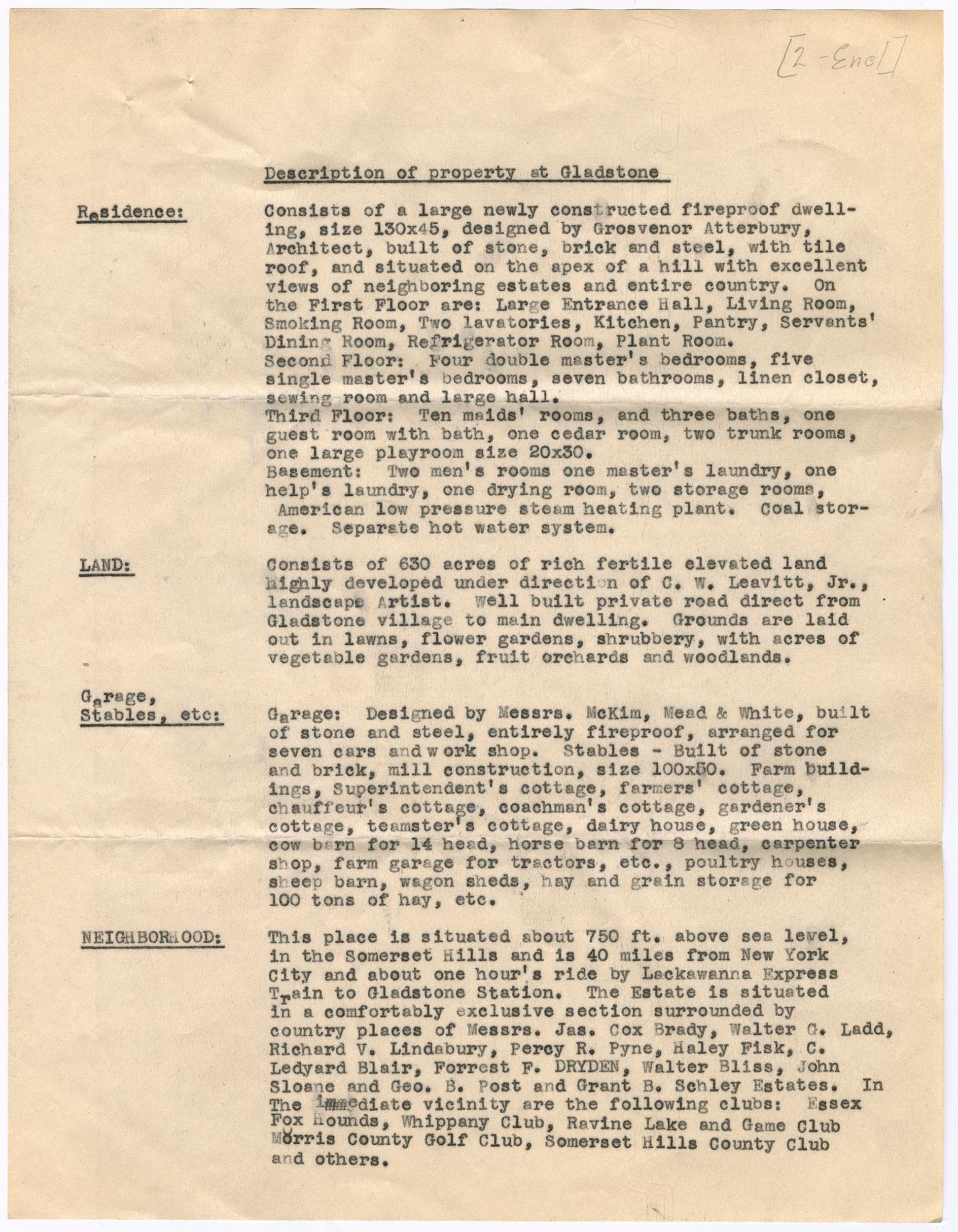 [2 -Encl]
Description of property at Gladstone
Residence: Consists of a large newly constructed fireproof dwelling, size 130x45, designed by Grosvenor Atterbury, Architect,2 built of stone, brick and steel, with tile roof, and situated on the apex of a hill with excellent views of neighboring estates and entire country. On the First Floor are: Large Entrance Hall, Living Room, Smoking Room, Two lavatories, Kitchen, Pantry, Servants' Dining Room, Refrigerator Room, Plant Room.
Second Floor: Four double master's bedrooms, five single master's bedrooms, seven bathrooms, linen closet, sewing room and large hall.
Third Floor: Ten maids' rooms, and three baths, one guest room with bath, one cedar room, two trunk rooms, one large playroom size 20x30.
Basement: Two men's rooms one master's laundry, one help's laundry, one drying room, two storage rooms, American low pressure steam heating plant. Coal storage. Seperate hot water system.
LAND: Consists of 630 acres of rich fertile elevated land highly developed under direction of C. W. Leavitt, Jr., landscape Artist.3 Well built private road direct from Gladstone village to main dwelling. Grounds are laid out in lawns, flower gardens, shrubbery, with acres of vegetable gardens, fruit orchards and woodlands.
Garage, Stables, etc: Garage: Designed by Messrs. McKim, Mead & White,4 built of stone and steel, entirely fireproof, arranged for seven cars and work shop. Stables - Built of stone and brick, mill construction, size 100x50. Farm buildings, Superintendent's cottage, farmers' cottage, chauffeur's cottage, coachman's cottage, gardener's cottage, teamster's cottage, dairy house, green house, cow barn for 14 head, horse barn for 8 head, carpenter shop, farm garage for tractors, etc., poultry houses, sheep barn, wagon sheds, hay and grain storage for 100 tons of hay, etc.
NEIGHBORHOOD: This place is situated about 750 ft. above sea level, in the Somerset Hills and is 40 miles from New York City and about one hour's ride by Lackawanna Express Train to Gladstone Station. The Estate is situated in a comfortably exclusive section surrounded by country places of Messrs. Jas. Cox Brady, Walter G. Ladd, Richard V. Lindabury, Percy R. Pyne, Haley Fisk, C. Ledyard Blair, Forrest F. DRYDEN, Walter Bliss, John Sloane and Geo. B. Post and Grant B. Schley Estates. In The immediate vicinity are the following clubs: Essex Fox Hounds, Whippany Club, Ravine Lake and Game Club Morris County Golf Club, Somerset Hills County Club and others.5
Correspondent: Judson Douglas Wetmore (1871–1930) was a mixed-race lawyer who grew up in Jacksonville, Florida, and was a childhood friend of James Weldon Johnson, who might have introduced Wetmore to Chesnutt. After getting a law degree at Michigan Law School in 1897, Wetmore worked in Jacksonville, but moved to New York City in 1906 to open a law practice. In 1907, he married and later divorced a White Jewish woman, Jeanette Gross (1888–?), with whom he had a daughter, Helen Mable (1908–?). In 1921, he married another White woman named Lucile (or Lucille) Pipes (1894–1966), with whom he had two children. Wetmore died by suicide in July 1930. Both of his wives were aware of his mixed-race status. In official records, he and his children consistently are listed as White, but it was not a secret he was Black (see "Cremate Body of New York Lawyer Whom Many Mistook for White," Afro-American [Baltimore, MD], August 9, 1930, 7; and James Weldon Johnson, Along This Way: The Autobiography of James Weldon Johnson [New York: Viking Press, 1968; orig. pub. 1933], 252).
1. The property Wetmore was trying to sell, sometimes known as "Hillandale," was a large mansion on 620 acres atop Mount St. John near Gladstone, NJ, built by the architect Grosvenor Atterbury (1869–1956) in 1906 for George Rudolf Mosle (1865–1941), a White businessman in the sugar trade. Mosle sold it in 1919 after losing his fortune, and Lucile Wetmore bought the estate from the Metropolitan Life Insurance Company in 1924. She defaulted on the loan in 1926, and the insurance company bought it back for $100,000. They then sold it, for an alleged $1,000,000, to an order of nuns, the Sisters of St. John the Baptist, who turned it into an orphanage and added a large school building ("Mosle Estate at Peapack to be Orphanage and Convent," Bernardsville News, Thursday, Aug 19, 1926, 1). [back]
2. Grosvenor Atterbury (1869–1956) was a White American architect based in New York who designed the country homes of wealthy industrialists, including Mosle's, in the early 1900s. He had a major role in the original design of the Forest Hills Gardens in Queens, New York City, in conjunction with landscape designer Frederick Law Olmsted, and he later worked on several major projects for John D. Rockefeller, Jr. [back]
3. Charles Welford Leavitt (1871–1928) was a White American landscape architect and urban planner. He was originally from New Jersey and was in high demand in the early 20th century on the East Coast for his park and garden designs. [back]
4. This was a prominent New York architecture firm, founded by architects Charles Follen McKim (1847–1909) and William Rutherford Mead (1846–1928); they were joined in 1879 by Stanford White (1853–1906). The firm rose to fame for its Beaux Arts and American Renaissance public buildings and private homes, especially in New York City. Grosvenor Atterbury worked for the firm as a young architect. [back]
5. The Somerset Hills area of New Jersey, including the villages of Gladstone,, Peapack, Bernardsville, and Far Hills, had been selected by wealthy New York industrialists and bankers as a bucolic location for their weekend and summer homes in the 1870s. By the 1890s it was connected by railway to Hoboken, NJ, and thus to New York City, making for an easy commute. The area residents mentioned here were all wealthy bankers and industrialists or their heirs, with a few architects among them. Several of these men had New Jersey roots; some were instrumental in founding the mentioned country and hunting clubs in the late 19th century. [back]