Nathan C. Newbold to Charles W. Chesnutt, 4 May 1922
Key
| Textual Feature | Appearance |
|---|---|
| alterations to base text (additions or deletions) | added or deleted text |
| passage deleted with a strikethrough mark | |
| passage deleted by overwritten added text | Deleted text Added text |
| position of added text (if not added inline) | [right margin] text added in right margin; [above line] text added above the line |
| proofreading mark | ‸ |
| page number, repeated letterhead, etc. | page number or repeated letterhead |
| supplied text | [supplied text] |
| archivist note | archivist note |
 Department of Public Instruction
State of North Carolina
Department of Public Instruction
State of North Carolina
The enclosed circular letter is a copy of one that I have sent to a number of leading negro educators in North Carolina and will explain itself. Some of these friends of mine have given me your name and stated that you can, no doubt, help me to get the information that I desire.2
You will observe from my letter heading that I am engaged in educational work in North Carolina and that I want the information because I believe I can use it to help promote negro education.
I am at Teachers College this year and I shall be glad to hear from you at this place. An early reply will be appreciated.
Very truly yours, N. C. Newbold Director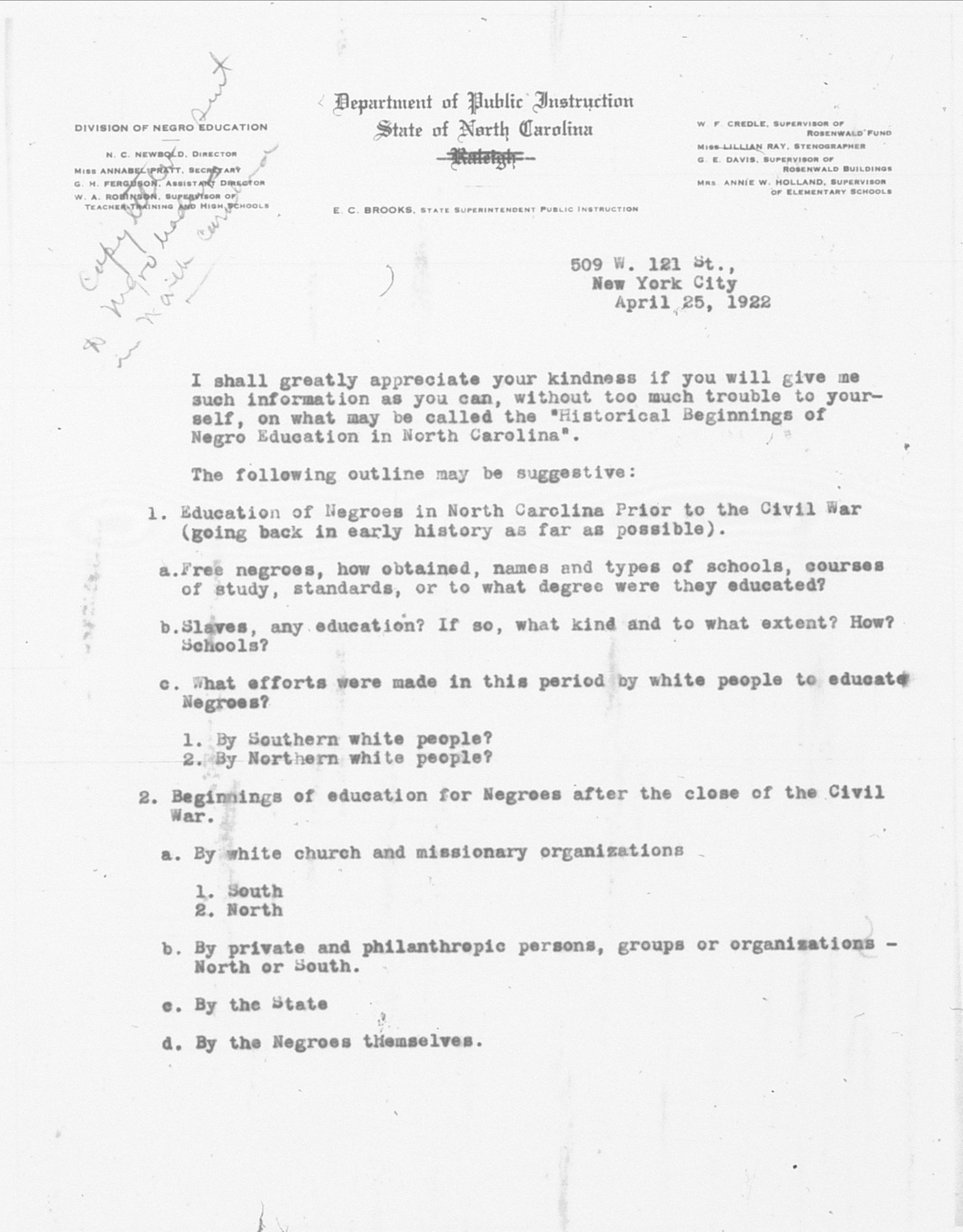 Department of Public Instruction
State of North Carolina
Department of Public Instruction
State of North Carolina
I shall greatly appreciate your kindness if you will give me such information as you can, without too much trouble to yourself, on what may be called the "Historical Beginnings of Negro Education in North Carolina".
The following outline may be suggestive:
1. Education of Negroes in North Carolina Prior to the Civil War (going back in early history as far as possible). a. Free negroes, how obtained, names and types of schools, courses of study, standards, or to what degree were they educated? b. Slaves, any education? If so, what kind and to what extent? How? Schools? c. What efforts were made in this period by white people to educate Negroes? 1. By Southern white people? 2. By Northern white people? 2. Beginnings of education for Negroes after the close of the Civil War. a. By white church and missionary organizations 1. South 2. North b. By private and philanthropic persons, groups or organizations - North or South. c. By the State d. By the Negroes themselves.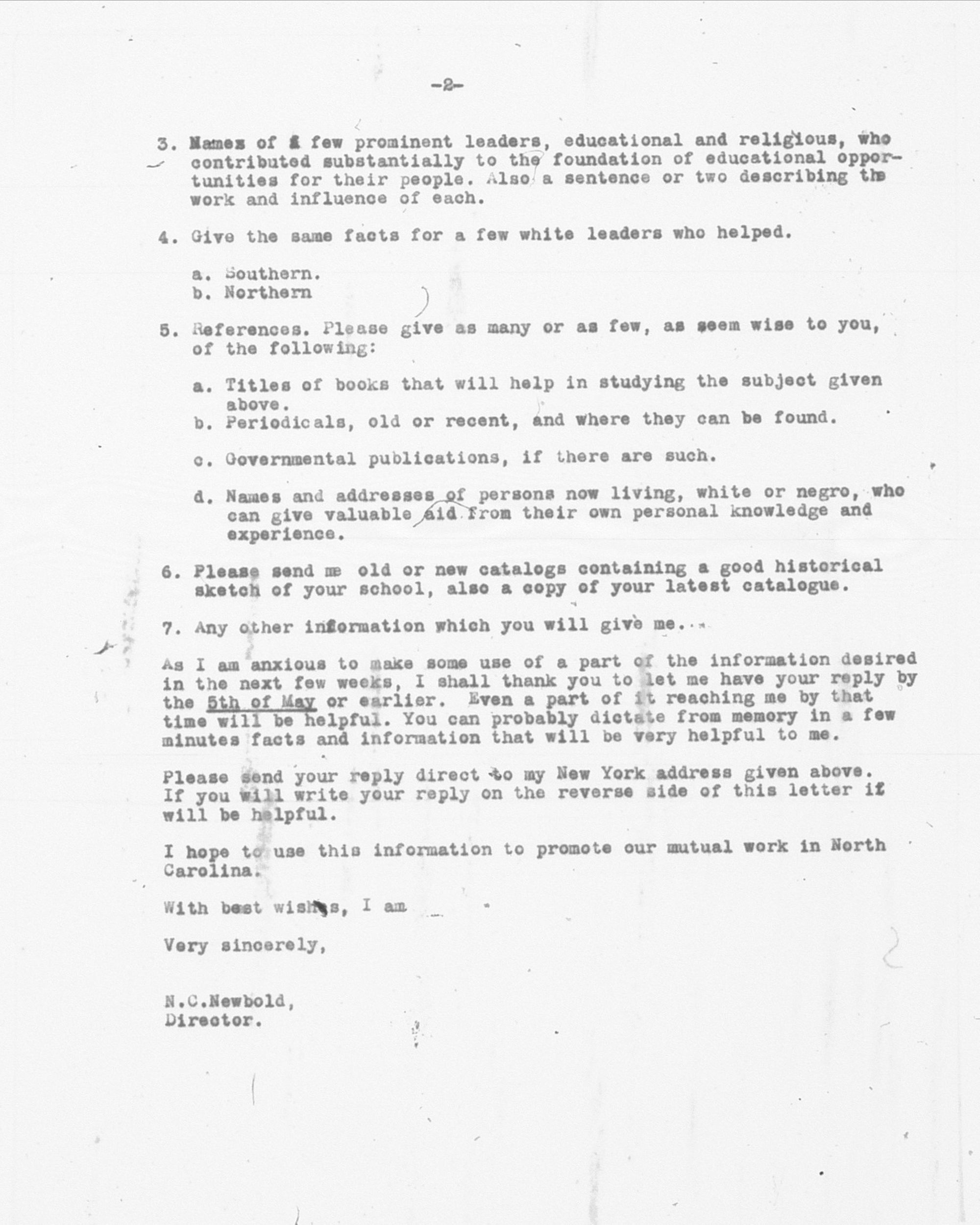 -2-
3. Names of a few prominent leaders, educational and religious, who contributed substantially to the foundation of educational opportunities for their people. Also a sentence or two describing the work and influence of each.
4. Give the same facts for a few white leaders who helped.
a. Southern.
b. Northern
5. References. Please give as many or as few, as seem wise to you, of the following:
a. Titles of books that will help in studying the subject given above.
b. Periodicals, old or recent, and where they can be found.
c. Governmental publications, if there are such.
d. Names and addresses of persons now living, white or negro, who can give valuable aid from their own personal knowledge and experience.
6. Please send me old or new catalogs containing a good historical sketch of your school, also a copy of your latest catalogue.
7. Any other information which you will give me.
-2-
3. Names of a few prominent leaders, educational and religious, who contributed substantially to the foundation of educational opportunities for their people. Also a sentence or two describing the work and influence of each.
4. Give the same facts for a few white leaders who helped.
a. Southern.
b. Northern
5. References. Please give as many or as few, as seem wise to you, of the following:
a. Titles of books that will help in studying the subject given above.
b. Periodicals, old or recent, and where they can be found.
c. Governmental publications, if there are such.
d. Names and addresses of persons now living, white or negro, who can give valuable aid from their own personal knowledge and experience.
6. Please send me old or new catalogs containing a good historical sketch of your school, also a copy of your latest catalogue.
7. Any other information which you will give me.
As I am anxious to make some use of a part of the information desired in the next few weeks, I shall thank you to let me have your reply by the 5th of May or earlier. Even a part of it reaching me by that time will be helpful. You can probably dictate from memory in a few minutes facts and information that will be very helpful to me.4
Please send your reply direct to my New York address given above. If you will write your reply on the reverse side of this letter it will be helpful.
I hope to use this information to promote our mutual work in North Carolina.
With best wishes, I am Very sincerely, N. C. Newbold, Director.Correspondent: Nathan Carter Newbold (1871–1957) was a White educator and civil servant from North Carolina who became the first state agent for Black schools in 1913. In 1920, he created the Division of Negro Education, acting as its director from 1921 to 1950. Throughout his career, he pursued graduate work in education, including at Columbia University's Teachers' College.
1. For readability, the remainder of the letterhead is not transcribed in the body of the letter but is included in this footnote as unformatted text. The letterhead can be seen in its entirety in the accompanying image of the letter. The text of the remainder of the letterhead is as follows: "N. C. NEWBOLD, DIRECTOR MISS ANNABEL PRATT, SECRETARY G. H. FERGUSON, ASSISTANT DIRECTOR W. A. ROBINSON, SUPERVISOR OF TEACHER-TRAINING AND HIGH SCHOOLS W. F. CREDLE, SUPERVISOR OF ROSENWALD FUND MISS LILLIAN RAY, STENOGRAPHER G. E. DAVIS, SUPERVISOR OF ROSENWALD BUILDINGS MRS. ANNIE W. HOLLAND, SUPERVISOR OF ELEMENTARY SCHOOLS" [back]
2. Chesnutt was recommended to Nathan C. Newbold as a source because of his early career as an educator in North Carolina's Black schools. He was an assistant at the Peabody School in Charlotte (1874–1877) and a teacher at the North Carolina State Colored Normal School in 1877 and served as its principal (1880–1883) before leaving for Ohio. His father, Andrew Jackson Chesnutt, had been part of the effort to found the Howard School, the forerunner of the Normal School and Chesnutt's own secondary school, in 1867. [back]
3. For readability, the remainder of the letterhead is not transcribed in the body of the letter but is included in this footnote as unformatted text. The letterhead can be seen in its entirety in the accompanying image of the letter. The text of the remainder of the letterhead is as follows: "N. C. NEWBOLD, DIRECTOR MISS ANNABEL PRATT, SECRETARY G. H. FERGUSON, ASSISTANT DIRECTOR W. A. ROBINSON, SUPERVISOR OF TEACHER-TRAINING AND HIGH SCHOOLS W. F. CREDLE, SUPERVISOR OF ROSENWALD FUND MISS LILLIAN RAY, STENOGRAPHER G. E. DAVIS, SUPERVISOR OF ROSENWALD BUILDINGS MRS. ANNIE W. HOLLAND, SUPERVISOR OF ELEMENTARY SCHOOLS" [back]
4. Nathan C. Newbold may have used the material he gathered for a report or speech, but his print publications on Black education in North Carolina did not appear until the 1930s: The Report of the Governor's Commission for the Study of Problems in the Education of Negroes in North Carolina (Raleigh, 1935) and Five North Carolina Negro Educators (Chapel Hill, NC: University of North Carolina Press, 1939). [back]