Charles W. Chesnutt to Harry L. Davis, 14 December 1921
Key
| Textual Feature | Appearance |
|---|---|
| alterations to base text (additions or deletions) | added or deleted text |
| passage deleted with a strikethrough mark | |
| passage deleted by overwritten added text | Deleted text Added text |
| position of added text (if not added inline) | [right margin] text added in right margin; [above line] text added above the line |
| proofreading mark | ‸ |
| page number, repeated letterhead, etc. | page number or repeated letterhead |
| supplied text | [supplied text] |
| archivist note | archivist note |
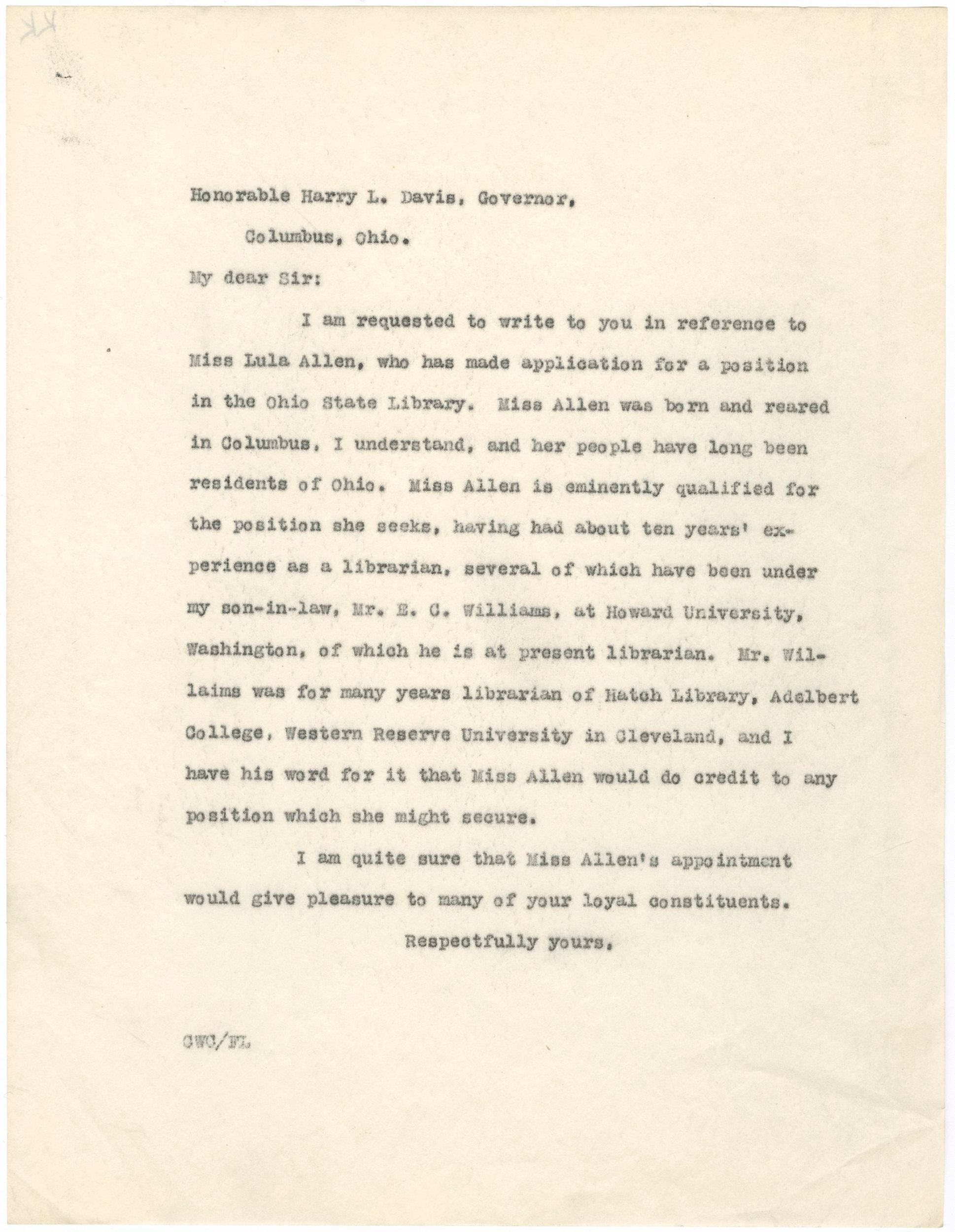 Honorable Harry L. Davis, Governor,
Columbus, Ohio.1
My dear Sir:
Honorable Harry L. Davis, Governor,
Columbus, Ohio.1
My dear Sir:
I am requested to write to you in reference to Miss Lula Allen,2 who has made application for a position in the Ohio State Library.3 Miss Allen was born and reared in Columbus, I understand, and her people have long been residents of Ohio. Miss Allen is eminently qualified for the position she seeks, having had about ten years' experience as a librarian, several of which have been under my son-in-law, Mr. E. C. Williams,4 at Howard University, Washington, of which he is at present librarian.5 Mr. Williams was for many years librarian of Hatch Library, Adelbert College, Western Reserve University in Cleveland,6 and I have his word for it that Miss Allen would do credit to any position which she might secure.
I am quite sure that Miss Allen's appointment would give pleasure to many of your loyal constituents.
Respectfully yours, CWC/FLCorrespondent: Harry Lyman Davis (1878–1950) was a White Republican from Cleveland, Ohio, who served three terms as Cleveland's mayor (1916–1920) before becoming Ohio's 49th Governor (1921–1923). Shortly after Chesnutt's death, he was elected mayor of Cleveland for one more term (1934–1935).
1. The December 17, 1921, reply to this letter, written by William S. Bundy (1893–1957), executive clerk for Governor Davis, makes clear that this letter was dated December 14, 1921. Chesnutt's letter to Davis was prompted by a December 3, 1921, letter from his son-in-law Edward C. Williams (1871–1920), requesting that Chesnutt write to the Governor. Chesnutt notified Williams on December 20, 1921, that he had sent the letter. [back]
2. Lula Allen (also Allan, 1879–1968), was a Black woman from Columbus, Ohio, the younger sister of Mattie Allen McAdoo (1868–1936). They sometimes performed together as singers and were personal friends of the Chesnutts. Although she did not hold a library science degree, Allen became cataloguer and then assistant librarian at Howard University in Washington, D. C., in the early 1910s, eventually under Chesnutt's son-in-law Edward C. Williams (1871–1929), who would become Howard's head librarian. Both Chesnutt and Williams wrote her recommendations for a position at the Ohio State Library in 1921 when she returned to Columbus. However, Allen does not seem to have worked there and by the late 1920s she had moved back Washington, D. C., and served as head librarian at the Miner Normal School, a teachers' college for Black women adjacent to the Howard University campus. [back]
3. The Ohio State Library (now the State Library of Ohio) in Columbus, Ohio, was founded in 1817 by the governor as a government agency exclusively for state legislators; it was opened to the public in 1853. From the beginning, it was overseen by a librarian appointed by the governor, but in 1921, a newly created State Library Board was given the power to appoint and remove the State Librarian. [back]
4. Edward Christopher Williams (1871–1929), the son of a Black father and a White mother of Irish descent, was from Cleveland, Ohio. He graduated from Western Reserve University's Adelbert College in 1892 and became its head librarian (1894–1909), also receiving an M.A. in library science at the New York Library School in 1899. He had known the Chesnutts at least since the 1890s and married Chesnutt's daughter Ethel in the fall of 1902; their son Charles (Charlie) was born in 1903. In 1909 the family moved to Washington, D. C., where Williams served as principal of M Street High School (1909–1916) and then as director of Howard University's library (1916–1929), where he also taught library science and foreign languages. He wrote a play performed at Howard University, as well as poetry and fiction for the Black literary magazine The Messenger in the 1920s. During the summer, Williams often worked at the Harlem branch of the New York Public Library at 135th Street, and in 1929 he enrolled in a Ph.D. program in library science at Columbia University in New York City, but in December of that year he died unexpectedly after a brief illness. [back]
5. A private university in Washington, D. C., Howard University was founded in 1867 by Oliver Otis Howard (1830–1909), the commissioner of the Freedmen's Bureau from 1865 to 1874, as one of the first Historically Black Colleges and Universities (HBCUs). Chesnutt visited Howard University on his first trip to Washington in 1879 (The Journals of Charles W. Chesnutt, ed. Richard Brodhead [Durham, NC: Duke University Press, 1993], 116). His son-in-law Edward C. Williams (1871–1929) was head librarian at Howard from 1916 until his death in 1929; his son-in-law John G. Slade (1890–1976) attended Howard Medical School; and his grandson Charles Waddell Chesnutt Williams (1909–1940) earned a B.A. and law degree from Howard. [back]
6. Western Reserve University was originally founded outside of Cleveland, Ohio, as Western Reserve College; it became Western Reserve University in 1882 as the campus moved to the city. (Later combined with the adjacent Case School of Applied Sciences, it is now Case Western Reserve University.) Chesnutt had many personal and professional ties to the university, especially through its law school and its library, where his son-in-law Edward C. Williams was head librarian (1894–1909). Chesnutt's daughter Dorothy attended the university's College for Women (1909–1913). Chesnutt also personally knew Charles F. Thwing (1853–1937), the university's president from 1891 to 1921. [back]