Charles W. Chesnutt to Wendell Phillips Dabney, 7 June 1931
Key
| Textual Feature | Appearance |
|---|---|
| alterations to base text (additions or deletions) | added or deleted text |
| passage deleted with a strikethrough mark | |
| passage deleted by overwritten added text | Deleted text Added text |
| position of added text (if not added inline) | [right margin] text added in right margin; [above line] text added above the line |
| proofreading mark | ‸ |
| page number, repeated letterhead, etc. | page number or repeated letterhead |
| supplied text | [supplied text] |
| archivist note | archivist note |
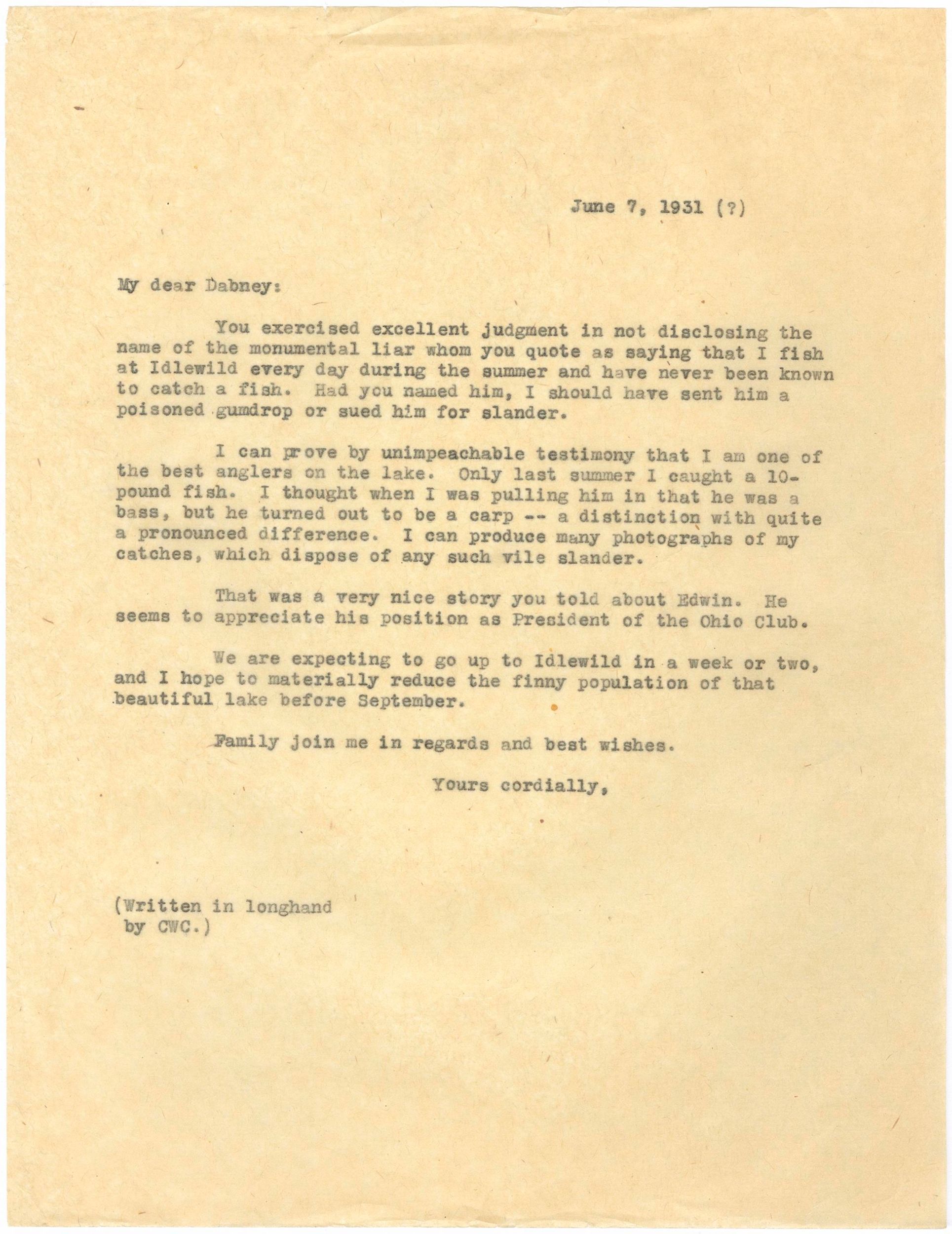 June 7, 1931 (?)1
My dear Dabney:
June 7, 1931 (?)1
My dear Dabney:
You exercised excellent judgment in not disclosing the name of the monumental liar whom you quote as saying that I fish at Idlewild2 every day during the summer and have never been known to catch a fish. Had you named him, I should have sent him a poisoned gumdrop or sued him for slander.
I can prove by unimpeachable testimony that I am one of the best anglers on the lake. Only last summer I caught a 10-pound fish. I thought when I was pulling him in that he was a bass, but he turned out to be a carp -- a distinction with quite a pronounced difference. I can produce many photographs of my catches, which dispose of any such vile slander.3
That was a very nice story you told about Edwin.4 He seems to appreciate his position as President of the Ohio Club.
We are expecting to go up to Idlewild in a week or two, and I hope to materially reduce the finny population of that beautiful lake before September.
Family join me in regards and best wishes.
Yours cordially, (Written in longhand by CWC.)Correspondent: Wendell Phillips Dabney (1865–1952) was a Black activist, musician, and journalist. Originally from Richmond, Virginia, he moved to Ohio in 1883 to study at Oberlin College and then moved to Cincinnati in 1894. He worked for the city of Cincinnati from 1895 until 1923 and was the founder, editor, and publisher of the Black weekly newspaper The Union (1907–1952).
1. The note in parentheses at the end of the letter indicates that this is a copy of a hand-written letter, perhaps a draft, that was likely typed by the assistants who helped Helen Chesnutt copy some of the letters that her father wrote (see Helen Chesnutt, Charles Waddell Chesnutt: Pioneer of the Color Line [Chapel Hill: University of North Carolina Press, 1952], v). Although the date on the original may not have been fully legible, the fact that Chesnutt and his family were in Idlewild, Michigan, by the end of June 1931 confirms that the letter was sent that month. [back]
2. After discovering Idlewild in 1921, the Chesnutts spent every summer at this location in Lake County, Michigan, about 380 miles west of Cleveland. Idlewild was a popular lakeside resort for hundreds of Black families from the urban Midwest from the 1910s to the 1960s, when racism excluded them from many White resort towns. In the spring of 1924, Chesnutt purchased a plot of land, and had a lakeside cabin built (14240 Lake Drive), which was completed in 1926. [back]
3. While the letter from Dabney to which Chesnutt replies here is lost, his ongoing banter with Dabney about fishing eventually resulted in Chesnutt sending Dabney several photographs; see Chesnutt's letter from October 16, 1931. [back]
4. Edwin Jackson Chesnutt (1883—1939) was the third child of Charles and Susan Chesnutt. Born in North Carolina, he spent his childhood in Cleveland, Ohio, graduated from Harvard University in 1905, and decided not to remain abroad after an extended stay in France in 1906. Instead, he trained and worked as a stenographer, including at the Tuskegee Institute from 1910–1912. After obtaining a degree in dentistry at Northwestern University in 1917, he became a dentist in Chicago. [back]