William Monroe Trotter to Charles W. Chesnutt, 22 February 1932
Key
| Textual Feature | Appearance |
|---|---|
| alterations to base text (additions or deletions) | added or deleted text |
| passage deleted with a strikethrough mark | |
| passage deleted by overwritten added text | Deleted text Added text |
| position of added text (if not added inline) | [right margin] text added in right margin; [above line] text added above the line |
| proofreading mark | ‸ |
| page number, repeated letterhead, etc. | page number or repeated letterhead |
| supplied text | [supplied text] |
| archivist note | archivist note |
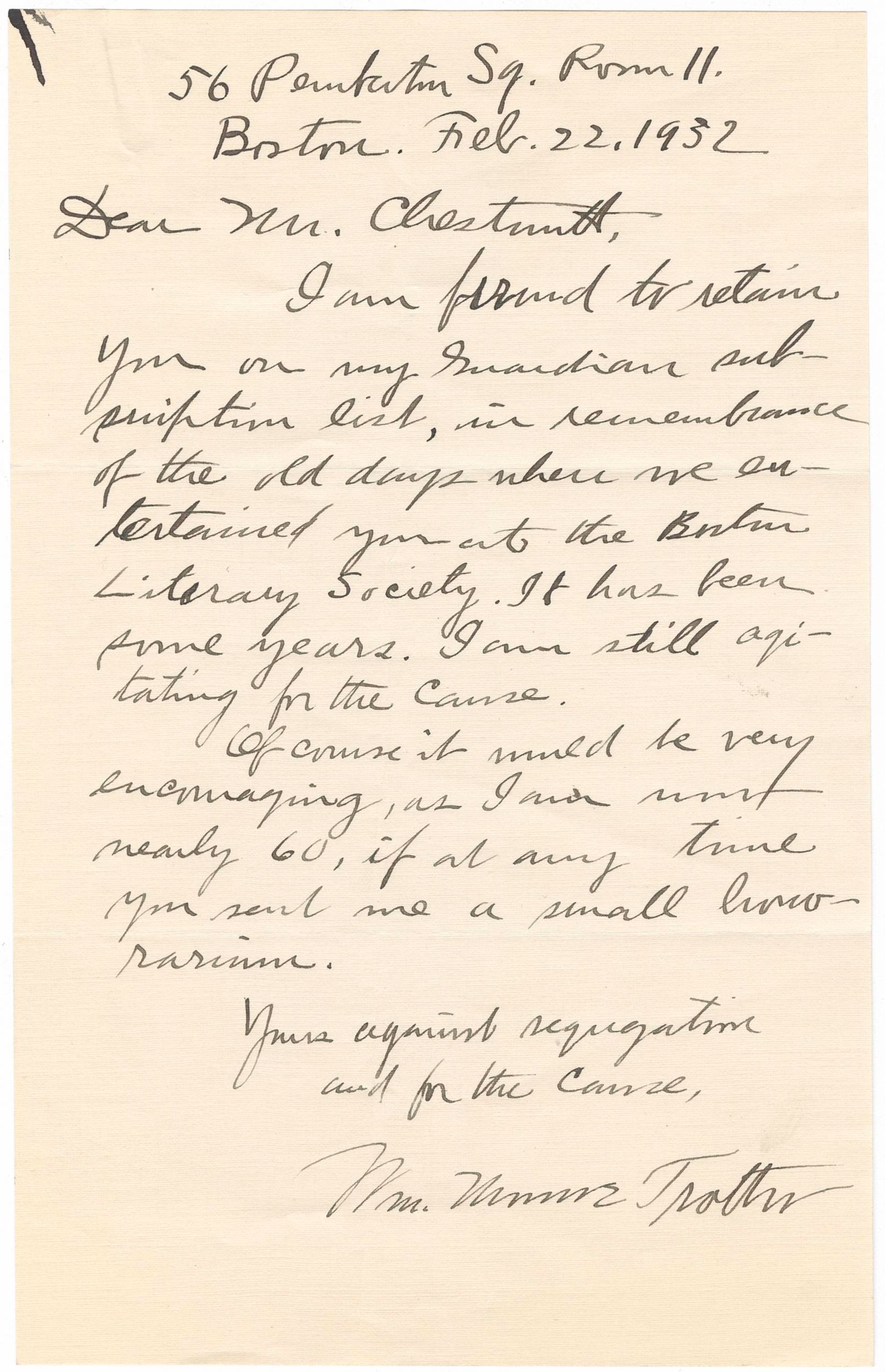 56 Pemberton Sq. Room 11
Boston
Feb 22, 1932
Dear Mr. Chestnutt,
56 Pemberton Sq. Room 11
Boston
Feb 22, 1932
Dear Mr. Chestnutt,
I am proud to retain you on my Guardian subscription list, in remembrance of the old days when we entertained you at the Boston Literary Society. It has been some years.1 I am still agitating for the cause.
Of course it would be very encouraging, as I am now nearly 60, if at any time you sent me a small honorarium.2
Yours against segregation and for the cause, Wm. Monroe TrotterCorrespondent: William Monroe Trotter (1872–1934) was a Black activist and journalist whose father had been one of the most prominent Black Democrats of his time. Educated at Harvard and mostly active in Boston, Massachusetts, Trotter was an outspoken critic of Booker T. Washington. He co-founded the newspaper The Guardian (Boston) and the Boston Literary and Historical Association, using both to criticize White racism in the U.S. and accommodationism among Blacks. Although initially allied with W. E. B. Du Bois and active in the Niagara Movement, which was instrumental in founding the NAACP, Trotter later distanced himself from the group and founded a more radical alternative, the National Equal Rights League.
1. Over twenty-five years earlier, on Sunday, June 25, 1905, Chesnutt gave a speech, "Race Prejudice; Its Causes and Its Cure" at the Boston Historical and Literary Association, co-founded and headed by William Monroe Trotter. See Chesnutt's letter to S. E. Courtney from May 16, 1905. [back]
2. The Boston-based Guardian, the weekly Black newspaper which William Monroe Trotter (1872–1934) had edited and published since 1901, had floundered for approximately fifteen years, and in early 1932 went bankrupt. Trotter and his sister and assistant editor Maude Trotter Steward (1875–1955) wrote to many subscribers for additional support. See Kerri K. Greenidge, Black Radical: The Life and Times of William Monroe Trotter (New York: W.W. Norton, 2020), 347. [back]