Charles W. Chesnutt to Frederick L. Hubbard, 5 February 1931
Key
| Textual Feature | Appearance |
|---|---|
| alterations to base text (additions or deletions) | added or deleted text |
| passage deleted with a strikethrough mark | |
| passage deleted by overwritten added text | Deleted text Added text |
| position of added text (if not added inline) | [right margin] text added in right margin; [above line] text added above the line |
| proofreading mark | ‸ |
| page number, repeated letterhead, etc. | page number or repeated letterhead |
| supplied text | [supplied text] |
| archivist note | archivist note |
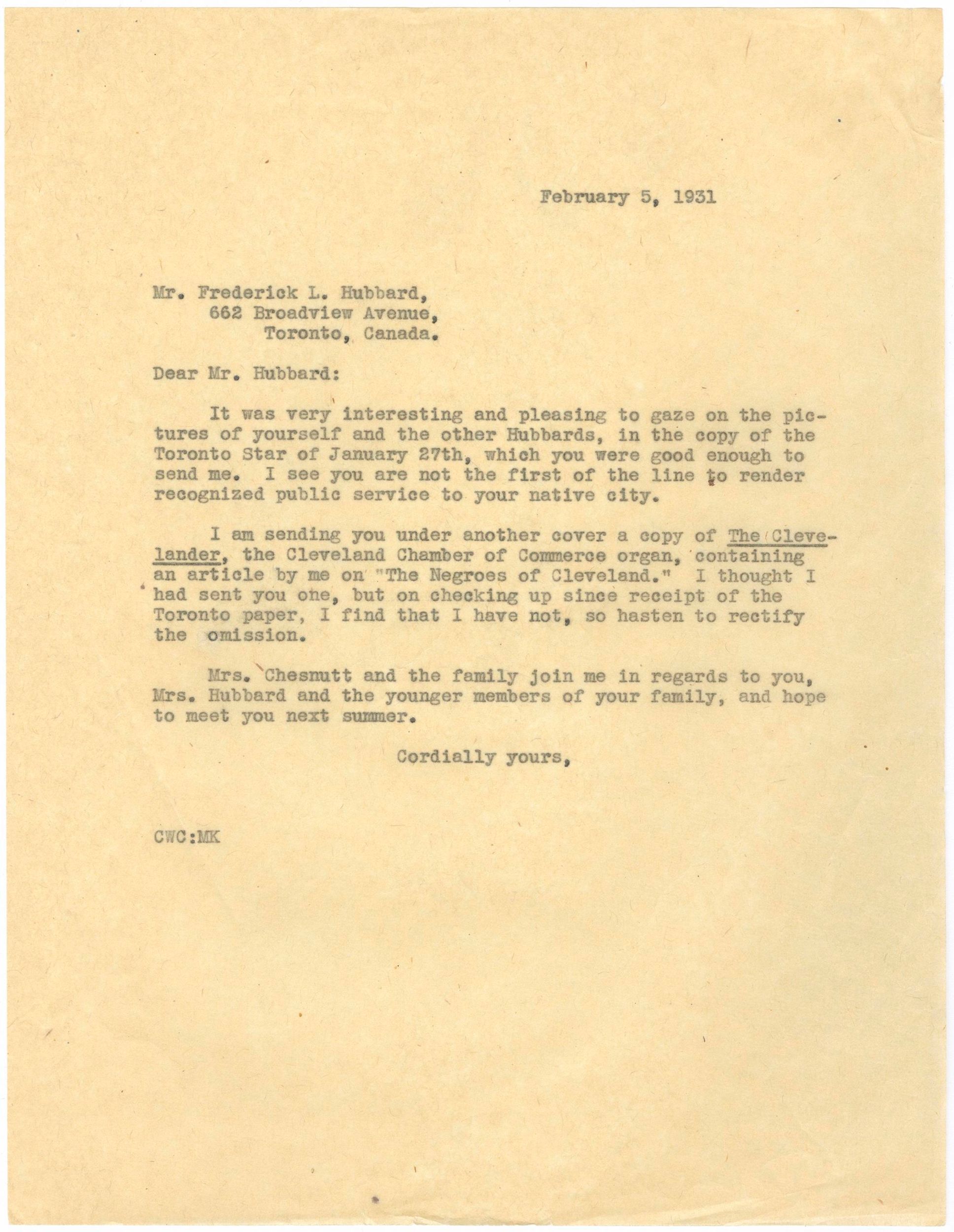 February 5, 1931
Mr. Frederick L. Hubbard,
662 Broadview Avenue,
Toronto, Canada.
Dear Mr. Hubbard:
February 5, 1931
Mr. Frederick L. Hubbard,
662 Broadview Avenue,
Toronto, Canada.
Dear Mr. Hubbard:
It was very interesting and pleasing to gaze on the pictures of yourself and the other Hubbards, in the copy of the Toronto Star of January 27th, which you were good enough to send me. I see you are not the first of the line to render recognized public service to your native city.1
I am sending you under another cover a copy of The Clevelander, the Cleveland Chamber of Commerce organ, containing an article by me on "The Negroes of Cleveland."2 I thought I had sent you one, but on checking up since receipt of the Toronto Paper, I find that I have not, so hasten to rectify the omission.
Mrs. Chesnutt3 and the family join me in regards to you, Mrs. Hubbard4 and the younger members of your family, and hope to meet you next summer.5
Cordially yours, CWC:MKCorrespondent: Frederick L. Hubbard (1878–1953) was a member of a prominent political family in Toronto, Canada. He worked for the Toronto Street Railway (1905–1921) and became the first Black person to serve on the Toronto Transportation Commission, including as chair (1929–1930), vice-chair (1931) and commissioner (1932–1939).
1. The article Hubbard sent noted the 89th birthday of his father, William P. Hubbard (1842–1935), Toronto's first elected Black politician, who served as alderman and controller on the city council for many years. It was accompanied by a photo of four generations of Hubbards, including Frederick himself, his son William P. Hubbard Jr. (1904–1949), and one of the great-grandchildren of Hubbard Sr., 3-year-old Fred Jr. (See "William P. Hubbard at 89th Milestone," Toronto Star, January 27, 1931, 2.) [back]
2. Chesnutt's essay "The Negro in Cleveland" was published in The Clevelander 5, no. 7 (November 1930): 3–4, 24–27. It was accompanied by a portrait of Chesnutt. [back]
3. Susan Perry Chesnutt (1861–1940) was from a well-established Black family in Fayetteville, North Carolina, and worked as a teacher at Fayetteville's Howard School before marrying Chesnutt. They were married from 1878 until his death in 1932 and had four children: Ethel, Helen, Edwin, and Dorothy. Susan led an active life in Cleveland. [back]
4. Grace Isabel Abbott (1880–1947) married Frederick Hubbard in 1903. She was also from Toronto, the only daughter of a Black physician, Dr. Anderson Ruffin Abbott (1837–1913), the son of free Blacks who had come from Alabama in the 1830s. Her father was the first Black major in the U.S. Army during the Civil War, and the first Black licensed physician in Canada, working primarily in Toronto. Fred and Grace Hubbard had at least three children, the oldest (William Peyton Hubbard Jr.) born in 1904. [back]
5. The Chesnutt and Hubbard families seem to have met in Idlewild, Michigan, during their summer vacation; Hubbard is mentioned as being present during a visit of the governor of Michigan for the dedication of the Idlewild Tabernacle in August of 1929 ("Thousands Hear Gov. Green Speak," Lake County Star ([Baldwin, MI], August 16, 1929, 1). [back]