H. Franklin Bray to Charles W. Chesnutt, 28 January 1931
Key
| Textual Feature | Appearance |
|---|---|
| alterations to base text (additions or deletions) | added or deleted text |
| passage deleted with a strikethrough mark | |
| passage deleted by overwritten added text | Deleted text Added text |
| position of added text (if not added inline) | [right margin] text added in right margin; [above line] text added above the line |
| proofreading mark | ‸ |
| page number, repeated letterhead, etc. | page number or repeated letterhead |
| supplied text | [supplied text] |
| archivist note | archivist note |
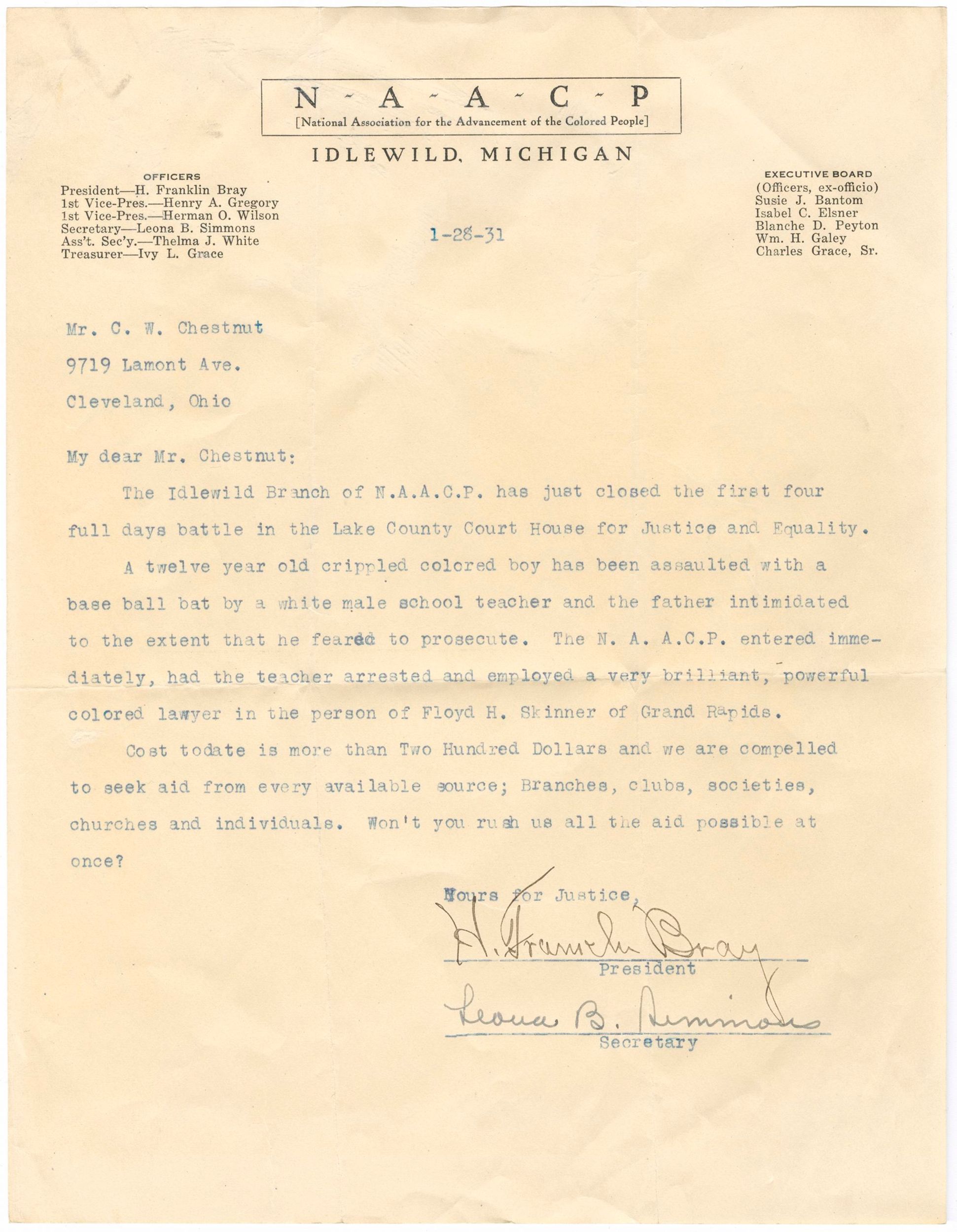 N-A-A-C-P
[National Association for the Advancement of the Colored People]1
IDLEWILD, MICHIGAN2
1-28-31
Mr. C. W. Chestnut
9719 Lamont Ave.
Cleveland, Ohio
My dear Mr. Chestnut:
N-A-A-C-P
[National Association for the Advancement of the Colored People]1
IDLEWILD, MICHIGAN2
1-28-31
Mr. C. W. Chestnut
9719 Lamont Ave.
Cleveland, Ohio
My dear Mr. Chestnut:
The Idlewild3 Branch of N.A.A.C.P. has just closed the first four full days of battle in the Lake County Court House for Justice and Equality.4
A twelve year old crippled colored boy has been assaulted with a base ball bat by a white male school teacher and the father intimidated to the extent that he feared to prosecute.5 The N. A. A.C.P. entered immediately, had the teacher arrested and employed a very brilliant, powerful colored lawyer in the person of Floyd H. Skinner6 of Grand Rapids.
Cost to date is more than Two Hundred Dollars and we are compelled to seek aid from every available source; Branches, clubs, societies, churches and individuals. Won't you rush us all the aid possible at once?
Yours for Justice, H. Franklin Bray President Leona B. Simmons7 SecretaryCorrespondent: H. (Harry) Franklin Bray (1875–11939) was a Black pastor in the A.M.E. Church who was originally from Ohio, and served in the Southwest and in Kansas before settling in Idlewild, Michigan in 1923 and founding what became the Tabernacle Church. He served as its pastor until shortly before his death, for a time as president of the local NAACP, and founded the institution of the Sunday Forums, at which Chesnutt spoke several times during his summers in Idlewild.
1. The National Association for the Advancement of Colored People (NAACP) began in February 1909, with a Committee on the Negro and "The Call," a statement protesting lawlessness against Black people. In 1910, the organization adopted its current name and in 1912 began publication of a monthly journal, The Crisis, which was edited by W. E. B. Du Bois from 1912 to 1944. Chesnutt's involvement with the NAACP extended over many years, and included serving on its General Committee, attending conferences, presiding at NAACP events in Cleveland, publishing four stories and two essays in The Crisis (1912, 1915, 1924, 1926, 1930, and 1931), and being awarded in 1928 the organization's highest honor, the Spingarn Medal. [back]
2. For readability, the remainder of the letterhead is not transcribed in the body of the letter but is included in this footnote as unformatted text. The letterhead can be seen in its entirety in the accompanying image of the letter. The text of the remainder of the letterhead is as follows: "OFFICERS President—H. Franklin Bray 1st Vice-Pres.—Herman O. Wilson Secretary—Leona B. Simmons Ass't Sec'y.—Thelma J. White Treasurer—Ivy L. Grace EXECUTIVE BOARD (Officers, ex-officio) Susie J. Bantom Isabel C. Elsner Blanche D. Peyton Wm. H. Galey Charles Grace, Sr." [back]
3. After discovering Idlewild in 1921, the Chesnutts spent every summer at this location in Lake County, Michigan, about 380 miles west of Cleveland. Idlewild was a popular lakeside resort for hundreds of Black families from the urban Midwest from the 1910s to the 1960s, when racism excluded them from many White resort towns. In the spring of 1924, Chesnutt purchased a plot of land, and had a lakeside cabin built (14240 Lake Drive), which was completed in 1926. [back]
4. The Idlewild Branch of the NAACP is first listed in NAACP records for 1930; by 1937, it had become the Lake County (Michigan) NAACP branch. Representatives of the national organization and of other local branches regularly came to the Idlewild resort, sometimes hosting events or giving speeches. [back]
5. In a November 1930 incident at the school in Webber Township, Michigan, teacher Carlton C. Bachman was accused of beating T. J. Johnson (12), a Black student, and his sister Susie Mae (14) with a baseball bat. The NAACP obtained a warrant for assault, and the trial began on January 21, 1931. However, the trial ended with a hung jury a week later, and the case was dismissed; although the NAACP argued for a new trial, none seems to have been brought ("Teacher's Trial Attracts Throngs," Lake County Star [Baldwin, MI], January 23, 1931, 1; "Deadlock Ends Teacher's Trial," Lake County Star, January 30, 1931, 1). [back]
6. Floyd Howard Skinner (1900-–1962) was a Black trial and criminal laywer who graduated from the University of Michigan and began to practice in Grand Rapids, Michigan, in 1928; for ten years, he was also president of the Grand Rapids NAACP, which had been formed in 1919. [back]
7. Leona B. Simmons (1903–1991) was a full-time resident and active community member of Idlewild, Michigan. She served as organist and pianist for the Tabernacle Church led by Reverend H. Franklin Bray; she was also secretary of the local branch of the NAACP for a time, and in the 1930s began to serve in various roles, including treasurer, in the administration of Yates Township, where Idlewild is located. [back]