Wendell Phillips Dabney to Charles W. Chesnutt, 21 January 1931
Key
| Textual Feature | Appearance |
|---|---|
| alterations to base text (additions or deletions) | added or deleted text |
| passage deleted with a strikethrough mark | |
| passage deleted by overwritten added text | Deleted text Added text |
| position of added text (if not added inline) | [right margin] text added in right margin; [above line] text added above the line |
| proofreading mark | ‸ |
| page number, repeated letterhead, etc. | page number or repeated letterhead |
| supplied text | [supplied text] |
| archivist note | archivist note |
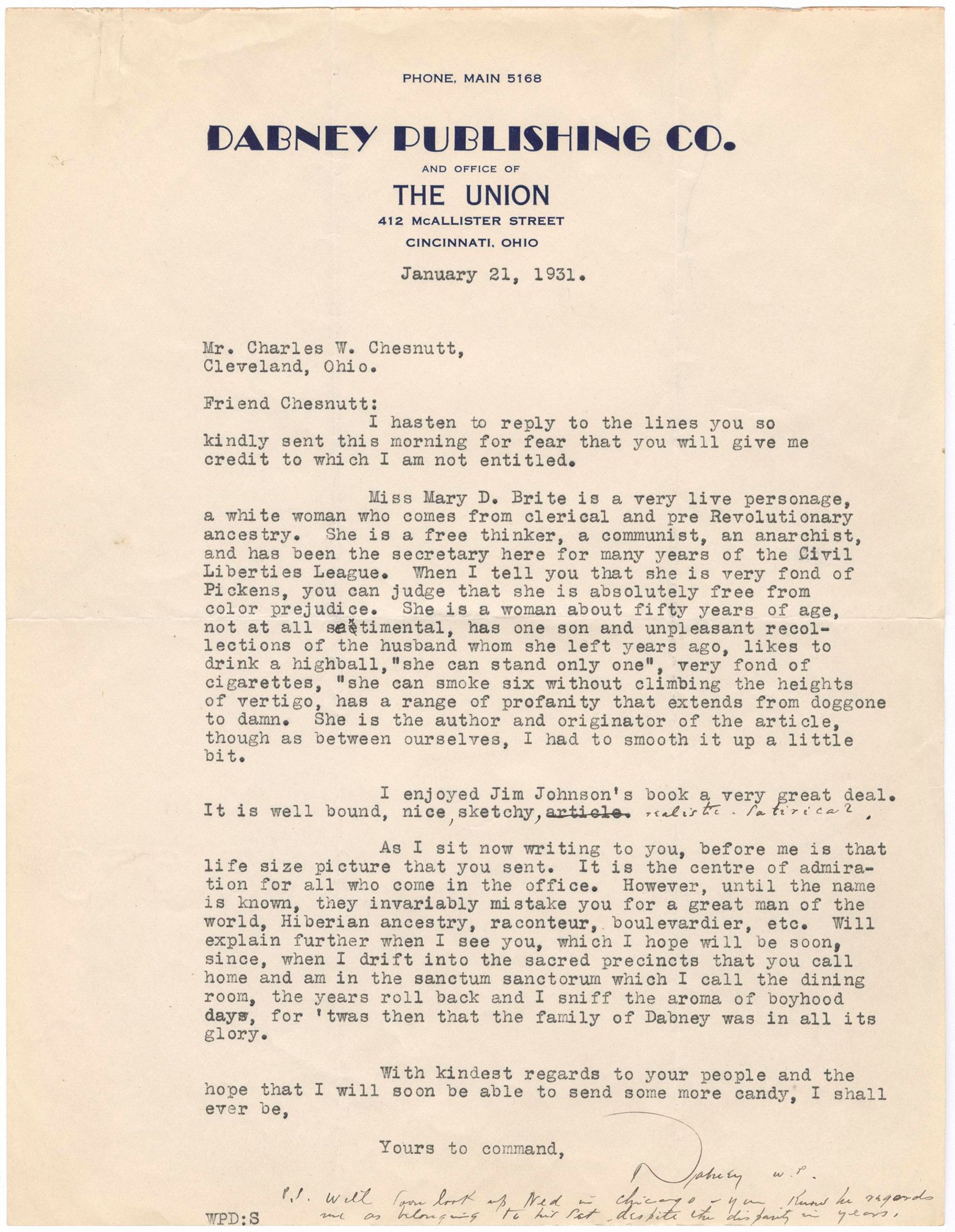 PHONE, MAIN 5168
DABNEY PUBLISHING CO. AND OFFICE OF THE UNION1
412 McALLISTER STREET
CINCINNATI, OHIO
January 21, 1931.
Mr. Charles W. Chesnutt,
Cleveland, Ohio.
Friend Chesnutt:
PHONE, MAIN 5168
DABNEY PUBLISHING CO. AND OFFICE OF THE UNION1
412 McALLISTER STREET
CINCINNATI, OHIO
January 21, 1931.
Mr. Charles W. Chesnutt,
Cleveland, Ohio.
Friend Chesnutt:
I hasten to reply to the lines you so kindly sent this morning for fear that you will give me credit to which I am not entitled.
Miss Mary D. Brite is a very live personage,2 a white woman who comes from clerical and pre Revolutionary ancestry. She is a free thinker, a communist, an anarchist, and has been the secretary here for many years of the Civil Liberties League. When I tell you that she is very fond of Pickens, you can judge that she is absolutely free from color prejudice.3 She is a woman about fifty years of age, not at all sneentimental, has one son and unpleasant recollections of the husband whom she left years ago, likes to drink a highball, "she can stand only one", very fond of cigarettes, "she can smoke six without climbing the heights of vertigo, has a range of profanity that extends from doggone to damn. She is the author and originator of the article, though as between ourselves, I had to smooth it up a little bit.4
I enjoyed Jim Johnson's5 book a very great deal. It is well bound, nice, sketchy, article.realistic, satirical.6
As I sit now writing to you, before me is that life size picture that you sent.7 It is the centre of admiration for all who come in the office. However, until the name is known, they invariably mistake you for a great man of the world, Hiberian ancestry, raconteur, boulevardier, etc. Will explain further when I see you, which I hope will be soon, since, when I drift into the sacred precincts that you call home and am in the sanctum sanctorum which I call the dining room, the years roll back and I sniff the aroma of boyhood days, for 'twas then that the family of Dabney was in all its glory.
With kindest regards to your people and the hope that I will soon be able to send some more candy, I shall ever be,
Yours to command, Dabney W. P. WPD:SP.S. Will soon look up Ned in Chicago—you know he regards me as belonging to his set, despite the disparity in years.8
Correspondent: Wendell Phillips Dabney (1865–1952) was a Black activist, musician, and journalist. Originally from Richmond, Virginia, he moved to Ohio in 1883 to study at Oberlin College and then moved to Cincinnati in 1894. He worked for the city of Cincinnati from 1895 until 1923 and was the founder, editor, and publisher of the Black weekly newspaper The Union (1907–1952).
1. The Union was a Cincinnati-based Black weekly newspaper founded in 1907 by Wendell Phillips Dabney (1865–1952), who edited it until his death. Initially affiliated with the Republican Party, it identified as Independent after 1925. [back]
2. Mary Davis Brite (1869–1952) was a White writer based in Cincinnati, Ohio. She was active as a suffragist and pacifist in the early 1900s, served as first secretary of the Cincinnati chapter of the American Civil Liberties Union (1922–1939), and contributed columns to the Nation, the Crisis, and other mostly left-leaning periodicals. [back]
3. William Pickens (1881–1954) was a Black journalist, orator, and college instructor and administrator who grew up in South Carolina and Arkansas. He was an outspoken civil-rights activist and a leader in the NAACP, serving as the Director of Branches (1920–1940). [back]
4. The referenced article is likely an article in the Cincinnatti Union titled "Dabney Enters Heaven: A 'Brite' Dream," published January 1, 1931. [back]
5. James Weldon Johnson (1871–1938) was a Black author and political activist. He was Executive Secretary of the NAACP (1920–1930). On December 17, 1930, he resigned as Secretary of the NAACP to accept the Adam K. Spence Chair of Creative Literature and Writing at Fisk University. [back]
6. Most likely Johnson's recently published nonfiction book, Black Manhattan (New York: Alfred A. Knopf, 1930). [back]
7. A large portrait photograph from 1930, a version of which accompanied Chesnutt's essay "The Negro in Cleveland", was displayed in Dabney's newspaper office. [back]
8. Edwin Jackson Chesnutt (1883—1939) was the third child of Charles and Susan Chesnutt. Born in North Carolina, he spent his childhood in Cleveland, Ohio, graduated from Harvard University in 1905, and decided not to remain abroad after an extended stay in France in 1906. Instead, he trained and worked as a stenographer, including at the Tuskegee Institute from 1910–1912. After obtaining a degree in dentistry at Northwestern University in 1917, he became a dentist in Chicago. [back]