Edgar J. Banks to Charles W. Chesnutt, 4 December 1922
Key
| Textual Feature | Appearance |
|---|---|
| alterations to base text (additions or deletions) | added or deleted text |
| passage deleted with a strikethrough mark | |
| passage deleted by overwritten added text | Deleted text Added text |
| position of added text (if not added inline) | [right margin] text added in right margin; [above line] text added above the line |
| proofreading mark | ‸ |
| page number, repeated letterhead, etc. | page number or repeated letterhead |
| supplied text | [supplied text] |
| archivist note | archivist note |
 EDGAR J. BANKS
EUSTIS, FLORIDA
December 4 1922
Mr. Chas. W. Chesnutt
9719 Lamont Ave N E
Cleveland, Ohio.
Dear Sir,
EDGAR J. BANKS
EUSTIS, FLORIDA
December 4 1922
Mr. Chas. W. Chesnutt
9719 Lamont Ave N E
Cleveland, Ohio.
Dear Sir,
While excavating in Babylonia for the University of Chicago, I obtained for my private collection a number of ancient inscribed Babylonian tablets which illustrate the oldest of writings. I now desire to dispose of them. They are mostly temple records and business documents dating from about 4000 years ago, and are the equal of those treasured in the great European museums.1
May I send you by parcel post a few of the tablets for your examination, with the understanding that any you do not care to keep may be returned within two weeks? The prices are from two to ten dollars each, a fraction of what an antiquity dealer would charge. Each tablet is accompanied with a description stating where it was found, its age and contents, and my guarantee that it is genuine.
Should you doubt the possibility of this offer, I would refer you to my sketch in Who's Who in America, or to the article BISMYA in the Encyclopedia Britanica.2
Sincerely yours, Edgar J. Banks EJB/M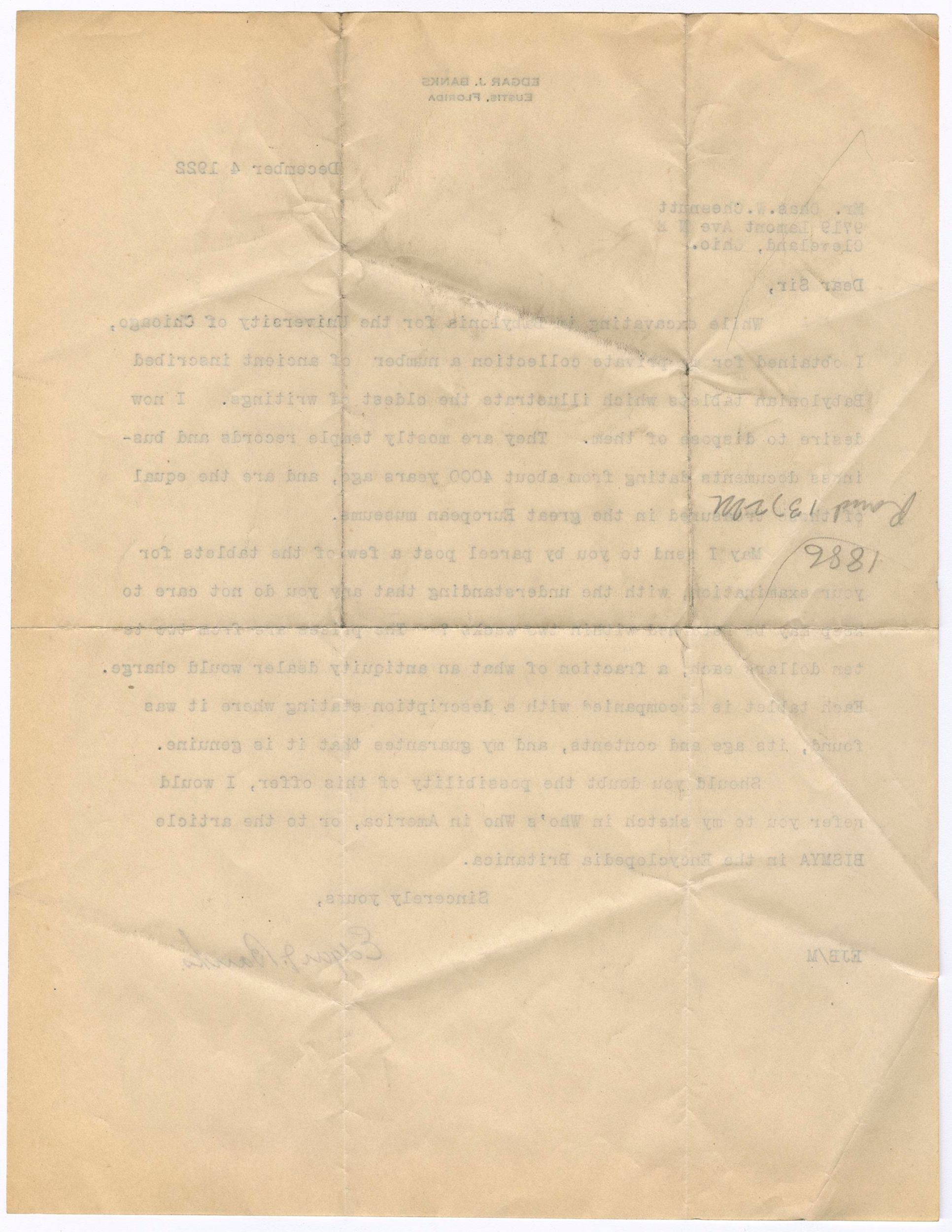
1886
Rand 1372W3
Correspondent: Edgar James Banks (1866–1945) was a White American archaeologist who briefly served as U.S. Consul to the Ottoman Empire (1897–1898) and specialized in ancient Assyria. His only major excavation (1903–1905) at Bismya, Iraq (then part of the Ottoman Empire), ended in scandal when he tried to go beyond his permit in sending antiquities to the U.S. But he returned with thousands of cuneiform tablets, gave lectures and published books on archaeology for the general public, becoming wealthy selling the Assyrian tablets to private individuals as well as libraries and museums. He split his time between Alpine, New Jersey, and Eustis, Florida.
1. Banks mass-mailed offers to sell the Assyrian cuneiform tablets from his collection (many of which were likely exported in violation of the Ottoman Empire's Antiquities Law) to private collectors, libraries, and museums, and succeeded in selling many. Chesnutt's membership in the Rowfant Club (noted in his Who's Who in America entry) and his interest in book collecting likely brought his name to Banks's attention. There is no indication that Chesnutt replied or purchased any tablets. [back]
2. See Encyclopaedia Britannica, 11th ed. Vol. 4 (New York: Encyclopaedia Britannica Co., 1910–1911), 11; Who's Who In America, Vol. 13: 1924–1925, edited by Albert Nelson Marquis (Chicago: A. N. Marquis & Co., 1924), 303–304. [back]
3. The significance of Chesnutt's note is not known, but "Rand 1372W" is the phone number of an unnamed "accountant-auditor" with eighteen years experience who advertised his services to small businesses like Chesnutt's in the classified ads of the Cleveland Plain Dealer multiple times between 1921 and 1923. [back]