Charles W. Chesnutt to Harold M. Kingsley, 3 October 1922
Key
| Textual Feature | Appearance |
|---|---|
| alterations to base text (additions or deletions) | added or deleted text |
| passage deleted with a strikethrough mark | |
| passage deleted by overwritten added text | Deleted text Added text |
| position of added text (if not added inline) | [right margin] text added in right margin; [above line] text added above the line |
| proofreading mark | ‸ |
| page number, repeated letterhead, etc. | page number or repeated letterhead |
| supplied text | [supplied text] |
| archivist note | archivist note |
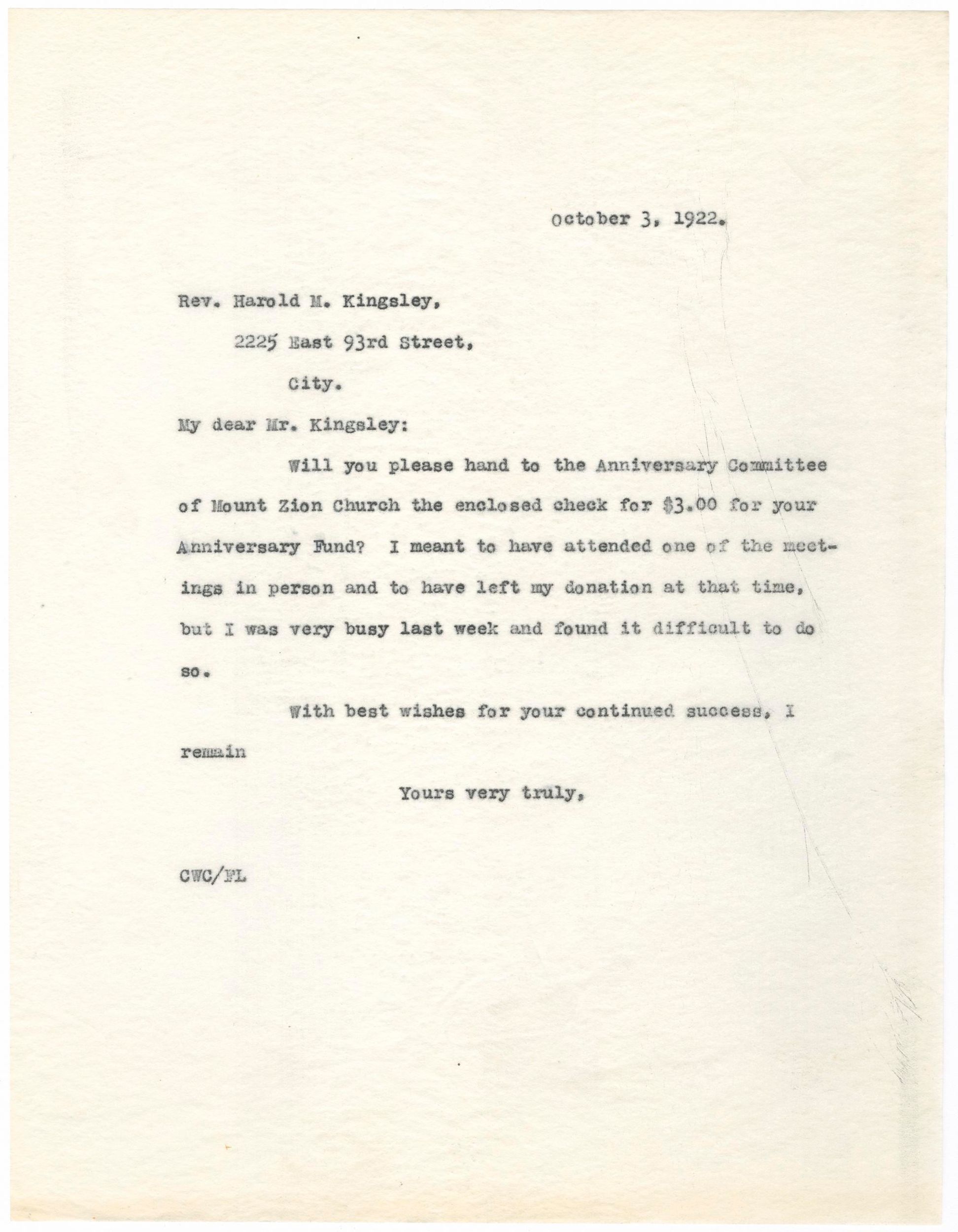 October 3, 1922.
Rev. Harold M. Kingsley,
2225 East 93rd Street,
City.
My dear Mr. Kingsley:
October 3, 1922.
Rev. Harold M. Kingsley,
2225 East 93rd Street,
City.
My dear Mr. Kingsley:
Will you please hand to the Anniversary Committee of Mount Zion Church1 the enclosed check for $3.00 for your Anniversary Fund? I meant to have attended one of the meetings in person and to have left my donation at that time, but I was very busy last week and found it difficult to do so.
With best wishes for your continued success, I remain
Yours very truly, CWC/FLCorrespondent: Harold M. Kingsley (1887–1970) was a Black minister and political activist. Originally from Alabama and with Episcopal roots, he became a Congregational minister in the early 1910s, and headed Mt. Zion Congregational Church in Cleveland from 1921 to 1923, before serving in Chicago at the Church of the Good Shepherd and at the Pilgrim House in Los Angeles, working for interracial harmony. His successor at Mt. Zion was Russell S. Brown (1889–1981), who served there from 1925 to 1933.
1. Mt. Zion Congregational Church was one of the first Black churches founded in Cleveland (1864–present). In its early years, it competerd with another church for the Black elites, St. Andrew's Episcopal (a co-founder of which was Chesnutt's relative John Patterson Green, 1845–1940), but was considered the more inclusive of the two. By the early 20th century, new Black churches (Baptist and African Methodist Episcopal) appealed more directly to a rapidly growing lower middle-class and working-class Black community. Attendance at Mt. Zion fluctuated greatly in the 1910s and 1920s, but the church provided a range of social services for the Black community. Chesnutt was not a member (his family attended services at an integrated church, Emmanuel Episcopal Church, beginning in the 1880s) but in the 1920s donated at least twice to their anniversary fundraiser. [back]