Glenn Frank to Charles W. Chesnutt, 17 June 1922
Key
| Textual Feature | Appearance |
|---|---|
| alterations to base text (additions or deletions) | added or deleted text |
| passage deleted with a strikethrough mark | |
| passage deleted by overwritten added text | Deleted text Added text |
| position of added text (if not added inline) | [right margin] text added in right margin; [above line] text added above the line |
| proofreading mark | ‸ |
| page number, repeated letterhead, etc. | page number or repeated letterhead |
| supplied text | [supplied text] |
| archivist note | archivist note |
[illustration]
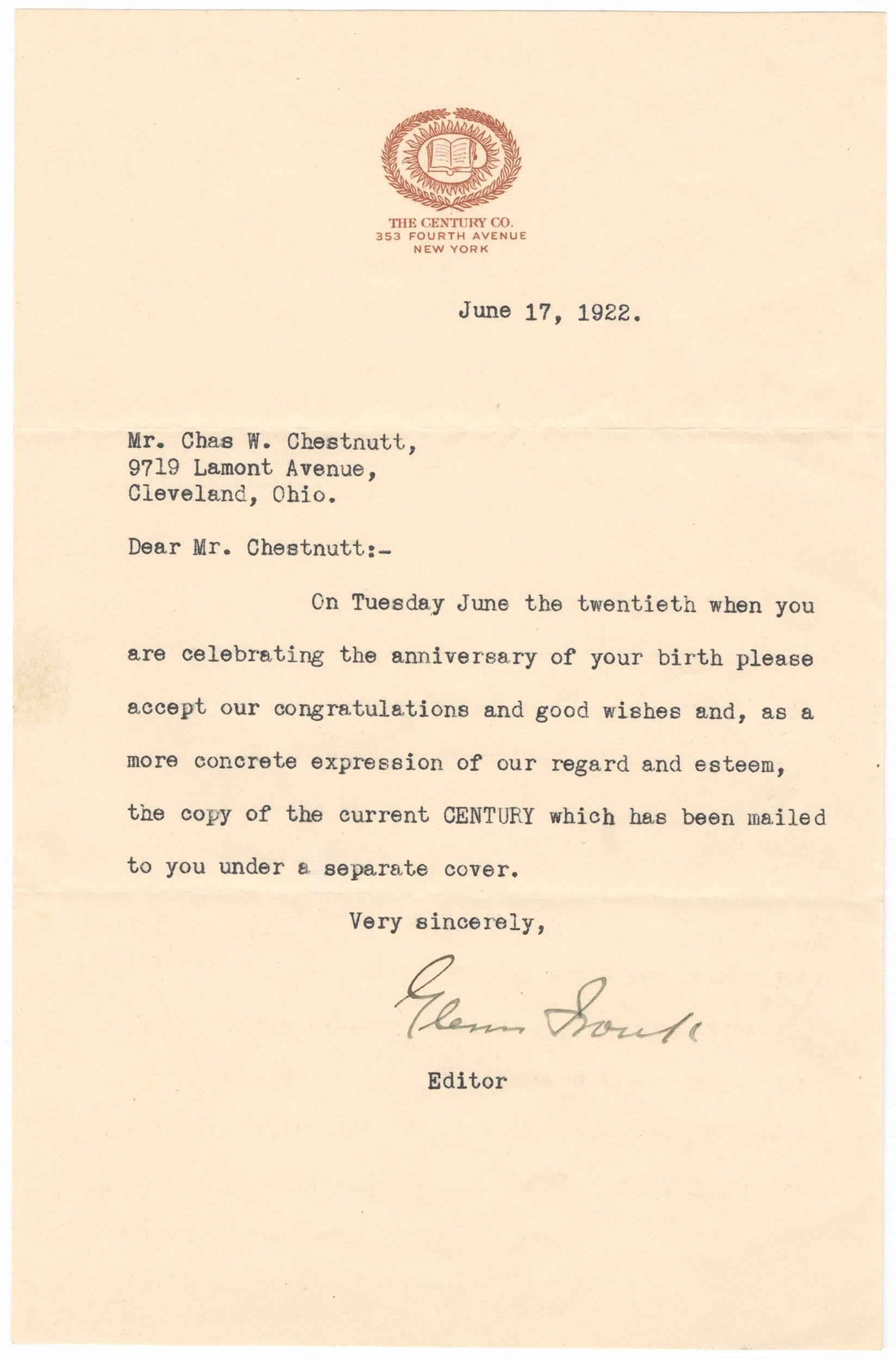
On Tuesday June the twentieth when you are celebrating the anniversary of your birth please accept our congratulations and good wishes and, as a more concrete expression of our regard and esteem, the copy of the current CENTURY which has been mailed to you under a separate cover.2
Very sincerely, Glenn Frank EditorCorrespondent: Glenn Frank (1887–1940) was a White orator, writer and editor from Queen City, Missouri who was associate editor (1919–1921) and then editor-in-chief (1921-1925) at Century Magazine before serving as president of the University of Wisconsin-Madison (1925–1937). While at the Century, he spoke out against the KKK and white supremacy.
1. The illustrated monthly Century Magazine was edited from 1881 to 1909 by Richard Watson Gilder (1844–1909). Chesnutt corresponded with Gilder and then-assistant editor Robert Underwood Johnson (1853–1937; editor 1909–1913). The magazine published articles and stories by Black writers and their White allies (including Chesnutt's story "The March of Progess" and work by his correspondents George W. Cable, Booker T. Washington, and W. E . B. Du Bois), but also by writers criticized by Chesnutt for their racism, like Thomas Nelson Page and Harry S. Edwards. After some turbulent years at the magazine, Glenn Frank (1887–1940) became first associate editor and then editor-in-chief (1919–1925). [back]
2. Chesnutt's birthday was June 20, 1858. Several other birthdays and anniversaries in the family also fell in June (see Helen Chesnutt, Charles Waddell Chesnutt: Pioneer of the Color Line [Chapel Hill: University of North Carolina Press, 1952], 263, 302), followed by summer vacations in July and August; as a result, Chesnutt's replies to summer mail were often delayed. [back]