Charles W. Chesnutt to John J. Wolf, 15 May 1922
Key
| Textual Feature | Appearance |
|---|---|
| alterations to base text (additions or deletions) | added or deleted text |
| passage deleted with a strikethrough mark | |
| passage deleted by overwritten added text | Deleted text Added text |
| position of added text (if not added inline) | [right margin] text added in right margin; [above line] text added above the line |
| proofreading mark | ‸ |
| page number, repeated letterhead, etc. | page number or repeated letterhead |
| supplied text | [supplied text] |
| archivist note | archivist note |
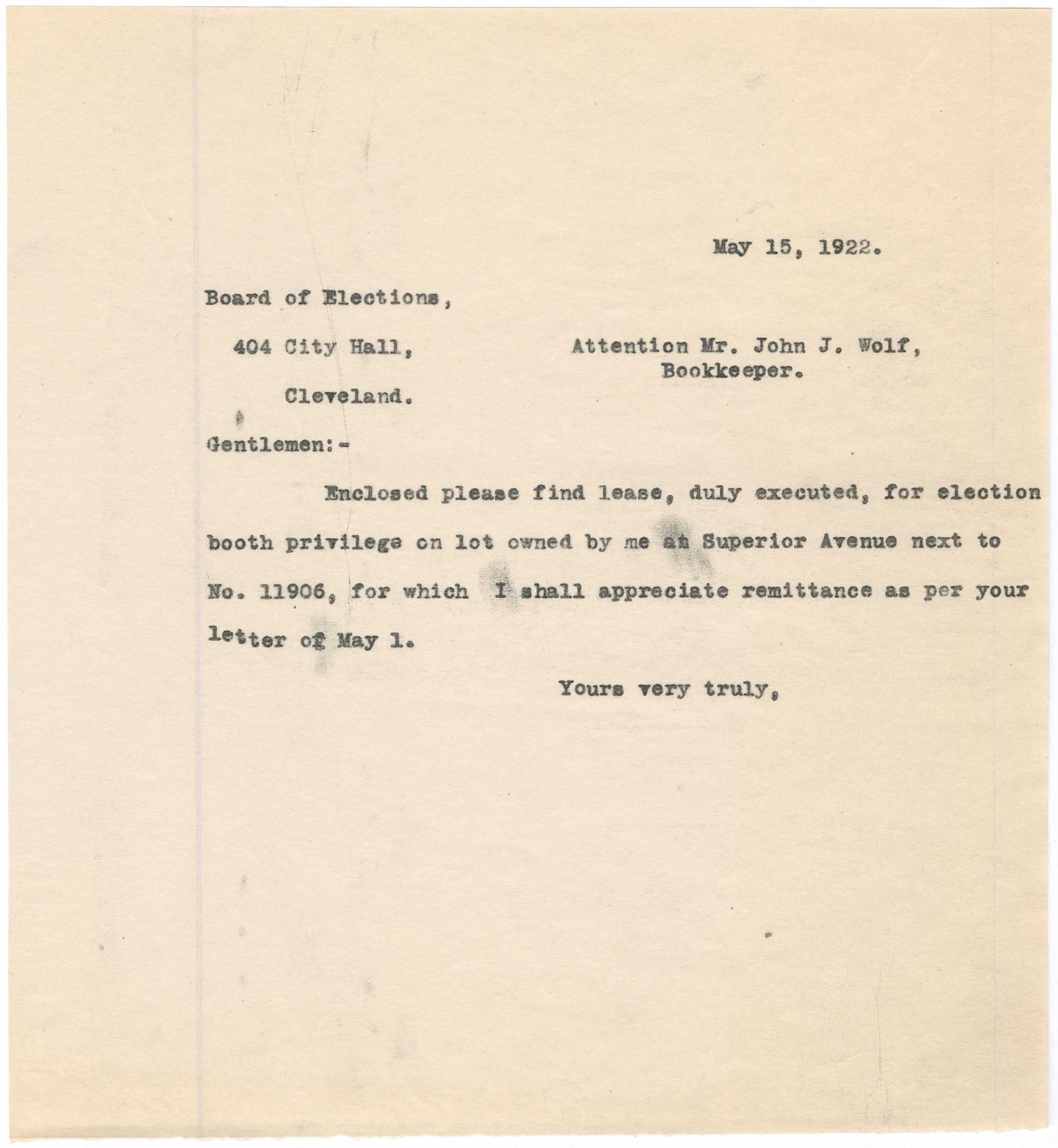 May 15, 1922.
Board of Elections,1
404 City Hall,
Cleveland.
Attention Mr. John J. Wolf,
Bookkeeper.
Gentlemen:-
May 15, 1922.
Board of Elections,1
404 City Hall,
Cleveland.
Attention Mr. John J. Wolf,
Bookkeeper.
Gentlemen:-
Enclosed please find lease, duly executed, for election booth privilege on lot owned by me ant Superior Avenue next to No. 11906, for which I shall appreciate remittance as per your letter ogf May 1.2
Correspondent: John J. Wolf (1877–1960) served as clerk and accountant for the Board of Elections for Cuyahoga County from 1911 to 1946.
1. The Board of Deputy State Supervisors and Inspectors of Elections was a state office in Cleveland responsible for oversight of Cuyahoga County elections. In existence since 1886 (after Ohio's voter registration law took effect in 1885), it was always made up of two Republicans and two Democrats who then chose their staff. [back]
2. Chesnutt owned an empty lot at 11900 and 11902 Superior Ave. in Cleveland, Ohio, by the early 1920s; the Union Trust Co. held the mortgage. By 1926 it had a single building with two storefronts, occupied by a series of small businesses; the structure no longer exists. Chesnutt also owned another rental property at 1267–1269 Lakeview Road, less than four hundred feet away. Superior Avenue is the main artery connecting the east and west sides of Cleveland's downtown; east of the city center it leads through a number of residential neighborhoods with storefronts along Superior. The area around 105th Street, as Chesnutt noted, housed "quite a few" of the seventy-five thousand African Americans that lived in the city by 1930 (see Chesnutt's essay "The Negro in Cleveland"). Chesnutt's properties were about a mile (1.5 kilometers or fifteen blocks) east of 105th Street. [back]