Chandler Owen to Charles W. Chesnutt, 10 May 1922
Key
| Textual Feature | Appearance |
|---|---|
| alterations to base text (additions or deletions) | added or deleted text |
| passage deleted with a strikethrough mark | |
| passage deleted by overwritten added text | Deleted text Added text |
| position of added text (if not added inline) | [right margin] text added in right margin; [above line] text added above the line |
| proofreading mark | ‸ |
| page number, repeated letterhead, etc. | page number or repeated letterhead |
| supplied text | [supplied text] |
| archivist note | archivist note |
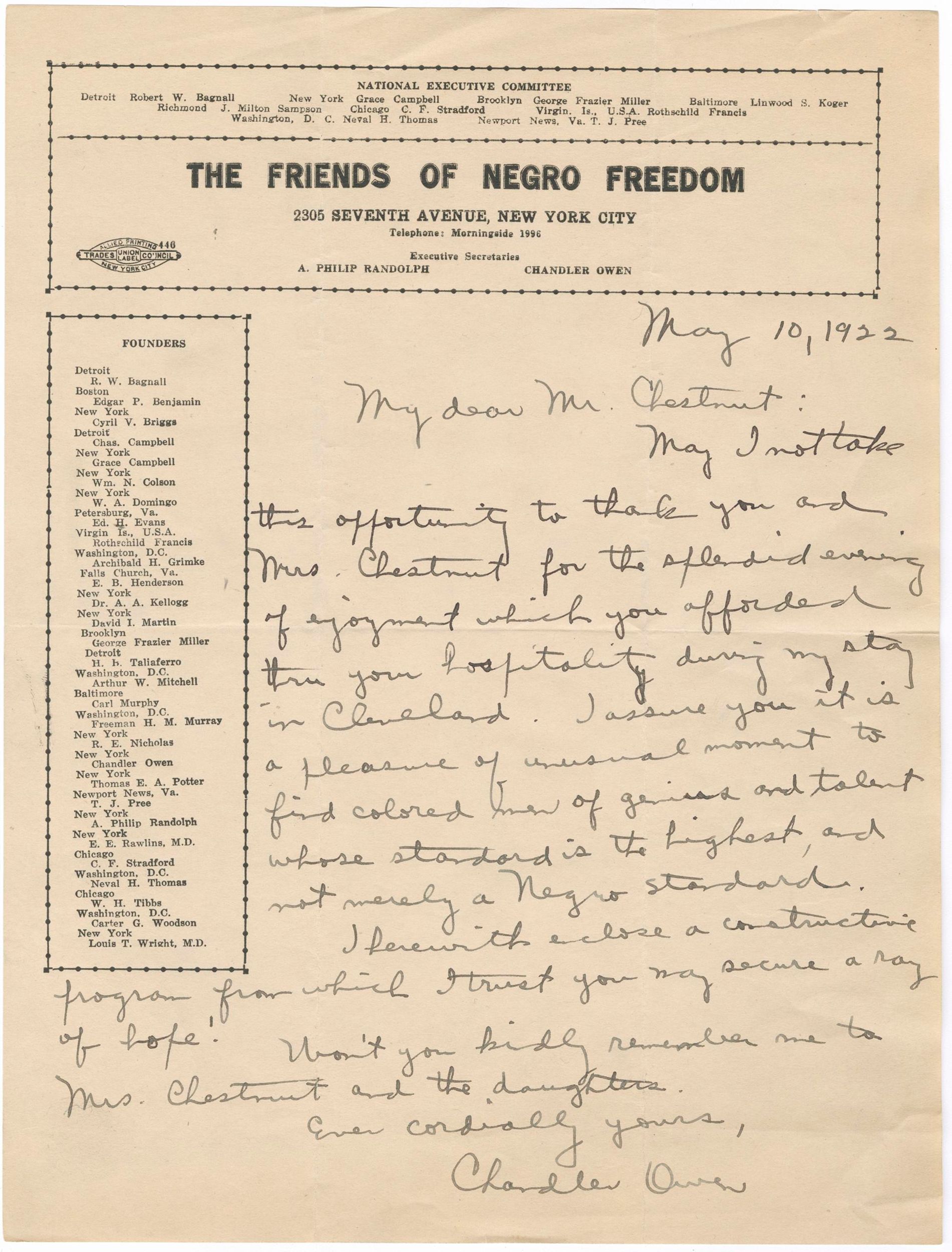 THE FRIENDS OF NEGRO FREEDOM1
2305 SEVENTH AVENUE, NEW YORK CITY
Telephone: Morningside 1996
Executive Secretaries
A. PHILIP RANDOLPH
CHANDLER OWEN2
May 10, 1922
My dear Mr. Chestnut:
THE FRIENDS OF NEGRO FREEDOM1
2305 SEVENTH AVENUE, NEW YORK CITY
Telephone: Morningside 1996
Executive Secretaries
A. PHILIP RANDOLPH
CHANDLER OWEN2
May 10, 1922
My dear Mr. Chestnut:
May I not take this opportunity to thank you and Mrs. Chestnut for the splendid evening of enjoyment which you afforded thru your hospitality during my stay in Cleveland.3 I assure you it is a pleasure of unusual moment to find colored men of genius and talent whose standard is the highest, and not merely a Negro standard.
I herewith enclose a constructive program from which I trust you may secure a ray of hope!4
Won't you kindly remember me to Mrs. Chestnut5 and the daughters.6
Ever cordially yours, Chandler OwenCorrespondent: Chandler Owen (1889–1967) was a Black writer from North Carolina who moved to New York City in 1913. With fellow Black Socialist A. Philip Randolph (1889–1979), he co-edited the Black monthly The Messenger (1917–1928) and co-founded The Friends of Negro Freedom. In 1923, Owen moved to Chicago and, as a Republican, ran unsuccessfully for a seat in the U.S. House of Representatives.
1. The Friends of Negro Freedom was a Black-run and Black-financed Socialist organization founded in 1920 by Chandler Owen, A. Philip Randolph, and others, partly as an alternative to the NAACP with its many White leaders and members. It existed until the late 1920s and was extensively surveilled by the U.S. government. [back]
2. For readability, the remainder of the letterhead is not transcribed in the body of the letter but is included in this footnote as unformatted text. The letterhead can be seen in its entirety in the accompanying image of the letter. The text of the remainder of the letterhead is as follows: NATIONAL EXECUTIVE COMMITTEE Detroit Robert W. Bagnall New York Grace Campbell Brooklyn George Frazier Miller Baltimore Linwood S. Koger Richmond J. Milton Sampson Chicago C. F. Stradford Virgin. Is., U.S.A. Rothschild Francis Washington, D. C. Neval H.Thomas Newport News, Va. T. J. Pree FOUNDERS Detroit R. W. Bagnall Boston Edgar P. Benjamin New York Cyril V. Briggs Detroit Chas. Campbell New York Grace Campbell New York Wm. N. Colson New York W. A. Domingo Petersburg, Va. Ed. H. Evans Virgin. Is., U.S.A. Rothschild Francis Washington, D.C. Archibald H. Grimke Falls Church, Va. E. B. Henderson New York Dr. A. A. Kellogg New York David I. Martin Brooklyn George Frazier Miller Detroit H. B. Taliaferro Washington, D.C. Arthur W. Mitchell Baltimore Carl Murphy Washington, D.C. Freeman H. M. Murray New York R. E. Nicholas New York Chandler Owen New York Thomas E. A. Potter Newport News, Va. T. J. Pree New York A. Philip Randolph New York E. E. Rawlins, M.D. Chicago C. F. Stratford Washington, D.C. Neval H. Thomas Chicago W. H. Tibbs Washington, D.C. Carter G. Woodson New York Louis T. Wright, M.D." The seal reads: Union Label Trades Council Allied Printing New York City 446 [back]
3. Owen had attended the tenth annual convention of the Socialist Party of the United States, held at Cleveland's Finnish Labor Hall, April 29–May 1, 1922. The party reconfirmed its commitment to allowing Black workers in its union and to independence for Haiti, both issues in which Chesnutt took much interest. In his address to the convention, Owen recounted his recent speaking tour of the western U.S. (see "Socialists Close Sessions Urging Militant Stand," [Cleveland] Plain Dealer, May 3, 1922, 3). [back]
4. The enclosure has not been preserved, but it was likely the issue of The Messenger featuring Chandler Owen's essay "From Coast to Coast," about The Friends of Negro Freedom, along with a list of the organization's most prominent founders, in The Messenger 4, no.5 (May 1922): 407–411. [back]
5. Susan Perry Chesnutt (1861–1940) was from a well-established Black family in Fayetteville, North Carolina, and worked as a teacher at Fayetteville's Howard School before marrying Chesnutt. They were married from 1878 until his death in 1932 and had four children: Ethel, Helen, Edwin, and Dorothy. Susan led an active life in Cleveland. [back]
6. In 1922, two of Chesnutt's daughters, Helen and Dorothy, were living with their parents while pursuing their careers. After finishing college in 1904, Helen had returned to Cleveland to work as a secondary-school teacher, and she continued to live at the house until her mother's death in 1940. Dorothy lived with her parents as a student, probation officer, and eventually junior-high teacher, until her husband completed his medical degree in 1931. [back]