Benjamin Brawley to Charles W. Chesnutt, 27 March 1922
Key
| Textual Feature | Appearance |
|---|---|
| alterations to base text (additions or deletions) | added or deleted text |
| passage deleted with a strikethrough mark | |
| passage deleted by overwritten added text | Deleted text Added text |
| position of added text (if not added inline) | [right margin] text added in right margin; [above line] text added above the line |
| proofreading mark | ‸ |
| page number, repeated letterhead, etc. | page number or repeated letterhead |
| supplied text | [supplied text] |
| archivist note | archivist note |
 [1]
MESSIAH BAPTIST CHURCH
BROCKTON, MASS.
PASTOR
BENJAMIN BRAWLEY
390 QUINCY STREET1
March 27, 1922.
Mr. Charles W. Chesnutt,
1106 Williamson Building,
Cleveland, Ohio.
Dear Mr. Chesnutt:--
[1]
MESSIAH BAPTIST CHURCH
BROCKTON, MASS.
PASTOR
BENJAMIN BRAWLEY
390 QUINCY STREET1
March 27, 1922.
Mr. Charles W. Chesnutt,
1106 Williamson Building,
Cleveland, Ohio.
Dear Mr. Chesnutt:--
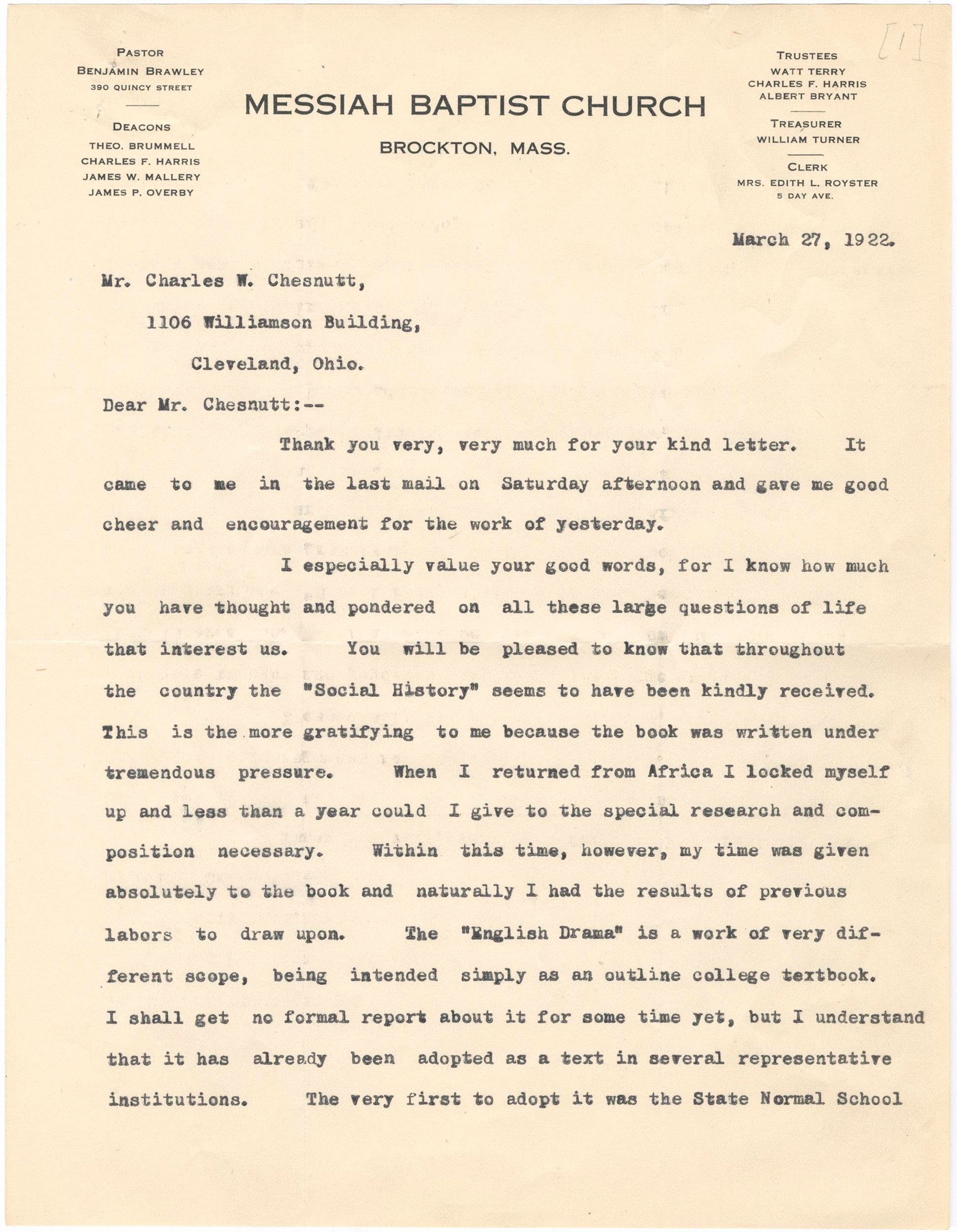
Thank you very, very much for your kind letter. It came to me in the last mail on Saturday afternoon and gave me good cheer and encouragement for the work of yesterday.
I especially value your good words, for I know how much you have thought and pondered on all these large questions of life that interest us. You will be pleased to know that throughout the country the "Social History"2 seems to have been kindly received. This is the more gratifying to me because the book was written under tremendous pressure. When I returned from Africa I locked myself up and less than a year could I give to the special research and composition necessary. Within this time, however, my time was given absolutely to the book and naturally I had the results of previous labors to draw upon. The "English Drama"3 is a work of very different scope, being intended simply as a outline college textbook. I shall get no formal report about it for some time yet, but I understand that it has already been adopted as a text in several representative institutions. The very first to adopt it was the State Normal School
 [2]
MESSIAH BAPTIST CHURCH
BROCKTON, MASS.
PASTOR
BENJAMIN BRAWLEY
390 QUINCY STREET
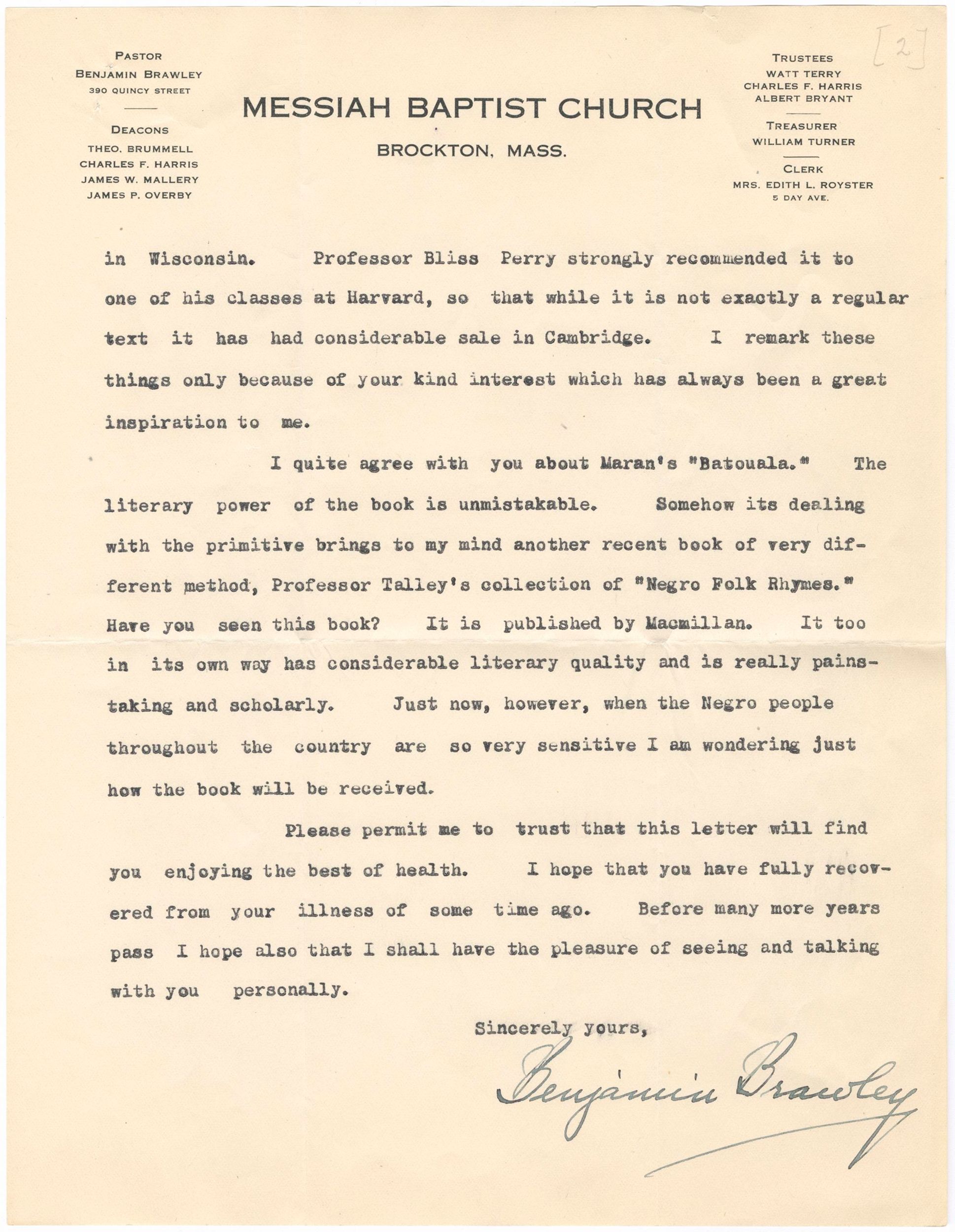
in Wisconsin.4 Professor Bliss Perry5 strongly recommended it to one of his classes at Harvard, so that while it is not exactly a regular text it has had considerable sale in Cambridge. I remark these things only because of your kind interest which has always been a great inspriation to me.
[2]
MESSIAH BAPTIST CHURCH
BROCKTON, MASS.
PASTOR
BENJAMIN BRAWLEY
390 QUINCY STREET
in Wisconsin.4 Professor Bliss Perry5 strongly recommended it to one of his classes at Harvard, so that while it is not exactly a regular text it has had considerable sale in Cambridge. I remark these things only because of your kind interest which has always been a great inspriation to me.
I quite agree with you about Maran's "Batouala."6 The literary power of the book is unmistakable. Somehow its dealing with the primitive brings to my mind another recent book of very different method, Professor Talley's collection of "Negro Folk Rhymes."7 Have you seen this book? It is published by Macmillan. It too in its own way has considerable literary quality and is really painstaking and scholarly. Just now, however, when the Negro people throughout the country are so very sensitive I am wondering just how the book will be received.
Please permit me to trust that this letter will find you enjoying the best of health. I hope that you have fully recovered from your illness of some time ago.8 Before many more years pass I hope also that I shall have the pleasure of seeing and talking with you personally.9
Sincerely yours, Benjamin BrawleyCorrespondent: Benjamin Griffith Brawley (1882–1939) was a Black writer, teacher, and clergyman from South Carolina, whose first college degree from Atlanta Baptist College (now Morehouse College) in 1901 was followed by degrees from the University of Chicago and Harvard. He taught at several historically Black colleges and universities, serving as dean at Morehouse College (1912–1920) and as chair of the English department at Howard University (1937–1939). He wrote poetry as well as many scholarly articles and books on Black history and literature, starting with A Short History of the American Negro (New York: Macmillan, 1913).
1. For readability, the remainder of the letterhead is not transcribed in the body of the letter but is included in this footnote as unformatted text. The letterhead can be seen in its entirety in the accompanying image of the letter. The text of the remainder of the letterhead is as follows: "DEACONS THEO. BRUMMELL CHARLES F. HARRIS JAMES W. MALLERY JAMES P. OVERBY TRUSTEES WATT TERRY CHARLES F. HARRIS ALBERT BRYANT TREASURER WILLIAM TURNER CLERK MRS. EDITH L. ROYSTER 5 DAY AVE." [back]
2. The full title of Brawley's study is A Social History of the American Negro. Being a History of the Negro Problem in the United States, Including a History and Study of the History of Liberia (New York: Macmillan, 1921). Its coverage begins in the 15th century and extends through the summer of 1919; one chapter is devoted to Liberia, where Brawley had recently spent several months. [back]
3. A Short History of the English Drama (Harcourt, Brace and Company, 1921) was intended as a textbook for English literature classes and covered drama from the medieval period through the late Victorian, with a brief coda on plays of the 1910s. [back]
4. The Wisconsin State Normal School in Milwaukee, Wisconsin, was founded in 1885 to train teachers, and in 1927 it was renamed Wisconsin State Teachers College-Milwaukee. It is now the University of Wisconsin-Milwaukee. [back]
5. Bliss Perry (1860–1954) was an influential White literary critic and professor who taught English literature at Princeton (1893–1900) and at Harvard (1907–1930). In between, he was the editor of the Atlantic Monthly (1899–1909), following Walter Hines Page, the editor that Chesnutt primarily interacted with at the Atlantic and at Houghton Mifflin Company, the magazine's publisher. [back]
6. René Maran (1887–1960) was a Black poet and novelist from Martinique (then a French colony), whose 1921 novel Batouala was translated by Adele Szold Seltzer for publication in the US (New York: Thomas Seltzer, 1922). [back]
7. Thomas Washington Talley, Negro Folk Rhymes, Wise and Otherwise (New York: Macmillan, 1922) consists of a collection of rhymes and a long essay, "A Study in Negro Folk Rhymes" (pp. 228–326). Talley (1868–1952) was a professor of chemistry at Fisk University (1903–1942); he began collecting and publishing secular Black folks songs and folk rhymes in the 1920s. [back]
8. Benjamin Brawley possibly refers to Chesnutt's greatly impaired health and mobility during his slow recovery from appendicitis and peritonitis in 1920. See Helen Chesnutt, Charles Waddell Chesnutt: Pioneer of the Color Line (Chapel Hill: University of North Carolina Press, 1952), 289. [back]
9. Although they corresponded occasionally, Benjamin Brawley and Chesnutt do not seem to have ever met in person, even as their work and their interests in Black history, literature, and education largely overlapped. [back]