Mary Dickerson Donahey to Charles W. Chesnutt, 10 January 1931
Key
| Textual Feature | Appearance |
|---|---|
| alterations to base text (additions or deletions) | added or deleted text |
| passage deleted with a strikethrough mark | |
| passage deleted by overwritten added text | Deleted text Added text |
| position of added text (if not added inline) | [right margin] text added in right margin; [above line] text added above the line |
| proofreading mark | ‸ |
| page number, repeated letterhead, etc. | page number or repeated letterhead |
| supplied text | [supplied text] |
| archivist note | archivist note |
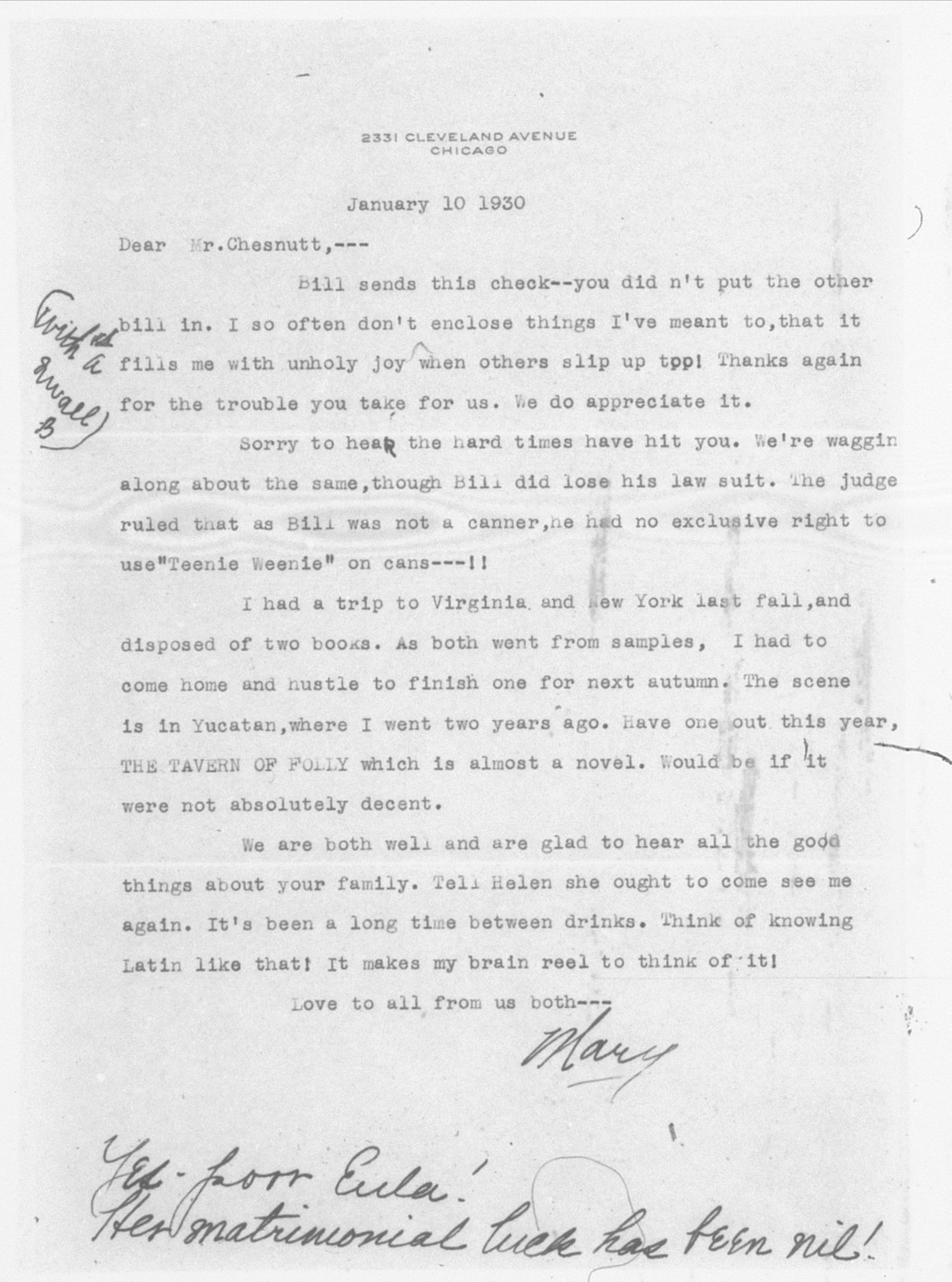 2331 CLEVELAND AVENUE
CHICAGO
January 10 19301
Dear Mr. Chesnutt,---
2331 CLEVELAND AVENUE
CHICAGO
January 10 19301
Dear Mr. Chesnutt,---
Bill2 sends this check--you did n't put the other (with a small B) bill in. I so often don't enclose things I've meant to, that it fills me with unholy joy when others slip up tppoo! Thanks again for the trouble you take for us. We do appreciate it.3
Sorry to heai[?]R the hard times have hit you. We're waggin along about the same, though Bill did lose his law suit. The judge ruled that as Bill was not a canner, he had no exclusive right to use "Teenie Weenie" on cans---!!4
I had a trip to Virginia and New York last fall, and disposed of two books. As both went from samples, I had to come home and hustle to finish one for next autumn. The scene is in Yucatan, where I went two years ago. Have one out this year, THE TAVERN OF FOLLY5 which is almost a novel. Would be if it were not absolutely decent.
We are both well and are glad to hear all the good things about your family. Tell Helen she ought to come see me again.6 It's been a long time between drinks. Think of knowing Latin like that! It makes my brain reel to think of it!
Love to all from us both--- MaryYes - poor Eula!7
Her matrimonial luck has been nil!
Correspondent: Mary Augusta Dickerson Donahey (1876–1962) was a White journalist and author of children's books. She was originally from New Jersey, grew up in New York City and worked for the Cleveland Plain Dealer from 1898 to 1905. She married the cartoonist William Donahey (1883–1970) in 1905 and moved with him to Chicago, where she wrote children's and young adult books, cookbooks and newspaper columns. The couple befriended the Chesnutts in the early 1900s, when they were part of the Tresart Club and the Chester Cliffs Club.
1. Mary Donahey mistakenly typed "1930" instead of "1931," but it is clear that she is responding to Chesnutt's letter from January 8, 1931. [back]
2. William (Bill) Donahey (1883–1970) was a White writer and cartoonist from Westchester, Ohio. After graduating from the Cleveland School of Art in 1903, he briefly worked for the Cleveland Plain Dealer, where he met and married Mary Dickerson Donahey (1876–1962) in 1905 and became friends with the Chesnutts. The couple joined the Chester Cliffs Club and built a cottage on the land. After 1905, the couple moved to Chicago, where he worked for the Chicago Tribune and produced a widely syndicated comic strip, the "Teenie Weenies," which ran intermittently from 1914 until his death and became the basis of an advertising campaign for a canned-goods company in the 1920s as well as for several books he co-wrote with his wife. [back]
3. The mentioned check would have covered the Donahey's share of the property and franchise tax for the land owned jointly by the Chester Cliffs Club near Cleveland; these payments were due every six months. Although neither the Donaheys nor the Chesnutts summered in Ohio after 1921, they kept their land. Chesnutt oversaw the financial matters in the late 1920s, so most correspondence with the Donaheys mentions financial transactions relating to the Club. [back]
4. From 1925 to 1928 Reid-Murdoch & Company, which produced canned goods, had used William Donahey's cartoon characters, the Teenie Weenies, on their products and in advertising. But in the fall of 1930, the company and Donahey lost a lawsuit they had brought against the Oconomowoc Canning Company in 1925 for their use of similar characters on their canned goods, since the Donahey's characters were not considered protected intellectual property in the trademark practices of the time. The Teenie Weenies were no longer used for merchandise after that, which meant the Donaheys lost a significant source of income. [back]
5. Mary Dickerson Donahey wrote young adult novels as well as children's books. The Spanish McQuades: The Lost Treasure of Zavala (Garden City, N.Y. : Doubleday, Doran, 1931), is an adventure novel about twins of Spanish-Irish descent set in the Yucatan. The Tavern of Folly (Garden City, N.Y., Doubleday, Doran, 1930) is a novel about a mysterious inheritance. The reference to the other two books "disposed of" in the fall of 1930 is unclear, but Mary Dickerson Donahey's Mysterious Mansions came out with the same publisher in 1932. [back]
6. Helen Maria Chesnutt (1880–1969) was Chesnutt's second child. She earned degrees from Smith College and Columbia University, taught Latin (including to Langston Hughes) at Cleveland's Central High School for more than four decades starting in 1904, co-authored a Latin textbook, The Road to Latin, in 1932, and served on the executive committee of the American Philological Association in 1920. She became her father's literary executor and first biographer. [back]
7. Eulalie (Eula) Gaskill Miller Counts (1869–1942) was a White woman who had family roots in Stark County, Ohio, where her father was a grain dealer. She attended Ohio Wesleyan University. Nothing is known about her first marriage, but a son from that marriage, Joseph Gaskill Miller, died young (1890–1908). Eula married A. Frank Counts (1881–1946) in 1913 and was active in a number of Women's clubs in Cleveland; the couple owned a cabin in the Chester Cliffs Club, near the Chesnutt family. Around 1930, the couple relocated to rural Virginia, possibly as a result of the scandal surrounding Frank's embezzlement and subsequent prison sentence; they owned a farm near Lightfoot, Virginia. [back]