Charles W. Chesnutt to William Donahey and Mary Dickerson Donahey, 23 May 1922
Key
| Textual Feature | Appearance |
|---|---|
| alterations to base text (additions or deletions) | added or deleted text |
| passage deleted with a strikethrough mark | |
| passage deleted by overwritten added text | Deleted text Added text |
| position of added text (if not added inline) | [right margin] text added in right margin; [above line] text added above the line |
| proofreading mark | ‸ |
| page number, repeated letterhead, etc. | page number or repeated letterhead |
| supplied text | [supplied text] |
| archivist note | archivist note |
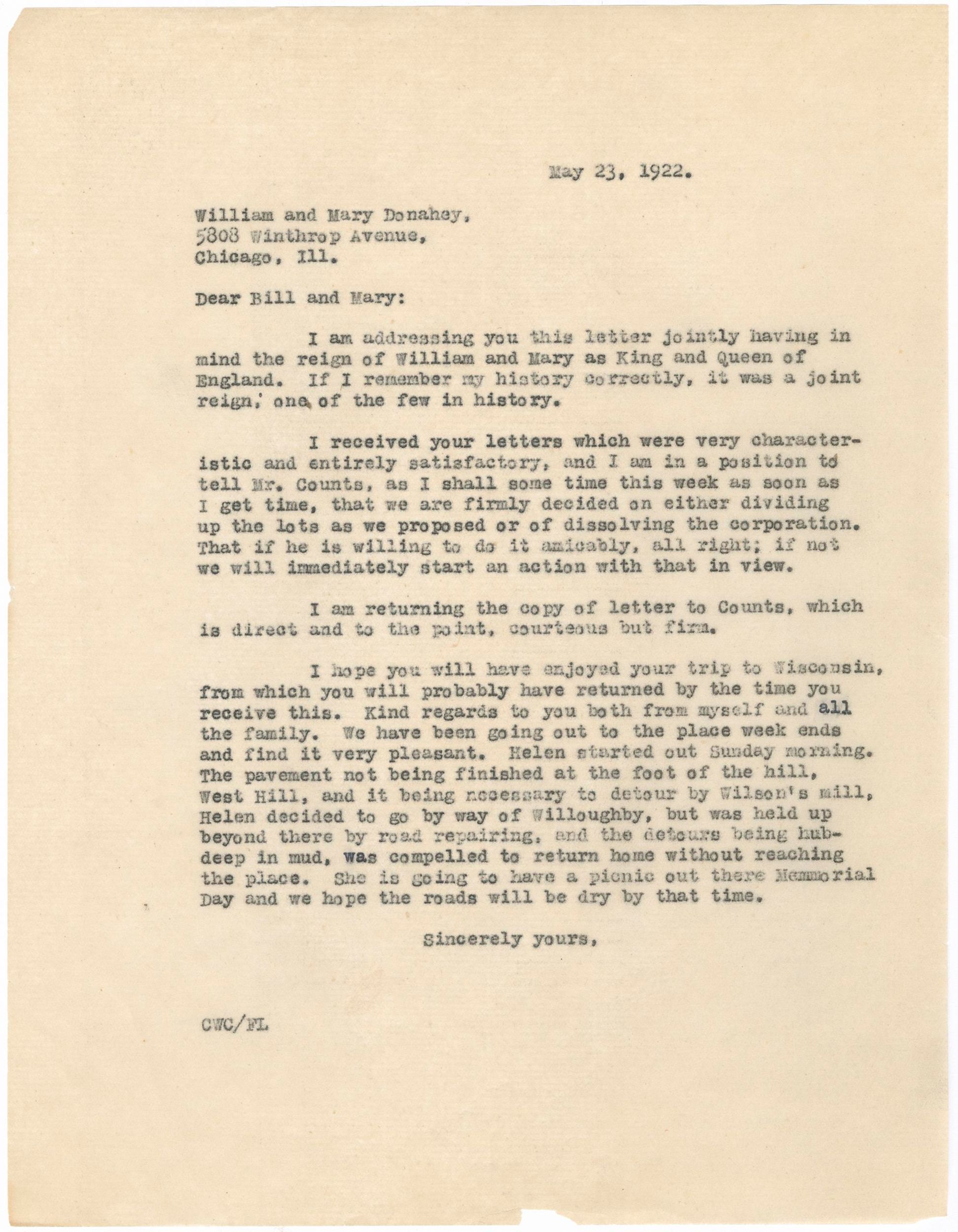 May 23, 1922.
William and Mary Donahey,
5808 Winthrop Avenue,
Chicago, Ill.
Dear Bill and Mary:
May 23, 1922.
William and Mary Donahey,
5808 Winthrop Avenue,
Chicago, Ill.
Dear Bill and Mary:
I am addressing you this letter jointly having in mind the reign of William and Mary as King and Queen of England. If I remember my history correctly, it was a joint reign; one of the few in history.
I received your letters which were very characteristic and entirely satisfactory, and I am in a position to tell Mr. Counts,1 as I shall some time this week as soon as I get time, that we are firmly decided on either dividing up the lots as we proposed or of dissolving the corporation.2 That if he is willing to do it amicably, all right; if not we will immediately start an action with that in view.3
I am returning the copy of letter to Counts, which is direct and to the point, courteous but firm.4
I hope you will have enjoyed your trip to Wisconsin, from which you will probably have returned by the time you receive this. Kind regards to you both from myself and all the family. We have been going out to the place week ends and find it very pleasant.5 Helen started out Sunday morning.6 The pavement not being finished at the foot of the hill, West Hill, and it being necessary to detour by Wilson's mill, Helen decided to go by way of Willoughby,7 but was held up beyond there by road repairing, and the detours being hub–deep in mud, was compelled to return home without reaching the place. She is going to have a picnic out there Memmorial Day and we hope the roads will be dry by that time.
Sincerely yours, CWC/FLCorrespondent: William (Bill) Donahey (1883–1970) was a White writer and cartoonist from Westchester, Ohio. After graduating from the Cleveland School of Art in 1903, he briefly worked for the Cleveland Plain Dealer, where he met and married Mary Dickerson Donahey (1876–1962) in 1905 and became friends with the Chesnutts. The couple joined the Chester Cliffs Club and built a cottage on the land. After 1905, the couple moved to Chicago, where he worked for the Chicago Tribune and produced a widely syndicated comic strip, the "Teenie Weenies," which ran intermittently from 1914 until his death and became the basis of an advertising campaign for a canned-goods company in the 1920s as well as for several books he co-wrote with his wife. Mary Augusta Dickerson Donahey (1876–1962) was a White journalist and author of children's books. She was originally from New Jersey, grew up in New York City and worked for the Cleveland Plain Dealer from 1898 to 1905. She married the cartoonist William Donahey (1883–1970) in 1905 and moved with him to Chicago, where she wrote children's and young adult books, cookbooks and newspaper columns. The couple befriended the Chesnutts in the early 1900s, when they were part of the Tresart Club and the Chester Cliffs Club.
1. Albert Franklin (Frank) Counts (1881–1946), a White Cleveland lawyer with a 1906 law degree from Western Reserve University's law school, was a member and initially the secretary and treasurer of the Chester Cliffs Club when it was founded. In 1913, he married Eulalie (Eula) Gaskill Miller Counts (1869–1942), who was also a shareholder in the Club. In 1930 Counts was given an eighteen-month prison sentence for embezzlement in a fraudulent divorce case. Paroled in December of 1931, he joined his wife in rural Virginia, where they lived on a farm that was auctioned off after his death. [back]
2. The suggestion to dissolve the Chester Cliffs Club as a corporation was first made by Mary Dickerson Donahey prior to the fall 1921 stockholder meeting (see her letter of September 2, 1921), after Frank and Eula Counts had sold one of their cottages to Ellen Delahunte, who was not part of the Company. Chesnutt used his knowledge of corporate and real estate law to argue against the dissolution, although the Chesnutts and Donaheys discussed it as an option throughout 1922; the corporation was never formally dissolved. [back]
3. The Chester Cliffs Club or Company was a small stockholding corporation founded in September 1903 by Chesnutt and ten friends who were "stockholders," in order to purchase eleven acres of land in Chester Township near Chesterland, Ohio, and Scotland, Ohio, twenty miles from Cleveland. Summer cottages were built by three of the parties in order to spend their summers away from the city, and in 1916 the Chesnutts purchased one of these. Stockholder meetings were called every fall, even as eventually only three families seem to have remained: the Chesnutts, the Donaheys (who were living in Chicago after 1905), and the Counts. In 1921, Frank Counts (1881–1946), a Cleveland lawyer who was the longtime secretary and treasurer of the Club and his wife Eulalie (Eula) (1869–1942) sold a lot with a cottage to Mary Ellen Delahunte (1870–1951) without consulting the other members, causing conflicts about property tax and upkeep for years. Shortly afterwards, Chesnutt, as the club president, took on the responsibility of reminding members of tax payments and calling the annual meeting. Some of the property was transferred to individual owners in 1923, but the corporation was never legally dissolved. [back]
4. For the contents of the enclosure, see William Donahey's letter of May 14, 1922, which includes the copy that Chesnutt made of Donahey's letter to Frank Counts. [back]
5. Chesnutt and his family typically spent their summers on their Chester Cliffs Company land from 1903 to 1920, eventually in their own cottage, purchased in 1916 (see Helen Chesnutt, Charles Waddell Chesnutt: Pioneer of the Color Line (Chapel Hill: University of North Carolina Press, 1952), 188. In 1921 they began to vacation in Idlewild, Michigan, instead. [back]
6. Helen Maria Chesnutt (1880–1969) was Chesnutt's second child. She earned degrees from Smith College and Columbia University, taught Latin (including to Langston Hughes) at Cleveland's Central High School for more than four decades starting in 1904, co-authored a Latin textbook, The Road to Latin, in 1932, and served on the executive committee of the American Philological Association in 1920. She became her father's literary executor and first biographer. [back]
7. Willoughby, Ohio, a town in Lake County, Ohio, west of Cleveland, with shore access to Lake Erie, is now a suburb on western edge of greater Cleveland. It had 1,700 inhabitants when the Chesnutts spent a summer near the beach there in 1900 (see Helen Chesnutt, Charles Waddell Chesnutt: Pioneer of the Color Line [Chapel Hill: University of North Carolina Press, 1952], 148). It is located ten miles north of Chesterland, Ohio, where the Chesnutts had their Chester Cliffs Club land. [back]