Mary Dickerson Donahey to Charles W. Chesnutt, 13 May 1922
Key
| Textual Feature | Appearance |
|---|---|
| alterations to base text (additions or deletions) | added or deleted text |
| passage deleted with a strikethrough mark | |
| passage deleted by overwritten added text | Deleted text Added text |
| position of added text (if not added inline) | [right margin] text added in right margin; [above line] text added above the line |
| proofreading mark | ‸ |
| page number, repeated letterhead, etc. | page number or repeated letterhead |
| supplied text | [supplied text] |
| archivist note | archivist note |
 [1]
WILLIAM DONAHEY1
5808 WINTHROP AVENUE
CHICAGO
May 13 1922
Dear Mr. Chesnutt,
[1]
WILLIAM DONAHEY1
5808 WINTHROP AVENUE
CHICAGO
May 13 1922
Dear Mr. Chesnutt,
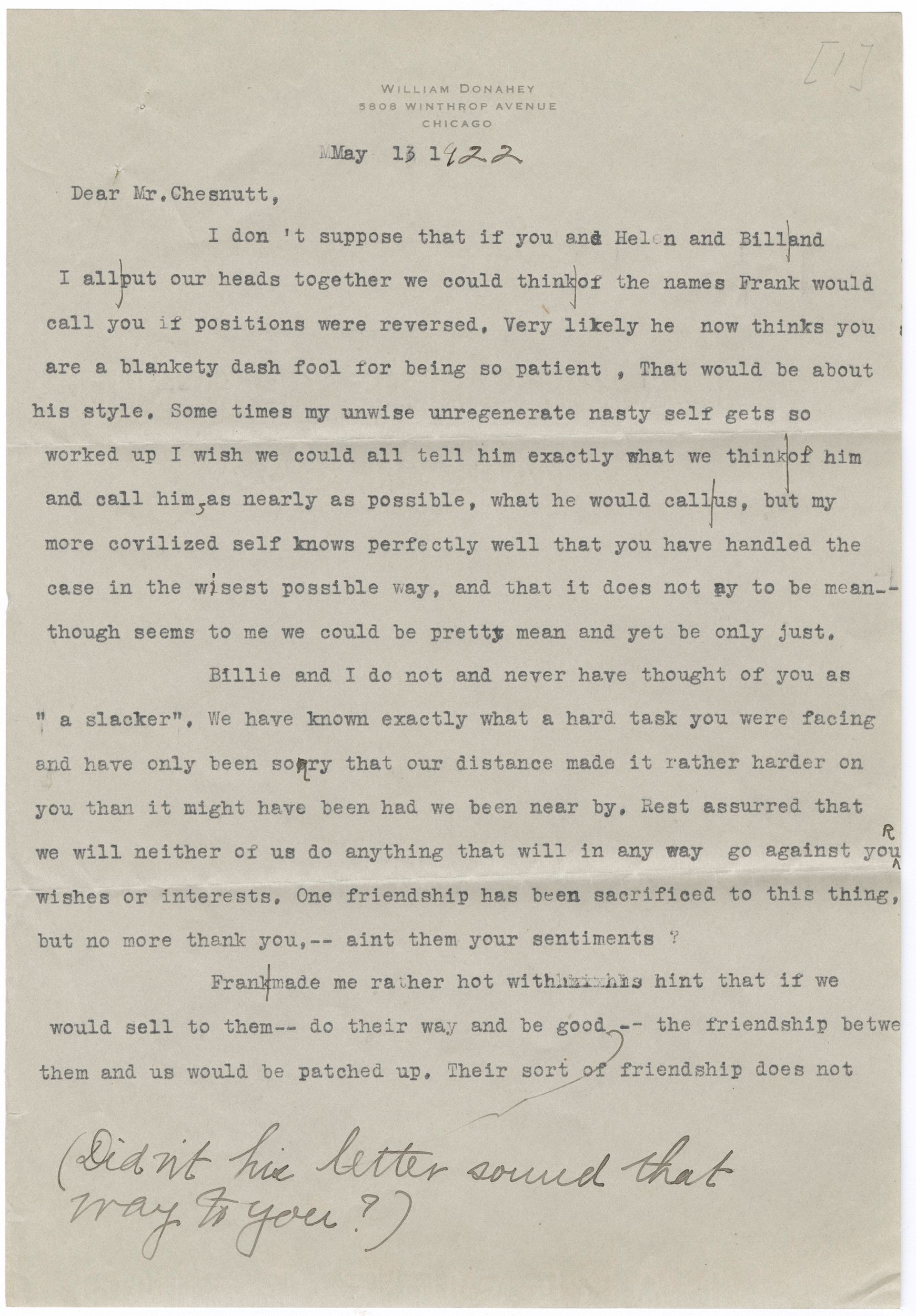
I don 't suppose that if you ansd Helen2 and Billand I allput our heads together we could thinkof the names Frank would call you if positions were reversed.3 Very likely he now thinks you are a blankety dash fool for being so patient , That would be about his style. Some times my unwise unregenerate nasty self gets so worked up I wish we could all tell him exactly what we thinkof him and call him, as nearly as possible, what he would callus, but my more covilized self knows perfectly well that you have handled the case in the wlisest possible way, and that it does not ay to be mean--though seems to me we could be prettty mean and yet be only just.
Billie and I do not and never have thought of you as " a slacker". We have known exactly what a hard task you were facing and have only been sooRry that our distance made it rather harder on you than it might have had we been near by.4
Rest assured that we will neither of us do anything that will in any way go against youR wishes or interests. One friendship has been sacrificed to this thing, but no more thank you,-- aint them your sentiments ?
Frankmade me rather hot with his hint that if we would sell to them-- do their way and be good (Didn't his letter sound that way to you?) -- the friendship betwe them and us would be patched up.5 Their sort of friendship does not
 [2]
WILLIAM DONAHEY
5808 WINTHROP AVENUE
CHICAGO
appeal to my fancy now I know what it is worth. Undoubtedly he
[2]
WILLIAM DONAHEY
5808 WINTHROP AVENUE
CHICAGO
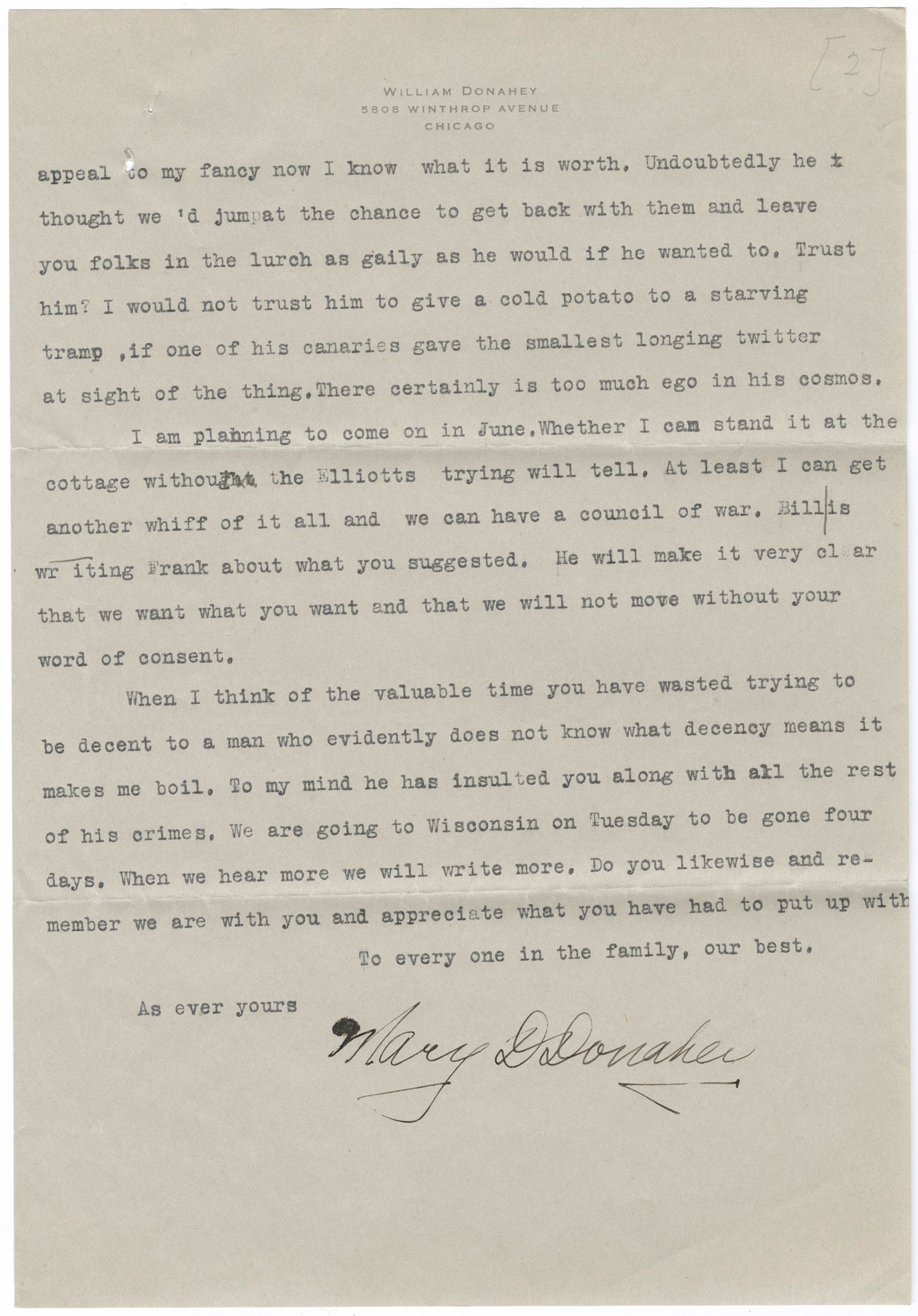
appeal to my fancy now I know what it is worth. Undoubtedly he t thought we 'd jumpat the chance to get back with them and leave you folks in the lurch as gaily as he would if he wanted to. Trust him? I would not trust him to give a cold potato to a starving tramp ,if one of his canaries gave the smallest longing twitter at sight of the thing.There certainly is too much ego in his cosmos.
I am platnning to come on in June.Whether I camn stand it at the cottage withougtht the Elliotts trying will tell.6 At least I can get another whiff of it all and we can have a council of war. Billis wr iting Frank about what you suggested. He will make it very clear that we want what you want and that we will not move without your word of consent.
When I think of the valuable time you have wasted trying to be decent to a man who evidently does not know what decency means it makes me boil. To my mind he has insulted you along with akll the rest of his crimes. We are going to Wisconsin on Tuesday to be gone four days. When we hear more we will write more. Do you likewise and remember we are with you and appreciate what you have had to put up with
Correspondent: Mary Augusta Dickerson Donahey (1876–1962) was a White journalist and author of children's books. She was originally from New Jersey, grew up in New York City and worked for the Cleveland Plain Dealer from 1898 to 1905. She married the cartoonist William Donahey (1883–1970) in 1905 and moved with him to Chicago, where she wrote children's and young adult books, cookbooks and newspaper columns. The couple befriended the Chesnutts in the early 1900s, when they were part of the Tresart Club and the Chester Cliffs Club.
1. William (Bill) Donahey (1883–1970) was a White writer and cartoonist from Westchester, Ohio. After graduating from the Cleveland School of Art in 1903, he briefly worked for the Cleveland Plain Dealer, where he met and married Mary Dickerson Donahey (1876–1962) in 1905 and became friends with the Chesnutts. The couple joined the Chester Cliffs Club and built a cottage on the land. After 1905, the couple moved to Chicago, where he worked for the Chicago Tribune and produced a widely syndicated comic strip, the "Teenie Weenies," which ran intermittently from 1914 until his death and became the basis of an advertising campaign for a canned-goods company in the 1920s as well as for several books he co-wrote with his wife. [back]
2. Helen Maria Chesnutt (1880–1969) was Chesnutt's second child. She earned degrees from Smith College and Columbia University, taught Latin (including to Langston Hughes) at Cleveland's Central High School for more than four decades starting in 1904, co-authored a Latin textbook, The Road to Latin, in 1932, and served on the executive committee of the American Philological Association in 1920. She became her father's literary executor and first biographer. [back]
3. Albert Franklin (Frank) Counts (1881–1946), a White Cleveland lawyer with a 1906 law degree from Western Reserve University's law school, was a member and initially the secretary and treasurer of the Chester Cliffs Club when it was founded. In 1913, he married Eulalie (Eula) Gaskill Miller Counts (1869–1942), who was also a shareholder in the Club. In 1930 Counts was given an eighteen-month prison sentence for embezzlement in a fraudulent divorce case. Paroled in December of 1931, he joined his wife in rural Virginia, where they lived on a farm that was auctioned off after his death. [back]
4. The Chester Cliffs Club or Company was a small stockholding corporation founded in September 1903 by Chesnutt and ten friends who were "stockholders," in order to purchase eleven acres of land in Chester Township near Chesterland, Ohio, and Scotland, Ohio, twenty miles from Cleveland. Summer cottages were built by three of the parties in order to spend their summers away from the city, and in 1916 the Chesnutts purchased one of these. Stockholder meetings were called every fall, even as eventually only three families seem to have remained: the Chesnutts, the Donaheys (who were living in Chicago after 1905), and the Counts. In 1921, Frank Counts (1881–1946), a Cleveland lawyer who was the longtime secretary and treasurer of the Club and his wife Eulalie (Eula) (1869–1942) sold a lot with a cottage to Mary Ellen Delahunte (1870–1951) without consulting the other members, causing conflicts about property tax and upkeep for years. Shortly afterwards, Chesnutt, as the club president, took on the responsibility of reminding members of tax payments and calling the annual meeting. Some of the property was transferred to individual owners in 1923, but the corporation was never legally dissolved. [back]
5. See Donahey's letter to Chesnutt of May 1, 1922, about Counts's offer to buy the Donaheys' share in the Chester Cliffs Club, and Chesnutt's two-part response [back]
6. It is not clear which mutual acquaintances are referenced, but when Dickerson Donahey lived in Cleveland, she belonged to the Women's Press Club with Jane Elliott Snow, who died in late 1922 (1837–1922), and might have known her extended family; Chesnutt also knew Abbie Cleaveland (Mrs. A.N.) Elliott (1847–1962), who invited him to read at the Bolton Avenue Presbyterian Church in Cleveland in April 1899, and whose son Ralph W. Elliott (1877-1962) was a Cleveland physician of the Donaheys' generation. Contact the Charles W. Chesnutt Archive if you have additional information. [back]