Ralph B. Pettit to Charles W. Chesnutt, 24 October 1924
Key
| Textual Feature | Appearance |
|---|---|
| alterations to base text (additions or deletions) | added or deleted text |
| passage deleted with a strikethrough mark | |
| passage deleted by overwritten added text | Deleted text Added text |
| position of added text (if not added inline) | [right margin] text added in right margin; [above line] text added above the line |
| proofreading mark | ‸ |
| page number, repeated letterhead, etc. | page number or repeated letterhead |
| supplied text | [supplied text] |
| archivist note | archivist note |
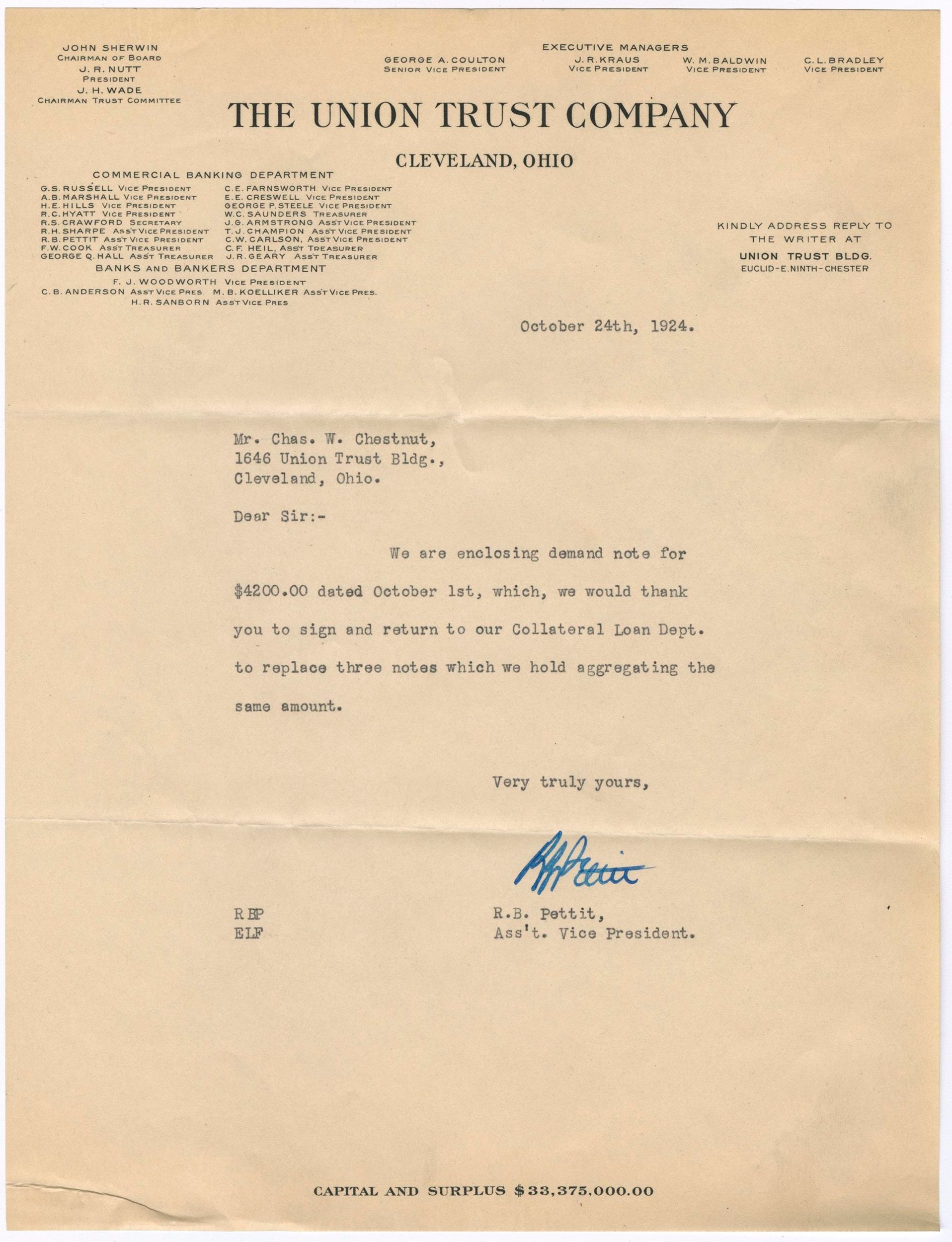 THE UNION TRUST COMPANY1
CLEVELAND, OHIO2
October 24, 1924.
Mr. Chas. W. Chestnut,
1646 Union Trust Bldg.,
Cleveland, Ohio.
Dear Sir:-
THE UNION TRUST COMPANY1
CLEVELAND, OHIO2
October 24, 1924.
Mr. Chas. W. Chestnut,
1646 Union Trust Bldg.,
Cleveland, Ohio.
Dear Sir:-
We are enclosing demand note for $4200.00 dated October 1st, which, we would thank you to sign and return to our Collateral Loan Dept. to replace three notes which we hold aggregating the same amount.3
Very truly yours, R. B. Pettit R. B. Pettit, Ass't. Vice President. RBP ELFCorrespondent: Ralph Bowman Pettit (1879–1954) was a White banker from Ohio who started as a bank accountant and teller in his early 20s and rose high in the ranks of Union Trust Bank after its founding in 1920. He worked primarily for the collateral loan department and was consecutively assistant vice president, vice president, and eventually treasurer of Union Trust, which is the position he held when the bank was closed after the bank collapse of 1933.
1. The Union Trust Company was a Cleveland bank trust, by 1920 a large nationwide bank following several mergers. In 1924, Chesnutt's company began renting offices in the new Union Trust Building that housed the bank's headquarters. Many of Chesnutt's investments were also with Union Trust. After the stock market collapse in 1929, he had to service a $18,500 loan for which the collateral had been stock market shares that were now worthless; the company also held the mortgage for his home at 9719 Lamont St. and for at least one rental property he owned (11900–02 Superior Ave.). Union Trust survived the early years of the Depression, but was not allowed to reopen after another collapse of the Cleveland banks in February 1933. [back]
2. For readability, the remainder of the Union Trust Company letterhead is not transcribed in the body of the letter but is included in this footnote as unformatted text. The letterhead can be seen in its entirety in the accompanying image of the letter. The text of the remainder of the letterhead is as follows: "JOHN SHERWIN CHAIRMAN OF BOARD J. R. NUTT PRESIDENT J. H. WADE CHAIRMAN TRUST COMMITEE GEORGE A. COULTON SENIOR VICE PRESIDENT EXECUTIVE MANAGERS J. R. KRAUS VICE PRESIDENT W. M. BALDWIN VICE PRESIDENT C. L. BRADLEY VICE PRESIDENT COMMERCIAL BANKING DEPARTMENT G.S. RUSSELL VICE PRESIDENT C. E. FARNSWORTH VICE PRESIDENT A. B. MARSHALL VICE PRESIDENT E.E. CRESWELL VICE PRESIDENT H.E. HILLS VICE PRESIDENT GEORGE P. STEELE VICE PRESIDENT R. C. HYATT VICE PRESIDENT W.C. SAUNDERS TREASURER R. S. CRAWFORD SECRETARY J. G. ARMSTRONG ASST VICE PRESIDENT R. H. SHARPE ASST VICE PRESIDENT T.J. CHAMPION ASST VICE PRESIDENT, R. B. PETTIT ASST VICE PRESIDENT, C. W. CARLSON, ASST VICE PRESIDENT F. W. COOK ASST TREASURER C. F. HEIL, ASST TREASURER, GEORGE Q. HALL ASST TREASURER J. R. GEARY ASST TREASURER BANKS AND BANKERS DEPARTMENT F. J. WOODWORTH VICE PRESIDENT C. B. ANDERSON ASST VICE PRES M. B. KOELLIKER ASST VICE PRESIDENT H. R. SANBORN ASST VICE PRES KINDLY ADDRESS REPLY TO THE WRITER AT UNION TRUST BLDG. EUCLID – E.NINTH – CHESTER CAPITAL AND SURPLUS $33,375,000.00" [back]
3. Before the stock market crash in 1929, it was common for stock to serve as a collateral for loans, which in Chesnutt's case were mortgages and loans with Union Trust Company relating to the real estate he owned. Chesnutt was able to avoid foreclosure when the value of this collateral collapsed in 1929 (partly by using life insurance policies as a new collateral, partly by using a large portion of his income to pay the loans back) but he never recovered financially. [back]