Walter L. Flory to Charles W. Chesnutt, 28 February 1922
Key
| Textual Feature | Appearance |
|---|---|
| alterations to base text (additions or deletions) | added or deleted text |
| passage deleted with a strikethrough mark | |
| passage deleted by overwritten added text | Deleted text Added text |
| position of added text (if not added inline) | [right margin] text added in right margin; [above line] text added above the line |
| proofreading mark | ‸ |
| page number, repeated letterhead, etc. | page number or repeated letterhead |
| supplied text | [supplied text] |
| archivist note | archivist note |
 [1]
LAW OFFICES OF
THOMPSON, HINE AND FLORY
1239 ENGINEERS BUILDING
CLEVELAND
AMOS BURT THOMPSON
CHARLES P. HINE
WALTER LE ROY FLORY
J. FRANK PEASE
JEROME C. FISHER
CHARLES W. SELLERS
STANLEY L. ORR
ROBERT F. BINGHAM
DAVID A. GASKILL
ELMORE L. ANDREWS
CARL V. WEYGANDT
READ M. KUHNS
ROLAND R. FOLEY
February 28, 1922.
Mr. Charles Chestnutt,
Williamson Building,
C i t y.
Dear Mr. Chestnutt:-
[1]
LAW OFFICES OF
THOMPSON, HINE AND FLORY
1239 ENGINEERS BUILDING
CLEVELAND
AMOS BURT THOMPSON
CHARLES P. HINE
WALTER LE ROY FLORY
J. FRANK PEASE
JEROME C. FISHER
CHARLES W. SELLERS
STANLEY L. ORR
ROBERT F. BINGHAM
DAVID A. GASKILL
ELMORE L. ANDREWS
CARL V. WEYGANDT
READ M. KUHNS
ROLAND R. FOLEY
February 28, 1922.
Mr. Charles Chestnutt,
Williamson Building,
C i t y.
Dear Mr. Chestnutt:-
At the suggestion of Mr. Ernest Angell1 of New York City, I am herewith sending to you a copy of the brief2 prepared by him and his associates, in the effort to obtain a just deal for the republic of Haiti in its relations to the United States.
In Mr. Angell's letter to me, he states, among other things, the following:-
"The facts of the United States intervention there in 1915 are so clear and so shocking an abuse of power, such an absolute violation of professed American principles, that we are trying by means of this investigation to do something to restore our good name in Latin America as well as to help Haiti.3 To this end I have written a brief on the facts at the intervention and the present status. Officially this is the work of Mr. Moorfield Storey of Boston,4 former president of the American Bar Association. Mr. Storey has signed it as have Frankfurter and Chafee of the Harvard Law School, Adelbert Moot of Buffalo and some others here in New York.5 Senator Pomrene6 is on this Senate Committee of investigation and I want to get as additional signatories a number of well known Ohio men. I can assure you that the statement of facts is as nearly accurate as I know how to make it and gives an absolutely fair picture of Haiti.
Will you take the time to look this over within the next few days and let me know whether we can have your name as another signatory? If you approve of it will you see if you can get two or three other good men in Cleveland or elsewhere in Ohio whose names would carry weight? We are not trying to get a mass of names but a few representative lawyers and public men from different parts of the country. I have good reason to expect that we will have on this inside the next few days the signatures of some of the best known lawyers in the country.7
[2] Mr. Charles Chestnutt,
2-28-22.
Page #2. -The situation is really important and critical. This brief with the proper names can when published and given to the right Senators and to the State Department afford such support to the pending King Resolution for withdrawal as to solve the situation satisfactorily."8
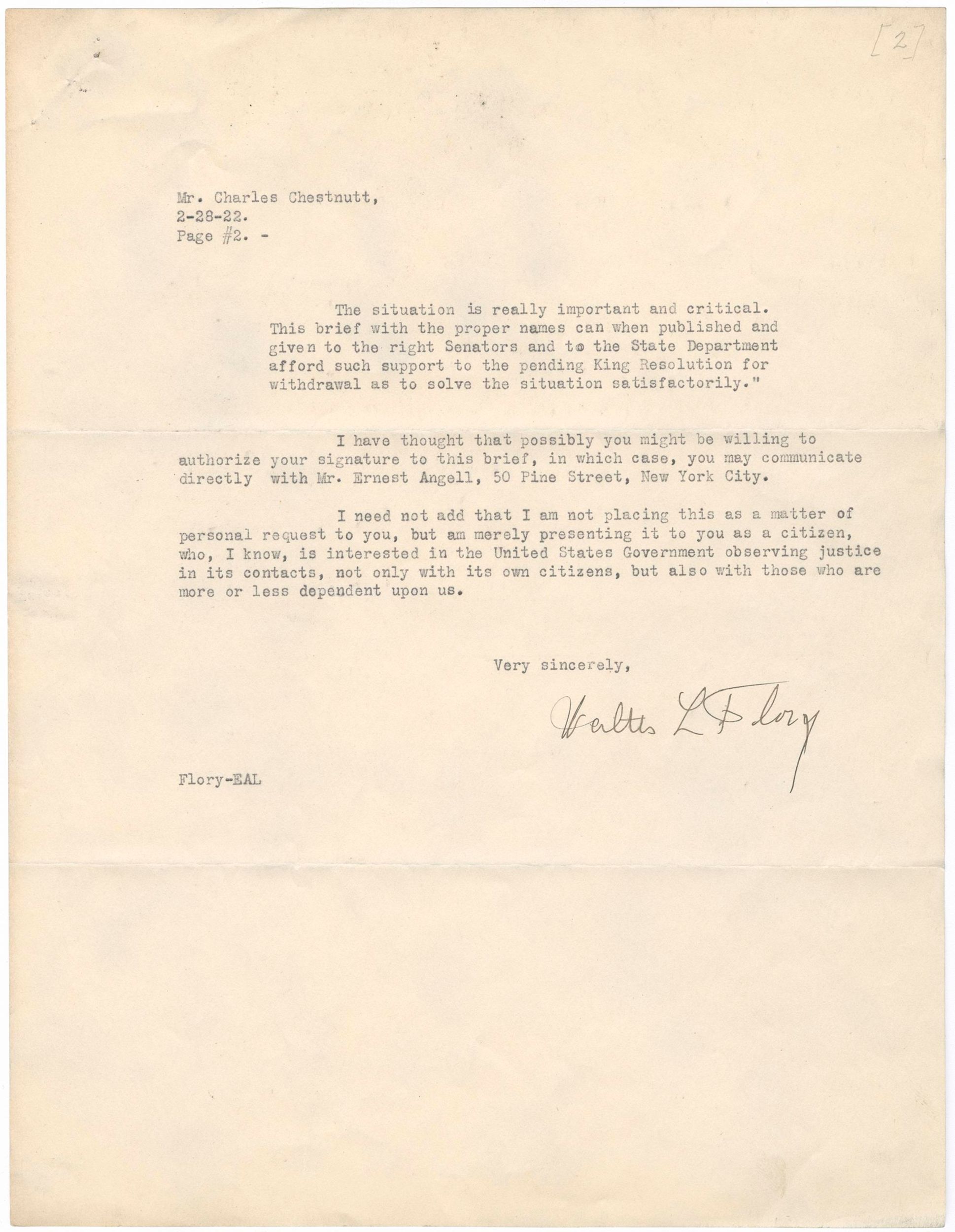
I have thought that possibly you might be willing to authorize your signature to this brief, in which case, you may communicate directly with Mr. Ernest Angell, 50 Pine Street, New York City.
I need not add that I am not placing this as a matter of personal request to you, but am merely presenting it to you as a citizen, who, I know, is interested in the United States Government observing justice in its contacts, not only with its own citizens, but also with those who are more or less dependent upon us.
Very sincerely, Walter L. Flory Flory-EALCorrespondent: Walter LeRoy Flory (1880–1951) was a White Cleveland lawyer, originally from Newark, Ohio, educated at Yale and the Western Reserve Law School. He began practicing in Cleveland in 1905 and was later part of the prominent law firm Thompson, Hine & Flory, founded in 1911. Flory was active in Cleveland's Citizens' League and other local civic organizations; like Chesnutt, he was a member of the Cleveland Bar Association and the Chamber of Commerce.
1. Ernest Angell (1889–1973) was a White lawyer, originally from Cleveland, who worked for a prominent Cleveland law firm after service in World War I and by 1920 was working in corporate law for the firm of Hardin & Hess in New York. He represented the Haiti-Santo Domingo Independence Society (founded in 1921) at the hearings of the 1921–22 Senate investigation on the U.S. occupation of Haiti. [back]
2. The sixteen-page report, entitled "The Seizure of Haiti by the United States: A Report on the Military Occupation of the Republic of Haiti and the History of the Treaty Forced Upon Her," was published by the Foreign Policy Association (New York) and distributed by the National Popular Government League (Washington, D.C.) with twenty-four signatures. It called for the U.S. to abrogate the treaty that was the basis of the occupation, for election of a new government in Haiti, and for new treaty negotiations between "free and independent sovereign states" (p. 15). [back]
3. In July 1915, U.S. forces invaded Haiti after the collapse of the Haitian government. Although initial resolutions to investigate had failed in both houses of Congress, in July 1921 the Senate passed a resolution and a committee was formed. Following hearings between August 1921 and June 1922, it eventually concluded that the occupation should continue. The official records of the hearings appeared in two parts, and those from October to early November 1921 served as the basis of Ernest Angell's brief shared with Chesnutt and others. [back]
4. Moorfield Storey (1845–1929) was a White Harvard-trained lawyer and civil-rights activist from Massachusetts who became the founding president of the NAACP (1909–1929). He practiced law in Boston and was briefly president of the American Bar Association (1895–1896). Opposed to U.S. military intervention abroad, he was active in the New England Anti-Imperialist League and chaired the Haiti-Santo Domingo Independence Society (founded in 1921), which hired Ernest Angell as its defense lawyer. [back]
5. Felix Frankfurter (1882–1965) and Zecharia Chafee Jr. (1885–1957) were both professors at Harvard Law School. Frankfurter had worked in the Bureau of Insular Affairs and the War Department in the 1910s and helped found the American Civil Liberties Union in 1920; he later sat on the U.S. Supreme Court (1939–1962). Adelbert Moot (1854–1929) was a former president of the New York State Bar Association. [back]
6. Atlee Pomerene (1863–1937) was a Democratic U.S. Senator for Ohio (1911–1923) and sat on the Senate committee that, from August 5, 1921 to June 1, 1922, investigated the U.S. occupation of Haiti. [back]
7. Although Chesnutt agreed to sign, his name was not included in the list of twenty-four "lawyers who are signatories of the brief" when it was published. [back]
8. Senate Resolution 256, introduced by Democratic Senator William H. King (Utah, 1863–1949) on March 10, 1922, called for the U.S. to withdraw from Haiti and to oversee democratic elections. (See "Would Evacuate Haiti," New York Times, March 11, 1922, 8.) [back]