Charles W. Chesnutt to Mildred Chadsey, 21 September 1932
Key
| Textual Feature | Appearance |
|---|---|
| alterations to base text (additions or deletions) | added or deleted text |
| passage deleted with a strikethrough mark | |
| passage deleted by overwritten added text | Deleted text Added text |
| position of added text (if not added inline) | [right margin] text added in right margin; [above line] text added above the line |
| proofreading mark | ‸ |
| page number, repeated letterhead, etc. | page number or repeated letterhead |
| supplied text | [supplied text] |
| archivist note | archivist note |
 September 21, 1932
Miss Mildred Chadsey,
Executive Secretary,
The Adult Education Association,1
City.
My dear Miss Chadsey:
September 21, 1932
Miss Mildred Chadsey,
Executive Secretary,
The Adult Education Association,1
City.
My dear Miss Chadsey:
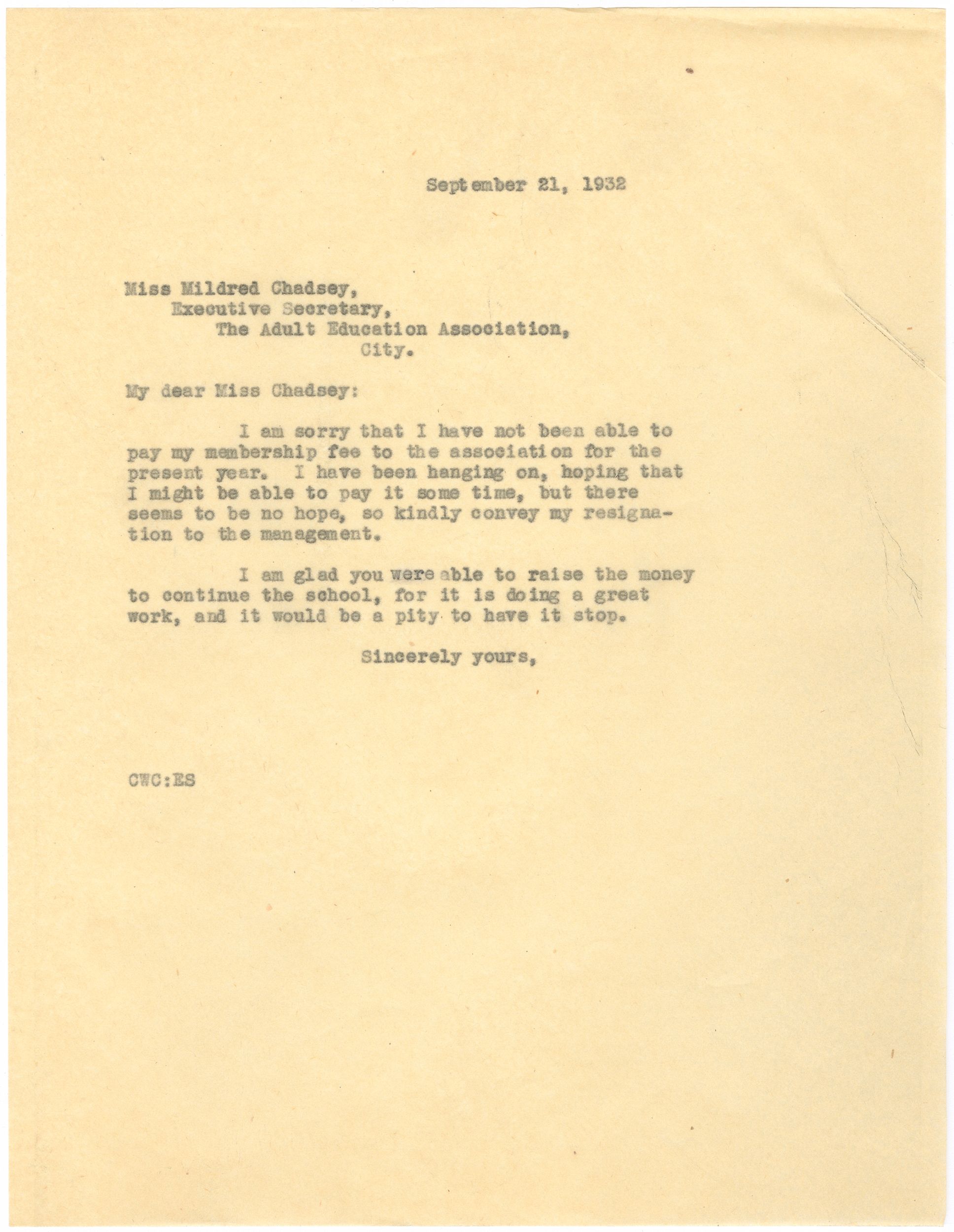
I am sorry that I have not been able to pay my membership fee to the association for the present year. I have been hanging on, hoping that I might be able to pay it some time, but there seems to be no hope, so kindly convey my resignation to the management.
I am glad you were able to raise the money to continue the school, for it is doing a great work, and it would be a pity to have it stop.
Sincerely yours, CWC:ESCorrespondent: Mildred Chadsey (1884–1940) was a progressive White activist in Cleveland. She became the city's first housing commissioner in 1912, trained social workers throughout the 1920s, and was active in the labor movement and a range of civic causes. From the late 1920s on, she was executive secretary of the Adult Education Association of Cleveland.
1. In 1925, the Education Extension Council, forerunner of the Adult Education Association of Cleveland, in conjunction with Western Reserve University and the Case School of Applied Sciences, founded Cleveland College, which provided late-afternoon and evening classes to working adults in downtown Cleveland. By 1932, the college was in severe financial difficulties but survived the Depression because of major fundraising efforts by Newton D. Baker (1871–1931) and others. [back]