Charles W. Chesnutt to Arthur B. Spingarn, 14 April 1931
Key
| Textual Feature | Appearance |
|---|---|
| alterations to base text (additions or deletions) | added or deleted text |
| passage deleted with a strikethrough mark | |
| passage deleted by overwritten added text | Deleted text Added text |
| position of added text (if not added inline) | [right margin] text added in right margin; [above line] text added above the line |
| proofreading mark | ‸ |
| page number, repeated letterhead, etc. | page number or repeated letterhead |
| supplied text | [supplied text] |
| archivist note | archivist note |
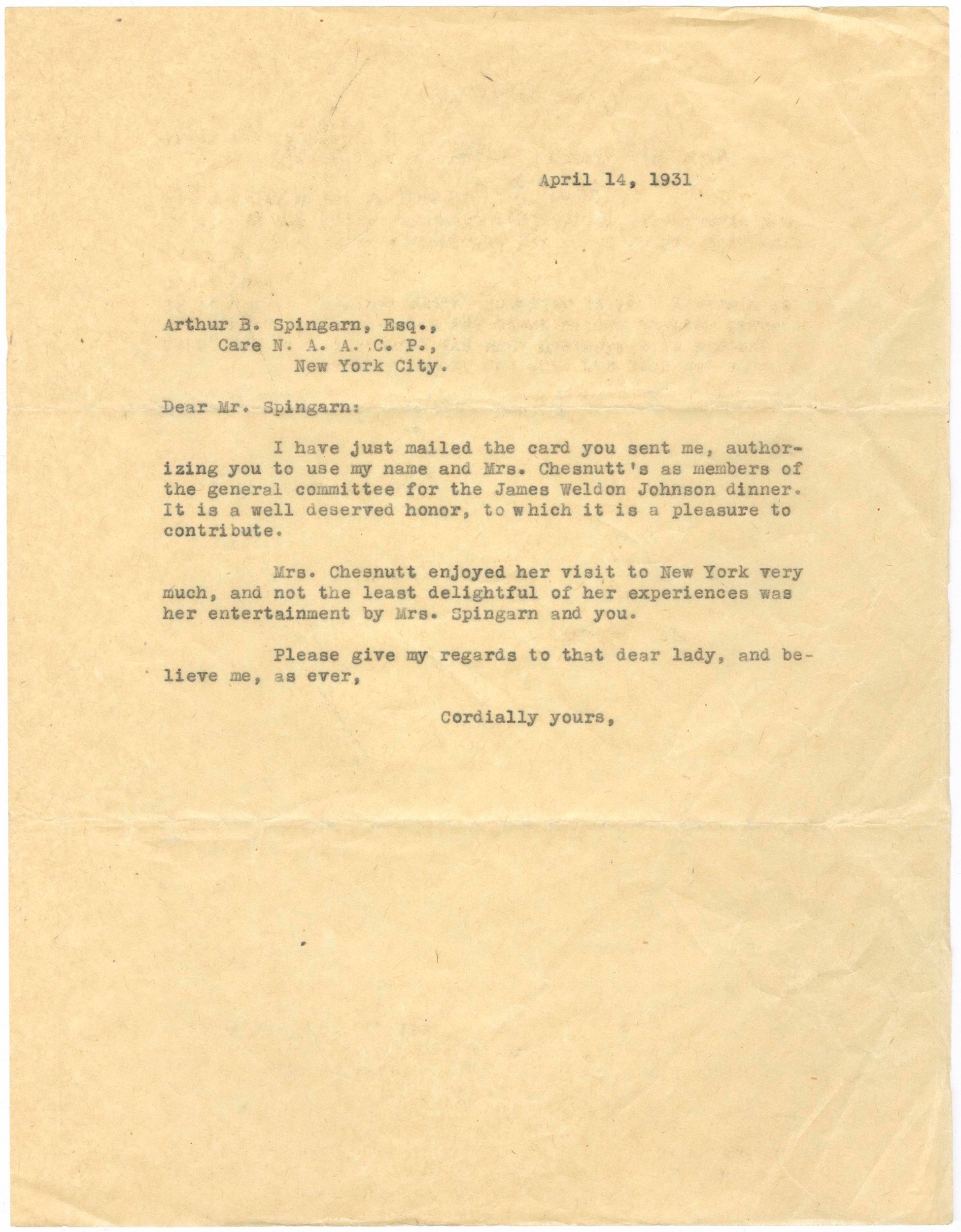 April 14, 1931
Arthur B. Spingarn, Esq.,
Care N. A. A. C. P.,1
New York City.
Dear Mr. Spingarn:
April 14, 1931
Arthur B. Spingarn, Esq.,
Care N. A. A. C. P.,1
New York City.
Dear Mr. Spingarn:
I have just mailed the card you sent me, authorizing you to use my name and Mrs. Chesnutt's2 as members of the general committee for the James Weldon Johnson3 dinner. It is a well deserved honor, to which it is a pleasure to contribute.4
Mrs. Chesnutt enjoyed her visit to New York very much,5 and not the least delightful of her experiences was her entertainment by Mrs. Spingarn6 and you.
Please give my regards to that dear lady, and believe me, as ever,
Cordially yours,Correspondent: Arthur Barnett Spingarn (1878–1971) was a White Jewish civil-rights activist who, alongside his brother Joel Spingarn, was a leading figure in the NAACP, ultimately serving as its president (1940–1965). He was a lawyer based in New York City and served on the NAACP's legal committee for many years.
1. The National Association for the Advancement of Colored People (NAACP) began in February 1909, with a Committee on the Negro and "The Call," a statement protesting lawlessness against Black people. In 1910, the organization adopted its current name and in 1912 began publication of a monthly journal, The Crisis, which was edited by W. E. B. Du Bois from 1912 to 1944. Chesnutt's involvement with the NAACP extended over many years, and included serving on its General Committee, attending conferences, presiding at NAACP events in Cleveland, publishing four stories and two essays in The Crisis (1912, 1915, 1924, 1926, 1930, and 1931), and being awarded in 1928 the organization's highest honor, the Spingarn Medal. [back]
2. Susan Perry Chesnutt (1861–1940) was from a well-established Black family in Fayetteville, North Carolina, and worked as a teacher at Fayetteville's Howard School before marrying Chesnutt. They were married from 1878 until his death in 1932 and had four children: Ethel, Helen, Edwin, and Dorothy. Susan led an active life in Cleveland. [back]
3. James Weldon Johnson (1871–1938) was a Black author and political activist. He was Executive Secretary of the NAACP (1920–1930). On December 17, 1930, he resigned as Secretary of the NAACP to accept the Adam K. Spence Chair of Creative Literature and Writing at Fisk University. [back]
4. The dinner to celebrate Johnson's service to the NAACP, held at the Hotel Pennsylvania in New York City on Thursday, May 14, 1931, had three hundred guests, many of them prominent leaders and supporters of the NAACP, including Chesnutt correspondents like Walter White, W. E. B. Du Bois, and the Spingarns. Chesnutt and his wife are not noted as having attended. (See "Many Laud Retiring N.A.A.C.P. Secretary at Pennsylvania Hotel Dinner," Afro-American [Baltimore, MD], May 23, 1931, 7). [back]
5. The Chesnutts were in New York City in late March of 1931, visiting Susan's sister Mary Perry McCracken (1878–1958) and her husband Richard ("Social News," New York Age, April 4, 1931, 2). [back]
6. Marion Mayer Goldman Spingarn (1867–1958) was a widow when she became Arthur Spingarn's wife in 1918. A White Jewish woman from New York City, she was a social worker and worked in women's welfare in the early years of their marriage. She actively supported the NAACP and her husband's work for the organization. [back]