Charles W. Chesnutt to Joel E. Spingarn, 5 January 1931
Key
| Textual Feature | Appearance |
|---|---|
| alterations to base text (additions or deletions) | added or deleted text |
| passage deleted with a strikethrough mark | |
| passage deleted by overwritten added text | Deleted text Added text |
| position of added text (if not added inline) | [right margin] text added in right margin; [above line] text added above the line |
| proofreading mark | ‸ |
| page number, repeated letterhead, etc. | page number or repeated letterhead |
| supplied text | [supplied text] |
| archivist note | archivist note |
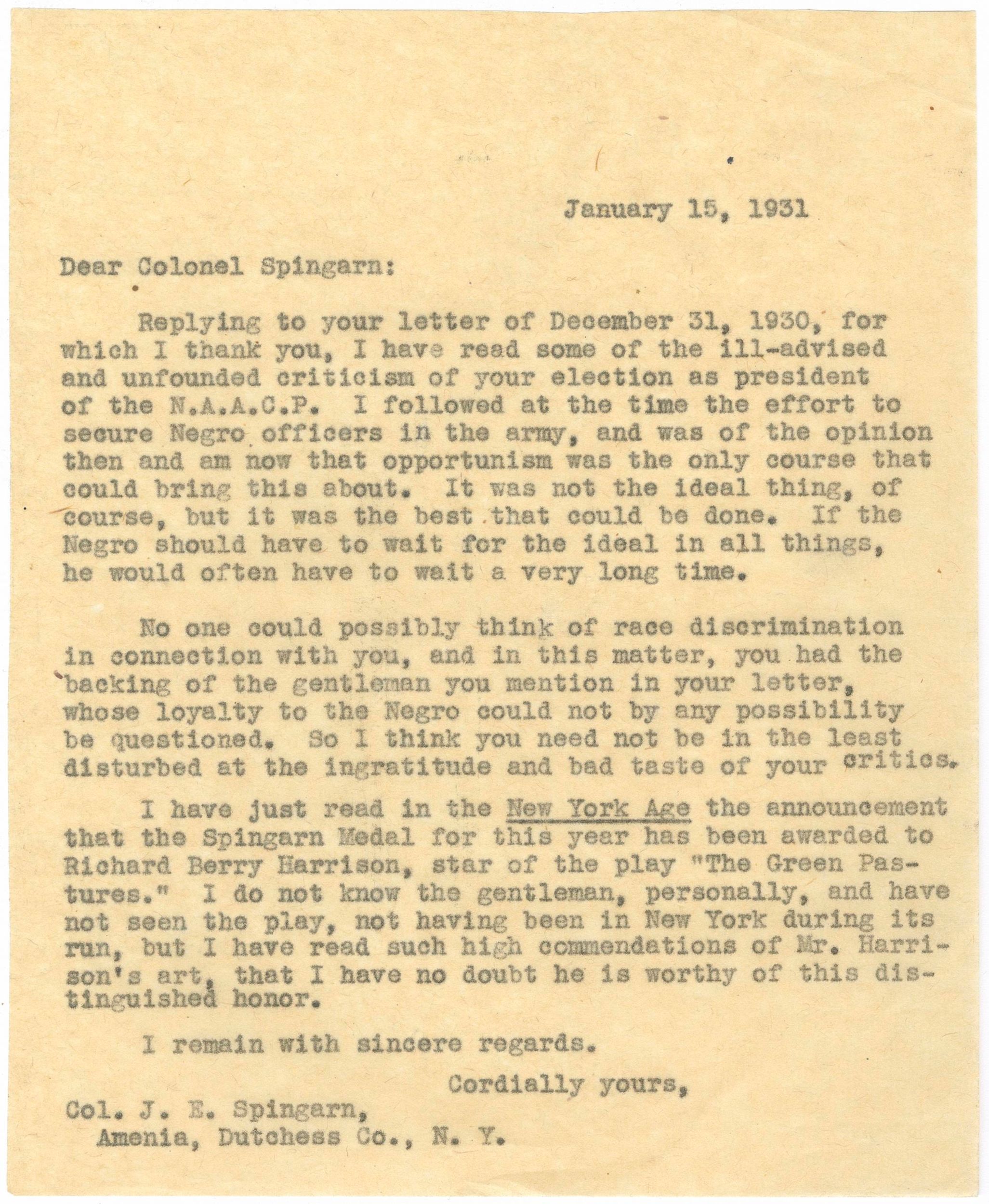 January 15, 1931
Dear Colonel Spingarn:
January 15, 1931
Dear Colonel Spingarn:
Replying to your letter of December 31, 1930, for which I thank you, I have read some of the ill-advised and unfounded criticism of your election as president of the N.A.A.C.P.1 I followed at the time the effort to secure Negro officers in the army, and was of the opinion then and am now that opportunism was the only course that could bring this about. It was not the ideal thing, of course, but it was the best that could be done. If the Negro should have to wait for the ideal in all things, he would often have to wait a very long time.2
No one could possibly think of race discrimination in connection with you, and in this matter, you had the backing of the gentleman3 you mention in your letter, whose loyalty to the Negro could not by any possibility be questioned. So I think you need not be in the least disturbed at the ingratitude and bad taste of your critics.
I have just read in the New York Age the announcement that the Spingarn Medal4 for this year has been awarded to Richard Berry Harrison,5 star of the play "The Green Pastures."6 I do not know the gentleman, personally, and have not seen the play, not having been in New York during its run, but I have read such high commendations of Mr. Harrison’s art, that I have no doubt he is worthy of this distinguished honor.
I remain with sincere regards.
Cordially yours, Col. J. E. Spingarn, Amenia, Dutchess Co., N. Y.7Correspondent: Joel Elias Spingarn (1875–1939) was a White Jewish civil rights activist, literary scholar and life-long Republican from New York City who was an active member of the NAACP from its earliest days (as chair of its board 1913–1919, treasurer 1919–1930, and president 1930–1939). He established the Spingarn Medal, the NAACP's highest honor, in 1914; Chesnutt received it in 1928.
1. The National Association for the Advancement of Colored People (NAACP) began in February 1909, with a Committee on the Negro and "The Call," a statement protesting lawlessness against Black people. In 1910, the organization adopted its current name and in 1912 began publication of a monthly journal, The Crisis, which was edited by W. E. B. Du Bois from 1912 to 1944. Chesnutt's involvement with the NAACP extended over many years, and included serving on its General Committee, attending conferences, presiding at NAACP events in Cleveland, publishing four stories and two essays in The Crisis (1912, 1915, 1924, 1926, 1930, and 1931), and being awarded in 1928 the organization's highest honor, the Spingarn Medal. [back]
2. Joel Spingarn's selection to become president of the NAACP in 1930, after the death of Moorfield Storey (1845–1929; NAACP president since 1909) was fully supported by the organization, but criticized by some Black activists outside of the NAACP because Spingarn was not Black, and because they thought he had been wrong to concede to segregated training for Black officers during World War I. [back]
3. This is likely a typo and intended to be "gentlemen." In his December 31, 1930, letter to Chesnutt, Spingarn references NAACP members and leaders Moorfield Storey, W. E. B. Du Bois, James Weldon Johnson, William Pickens, and George W. Cook. These men were all allies during Spingarn's World War I efforts to establish a route for Black soldiers to become officers. [back]
4. The highest honor of the National Association for the Advancement of Colored People (NAACP) is the Spingarn Medal, awarded annually since 1915, for the highest achievement of a living African American in the preceding year. Joel Spingarn (1875—1939), a professor of literature and one of the NAACP founders, was elected board chairman of the NAACP in 1915 and served as president from 1929 to 1939. Chesnutt received this award in 1928. [back]
5. Richard Berry Harrison (1864–1935) was a dramatic reader and actor. In the 1890s he traveled the U.S. with a repertoire that included the poetry of Paul Laurence Dunbar. In 1930 he gained further fame for his role in Marc Connelly's Pulitzer-prize winning play The Green Pastures. Harrison received the NAACP's Spingarn Medal in 1930. [back]
6. The Green Pastures (1930) was a Pulitzer-prize winning play by White writer Marc Connelly (1890–1980) that set Biblical tales in a New Orleans Black community. In 1930–1931, the play ran for sixteen months on Broadway with an all-Black cast, before a successful tour of more than two hundred cities. [back]
7. Joel Spingarn and his wife Amy owned a historic estate, Troutbeck, in Amenia in upstate New York, about one hundred miles from New York City. They hosted two important conferences on race matters there in 1916 and 1933; Chesnutt attended the 1916 conference. Amy Spingarn also ran the Troutbeck Press, which published early poems by Chesnutt's family friend Langston Hughes (1902–1967). [back]