Charles W. Chesnutt to William Stanley Braithwaite, 8 September 1924
Key
| Textual Feature | Appearance |
|---|---|
| alterations to base text (additions or deletions) | added or deleted text |
| passage deleted with a strikethrough mark | |
| passage deleted by overwritten added text | Deleted text Added text |
| position of added text (if not added inline) | [right margin] text added in right margin; [above line] text added above the line |
| proofreading mark | ‸ |
| page number, repeated letterhead, etc. | page number or repeated letterhead |
| supplied text | [supplied text] |
| archivist note | archivist note |
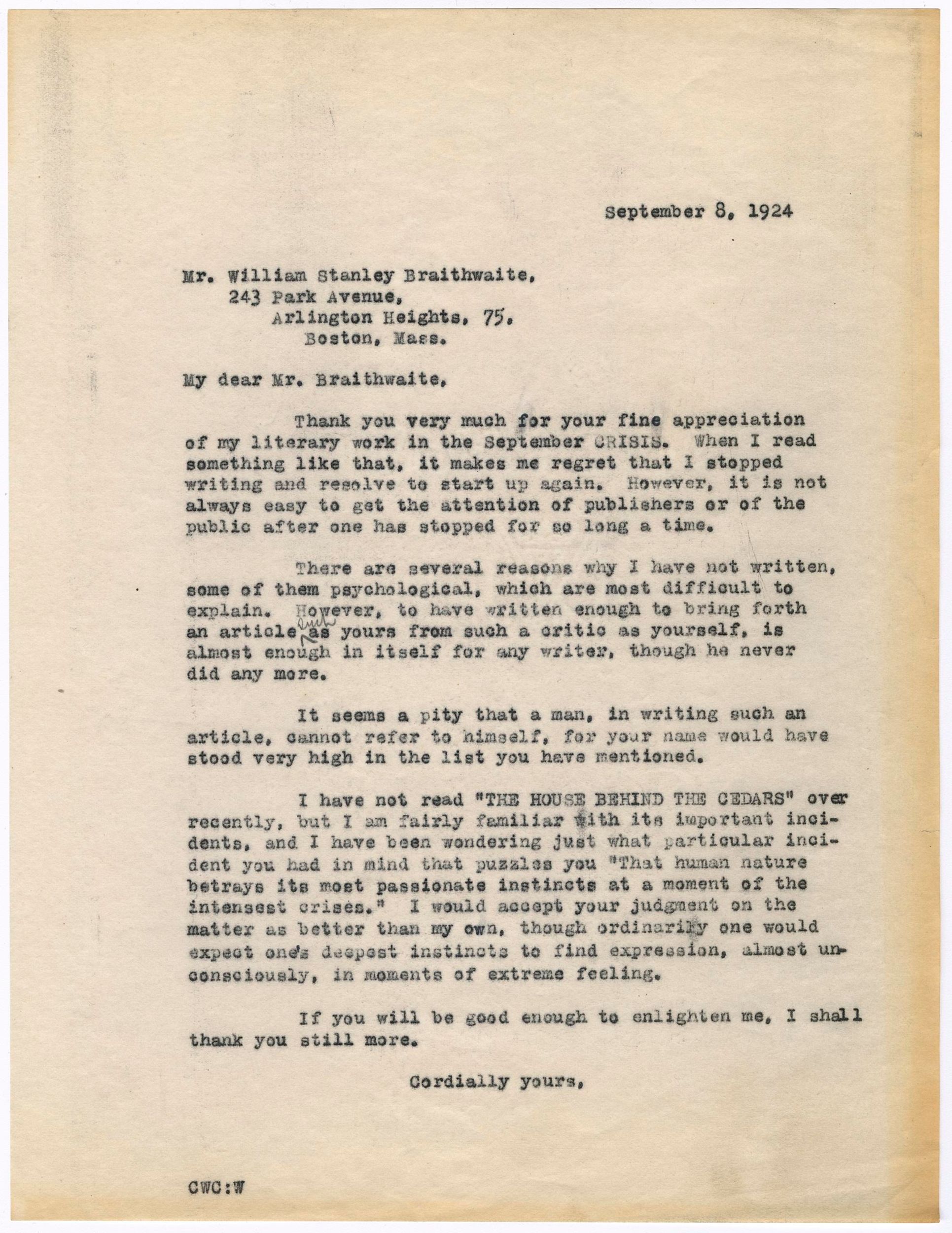 September 8, 1924
Mr. William Stanley Braithwaite,
243 Park Avenue,
Arlington Heights, 75,
Boston, Mass.
My dear Mr. Braithwaite,
September 8, 1924
Mr. William Stanley Braithwaite,
243 Park Avenue,
Arlington Heights, 75,
Boston, Mass.
My dear Mr. Braithwaite,
Thank you very much for your fine appreciation of my literary work in the September CRISIS.1 When I read something like that, it makes me regret that I stopped writing and resolve to start up again.2 However, it is not always easy to get the attention of publishers or of the public after one has stopped for so long a time.3
There are several reasons why I have not written, some of them psychological, which are most difficult to explain. However, to have written enough to bring forth an article such as yours from such a critic as yourself, is almost enough in itself for any writer, though he never did any more.
It seems a pity that a man, in writing such an article, cannot refer to himself, for your name would have stood very high in the list you have mentioned.
I have not read "THE HOUSE BEHIND THE CEDARS"4 over recently, but I am fairly familiar with its important incidents, and I have been wondering just what particular incident you had in mind that puzzles you "That human nature betrays its most passionate instincts at a moment of the intensest crises."5 I would accept your judgment on the matter as better than my own, though ordinarily one would expect one's deepest instincts to find expression, almost unconsciously, in moments of extreme feeling.
If you will be good enough to enlighten me, I shall thank you still more.
Cordially yours, CWC:WCorrespondent: William Stanley Braithwaite (1878–1962) was a self-educated Black literary critic, writer, and publisher from Boston. After an apprenticeship in a publishing house, he began to write poetry and was briefly the book critic for The Colored American Magazine (1901–02). He became the literary critic of the Boston Evening Transcript (1906–1931), and published criticism, poetry, and fiction. He was best known for his anthologies, most notably the Anthology of Magazine Verse and Yearbook of American Poetry (1913–1939). He contributed to Alain Locke's anthology The New Negro (1925), but usually wrote about White authors, a fact that sometimes drew criticism. Ten years before Chesnutt, Braithwaite received the Spingarn Medal, the NAACP's highest honor.
1. The National Association for the Advancement of Colored People (NAACP) began in February 1909, with a Committee on the Negro and "The Call," a statement protesting lawlessness against Black people. In 1910, the organization adopted its current name and in 1912 began publication of a monthly journal, The Crisis, which was edited by W. E. B. Du Bois from 1912 to 1944. Chesnutt's involvement with the NAACP extended over many years, and included serving on its General Committee, attending conferences, presiding at NAACP events in Cleveland, publishing four stories and two essays in The Crisis (1912, 1915, 1924, 1926, 1930, and 1931), and being awarded in 1928 the organization's highest honor, the Spingarn Medal. [back]
2. In his essay "The Negro in Literature," (The Crisis 28, no. 5 [September 1924]: 200–210), Braithwaite dedicated a long paragraph to praising Chesnutt's fiction. [back]
3. In "The Negro in Literature", Braithwaite noted that Chesnutt had not published fiction since 1905. He speculated that the author was disappointed because "his stories failed to win popularity" (210) but he had heard rumors that Chesnutt was still writing. Although Chesnutt does not mention it, two of his short stories had appeared in The Crisis in 1912 and 1915. He had also submitted for publication two book-length manuscripts, Aunt Hagar's Children and Paul Marchand, F.M.C., in 1919 and 1921, respectively, but both were declined. Very shortly after this letter was written, he submitted another story, "The Marked Tree," published in December 1924 and January 1925. See Chesnutt's letter to W. E. B. Du Bois of September 16, 1924. [back]
4. The House Behind the Cedars (Houghton, Mifflin & Company, 1900) was Chesnutt's first published novel. House evolved over more than a decade from a short story, "Rena Walden," first drafted in the late 1880s. It was the only novel by Chesnutt to be serialized, once in 1900-1901 in the monthly Self Culture and again in 1921-1922 in the Black weekly Chicago Defender. House was also his only novel to be adapted to film (1924 and 1932). [back]
5. Chesnutt is quoting from a portion of Braithwaite's essay in which Braithwaite notes "defects" in Chesnutt's novels, considering him "primarily a short story writer" (210). No response from Braithwaite has been located. [back]