Charles W. Chesnutt to Houghton Mifflin Company, 4 August 1924
Key
| Textual Feature | Appearance |
|---|---|
| alterations to base text (additions or deletions) | added or deleted text |
| passage deleted with a strikethrough mark | |
| passage deleted by overwritten added text | Deleted text Added text |
| position of added text (if not added inline) | [right margin] text added in right margin; [above line] text added above the line |
| proofreading mark | ‸ |
| page number, repeated letterhead, etc. | page number or repeated letterhead |
| supplied text | [supplied text] |
| archivist note | archivist note |
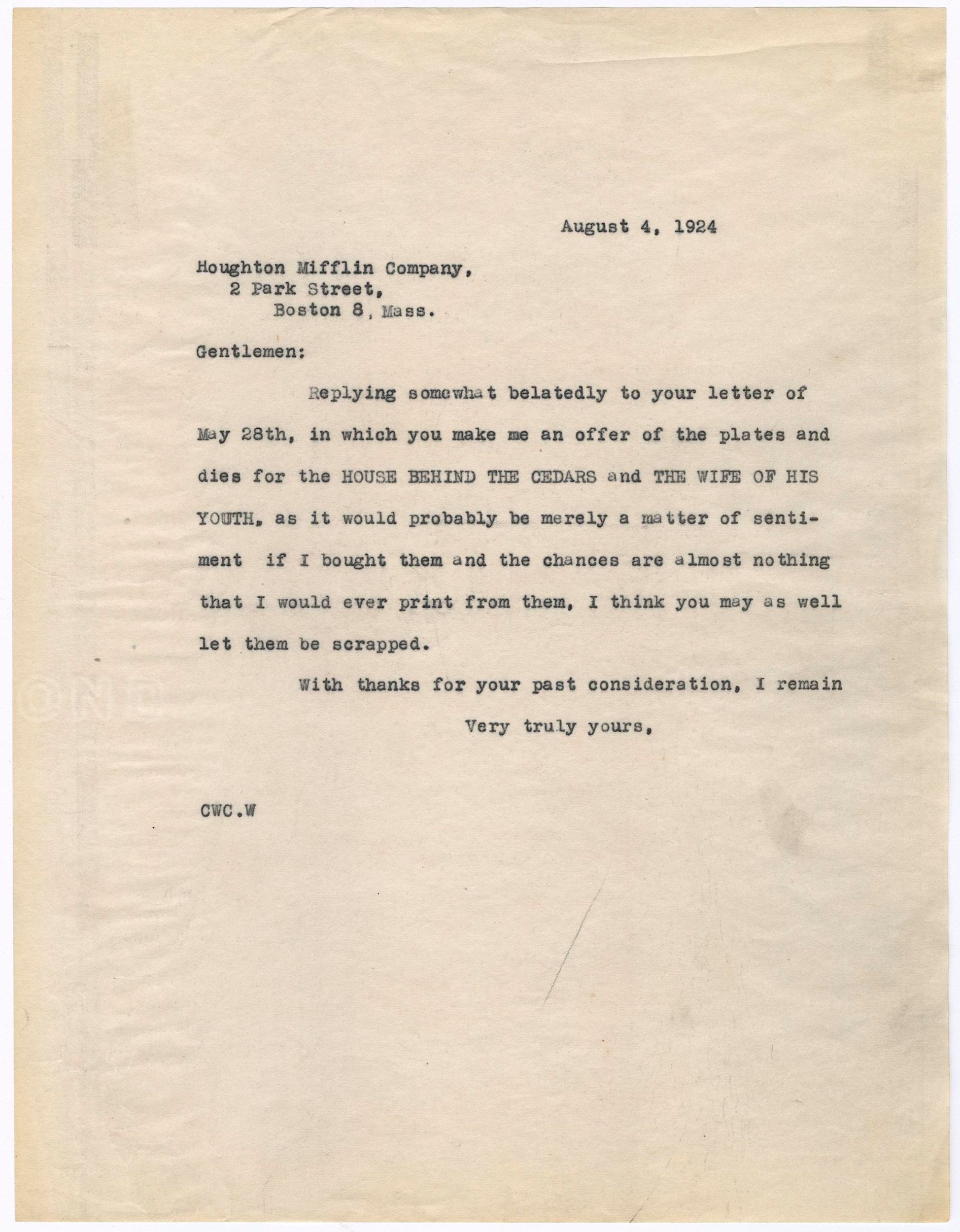 Houghton Mifflin Company,
2 Park Street,
Boston 8, Mass.
Genttlemen:
Houghton Mifflin Company,
2 Park Street,
Boston 8, Mass.
Genttlemen:
Replying somewhat belatedly to your letter of May 28th, in which you make me an offer of the plates and dies for the House Behind The Cedars and The Wife of His Youth, as it would probably be merely a matter of sentiment if I bought them and the chances are almost nothing that I would ever print from them, I think you may as well let them be scrapped.
With thanks for your past consideration, I remain very truly yours, CWC.CCorrespondent: