Judson Douglas Wetmore to Charles W. Chesnutt, 29 December 1922
Key
| Textual Feature | Appearance |
|---|---|
| alterations to base text (additions or deletions) | added or deleted text |
| passage deleted with a strikethrough mark | |
| passage deleted by overwritten added text | Deleted text Added text |
| position of added text (if not added inline) | [right margin] text added in right margin; [above line] text added above the line |
| proofreading mark | ‸ |
| page number, repeated letterhead, etc. | page number or repeated letterhead |
| supplied text | [supplied text] |
| archivist note | archivist note |
 [1]
SIXTY-THREE PARK ROW
NEW YORK CITY
December 29th, 1922.
Mr. Charles W. Chesnutt,
Wiliamson Building,
Cleveland, Ohio.
My dear Mr. Chesnutt,
[1]
SIXTY-THREE PARK ROW
NEW YORK CITY
December 29th, 1922.
Mr. Charles W. Chesnutt,
Wiliamson Building,
Cleveland, Ohio.
My dear Mr. Chesnutt,
I cannot tell you how pleased I was about two months ago to get a letter from you, and not only to find that you were still living and able to go to business, but also to know, that you had not forgotten me. I did not send you a Christmas card, for the same reason that I didn't send cards to a great many of my friends. I forgot to order my cards until it was too late to get them printed by Christmas, and the result was, I did not send out cards this year.
I am writing however to tell you, that I did not forget you Christmas time, and to let you know that I hope you had a pleasant Christmas, and wish for you a properous and happy New Year.
In your letter, you stated that you expected to visit New York this winter, and if you do, I want you to come to my house for dinner, as we have an excellent cook,
 [2]
-2-
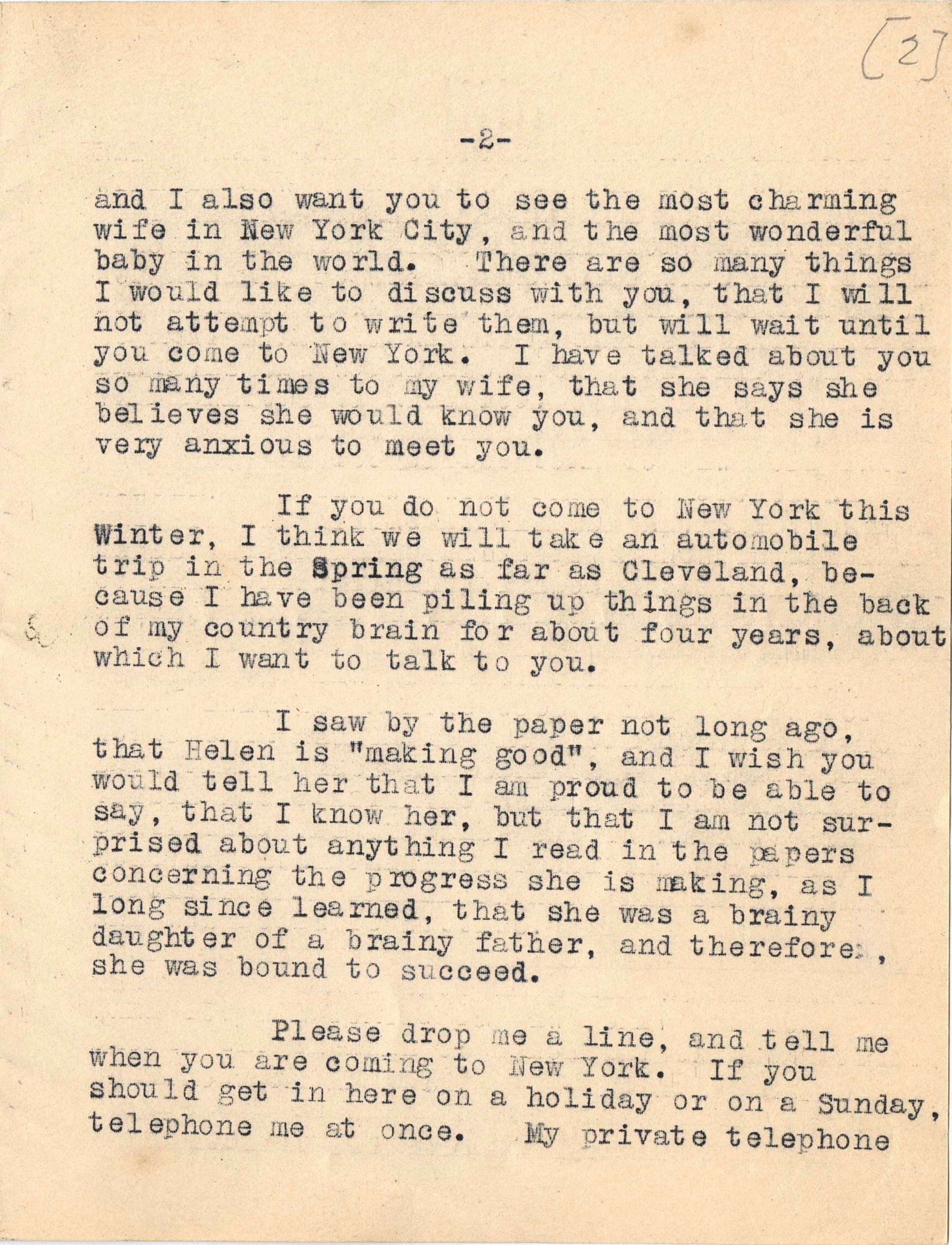
and I also want you to see the most charming wife in New York City, and the most wonderful baby in the world.1 There are so many things I would like to discuss with you, that I will not attempt to write them, but will wait until you come to New York. I have talked about you so many times to my wife, that she says she believes she would know you, and that she is very anxious to meet you.
[2]
-2-
and I also want you to see the most charming wife in New York City, and the most wonderful baby in the world.1 There are so many things I would like to discuss with you, that I will not attempt to write them, but will wait until you come to New York. I have talked about you so many times to my wife, that she says she believes she would know you, and that she is very anxious to meet you.
If you do not come to New York this Winter, I think we will take an automobile trip in the Spring as far as Cleveland, because I have been piling up things in the back of my country brain for about four years, about which I want to talk to you.
I saw by the paper not long ago, that Helen2 is "making good", and I wish you would tell her that I am proud to be able to say, that I know her, but that I am not surprised about anything I read in the papers concerning the progress she is making, as I long since learned, that she was a brainy daughter of a brainy father, and therefore, she was bound to succeed.
Please drop me a line, and tell me when you are coming to New York. If you should get in here on a holiday or on a Sunday, telephone me at once. My private telephone
 [3]
-3-
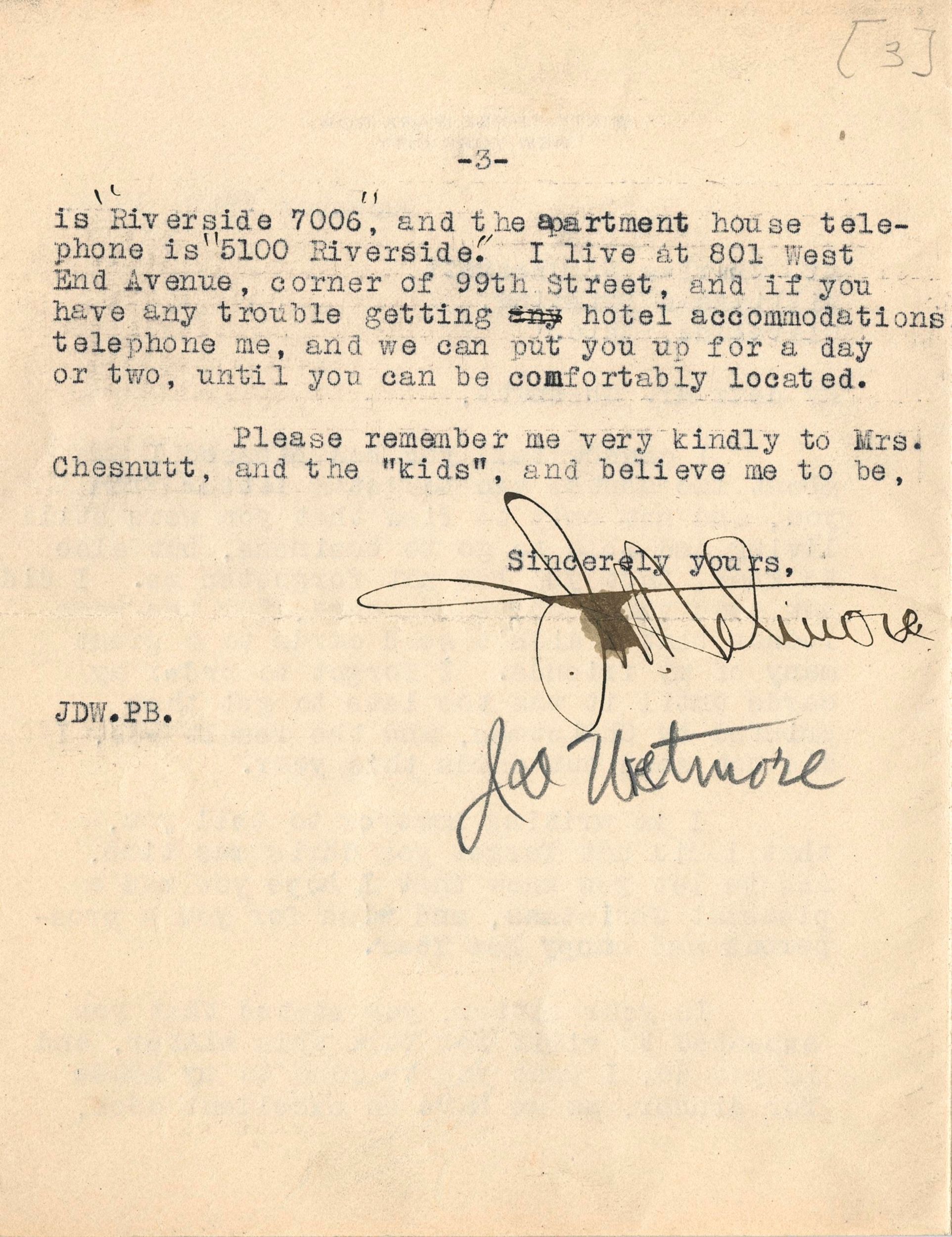
is "Riverside 7006", and the apartment house telephone is "5100 Riverside." I live at 801 West End Avenue, corner of 99th Street, and if you have any trouble getting
[3]
-3-
is "Riverside 7006", and the apartment house telephone is "5100 Riverside." I live at 801 West End Avenue, corner of 99th Street, and if you have any trouble getting any hotel accommodations telephone me, and we can put you up for a day or two, until you can be comfortably located.
Please remember me very kindly to Mrs. Chesnutt,3 and the "kids", and believe me to be,
Sincerely yours, J Wetmore JDW.PB. J D WetmoreCorrespondent: Judson Douglas Wetmore (1871–1930) was a mixed-race lawyer who grew up in Jacksonville, Florida, and was a childhood friend of James Weldon Johnson, who might have introduced Wetmore to Chesnutt. After getting a law degree at Michigan Law School in 1897, Wetmore worked in Jacksonville, but moved to New York City in 1906 to open a law practice. In 1907, he married and later divorced a White Jewish woman, Jeanette Gross (1888–?), with whom he had a daughter, Helen Mable (1908–?). In 1921, he married another White woman named Lucile (or Lucille) Pipes (1894–1966), with whom he had two children. Wetmore died by suicide in July 1930. Both of his wives were aware of his mixed-race status. In official records, he and his children consistently are listed as White, but it was not a secret he was Black (see "Cremate Body of New York Lawyer Whom Many Mistook for White," Afro-American [Baltimore, MD], August 9, 1930, 7; and James Weldon Johnson, Along This Way: The Autobiography of James Weldon Johnson [New York: Viking Press, 1968; orig. pub. 1933], 252).
1. Judson Douglas Wetmore's second wife, Lucile (or Lucille) Pipes Wetmore (1894–1966), was a White woman, originally from Louisiana and widowed in 1918 after a very brief first marriage. The couple married in 1921 and had two children: Frances Lucile (1922–1993) and Judson Douglas, Jr. ("Junior," 1923–1995). After Wetmore's suicide, Lucile remarried in 1931 and again in 1945. [back]
2. Helen Maria Chesnutt (1880–1969) was Chesnutt's second child. She earned degrees from Smith College and Columbia University, taught Latin (including to Langston Hughes) at Cleveland's Central High School for more than four decades starting in 1904, co-authored a Latin textbook, The Road to Latin, in 1932, and served on the executive committee of the American Philological Association in 1920. She became her father's literary executor and first biographer. [back]
3. Susan Perry Chesnutt (1861–1940) was from a well-established Black family in Fayetteville, North Carolina, and worked as a teacher at Fayetteville's Howard School before marrying Chesnutt. They were married from 1878 until his death in 1932 and had four children: Ethel, Helen, Edwin, and Dorothy. Susan led an active life in Cleveland. [back]