Robert Levy to Charles W. Chesnutt, 3 February 1921
Key
| Textual Feature | Appearance |
|---|---|
| alterations to base text (additions or deletions) | added or deleted text |
| passage deleted with a strikethrough mark | |
| passage deleted by overwritten added text | Deleted text Added text |
| position of added text (if not added inline) | [right margin] text added in right margin; [above line] text added above the line |
| proofreading mark | ‸ |
| page number, repeated letterhead, etc. | page number or repeated letterhead |
| supplied text | [supplied text] |
| archivist note | archivist note |
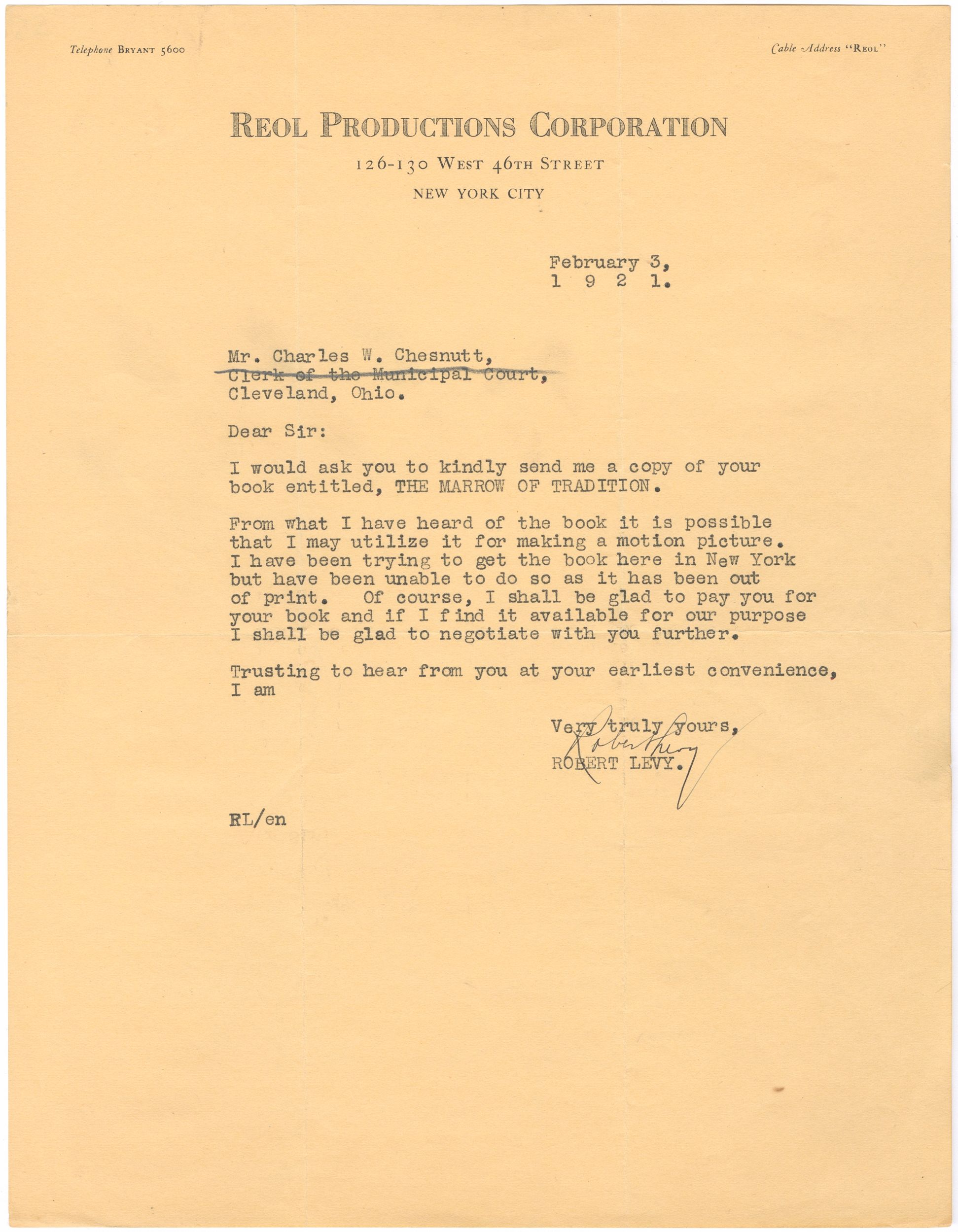 Telephone BRYANT 5600
Cable Address "REOL"
REOL PRODUCTIONS CORPORATION1
126-130 WEST 46TH STREET
NEW YORK CITY
February 3, 1921.
Mr. Charles W. Chesnutt,
Telephone BRYANT 5600
Cable Address "REOL"
REOL PRODUCTIONS CORPORATION1
126-130 WEST 46TH STREET
NEW YORK CITY
February 3, 1921.
Mr. Charles W. Chesnutt,
I would ask you to kindly send me a copy of your book entitled, THE MARROW OF TRADITION.2
From what I have heard of the book it is possible that I may utilize it for making a motion picture. I have been trying to get the book here in New York but have been unable to do so as it has been out of print. Of course, I shall be glad to pay you for your book and if I find it available for our purpose I shall be glad to negotiate with you further.
Trusting to hear from you at your earliest convenience, I am
Very truly yours, Robert Levy ROBERT LEVY. RL/enCorrespondent: Robert Levy (1888–1959) was a producer and director in Black theater and film in the 1920s. He was the manager of the Lafayette Theater in Harlem from 1916 until 1919, and founded REOL Productions, a film company dedicated to making films for Black audiences. A White Jewish immigrant from Britain, he was at times criticized for not making space for Black leadership in his theater and films.
1. REOL Productions was a film company founded by Robert Levy (1888–1959). Like the Micheaux Film Corporation, its direct rival, REOL sought to produce films based on the writings of Black writers and aimed at Black audiences. The company was incorporated in May of 1920 and released twelve silent films in 1921 and 1922, before being dissolved in 1924. Negotiations over the film rights to Chesnutt's The Marrow of Tradition did not ultimately result in a contract. [back]
2. The Marrow of Tradition was published by Houghton, Mifflin & Company in October 1901. The novel was a thinly veiled account of the Wilmington Massacre of 1898, a White supremacist coup that overthrew an interracial city government, targeted Black elected officials, killed between sixty and three hundred Black citizens, and terrorized several thousand who fled the city and never returned. [back]