Booker T. Washington to Charles W. Chesnutt, 26 May 1908
Key
| Textual Feature | Appearance |
|---|---|
| alterations to base text (additions or deletions) | added or deleted text |
| passage deleted with a strikethrough mark | |
| passage deleted by overwritten added text | Deleted text Added text |
| position of added text (if not added inline) | [right margin] text added in right margin; [above line] text added above the line |
| proofreading mark | ‸ |
| page number, repeated letterhead, etc. | page number or repeated letterhead |
| supplied text | [supplied text] |
| archivist note | archivist note |
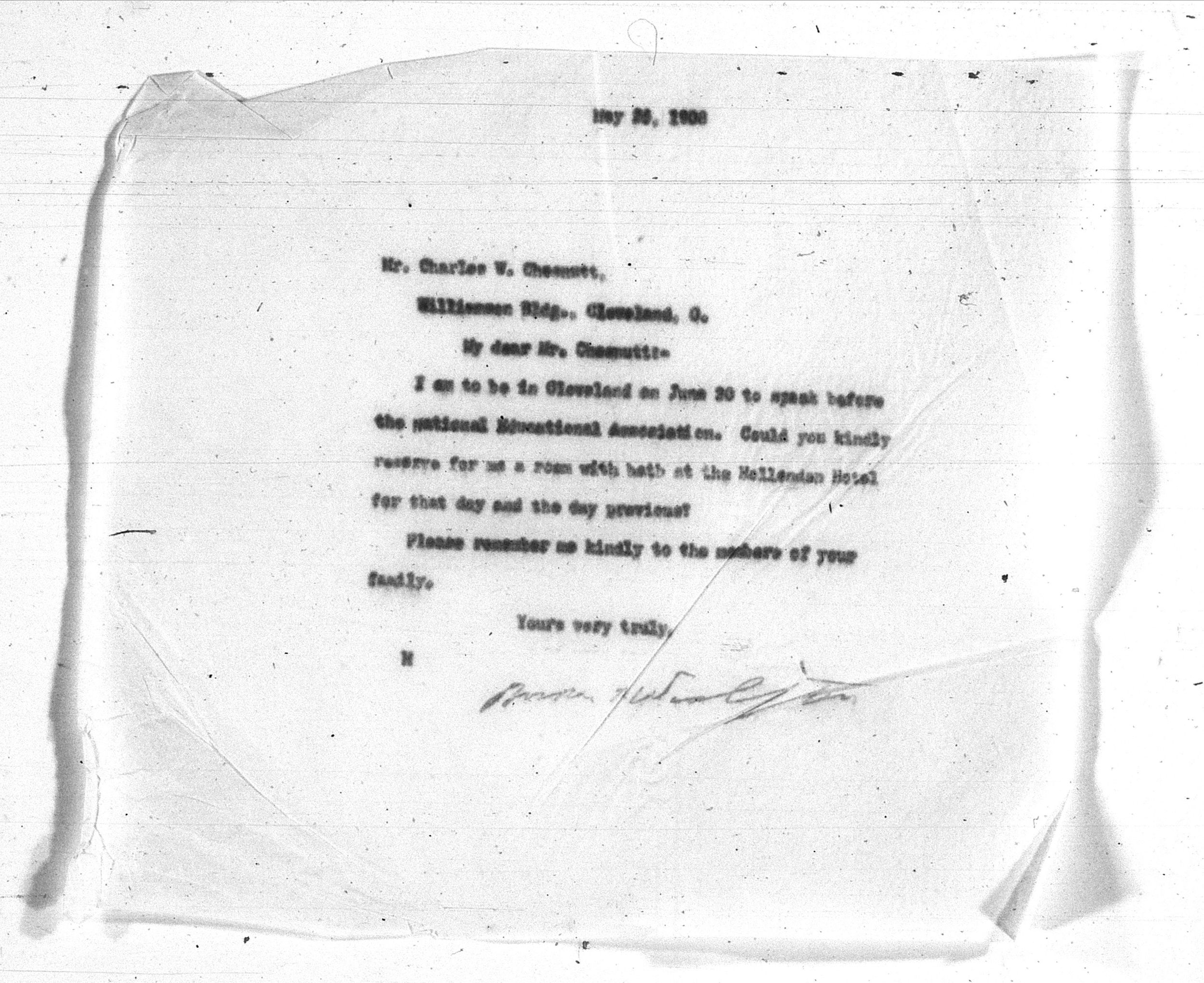 May 26, 1908
Mr. Charles W. Chesnutt,
Williamson Bldg., Cleveland, O.
My dear Mr. Chesnutt-
May 26, 1908
Mr. Charles W. Chesnutt,
Williamson Bldg., Cleveland, O.
My dear Mr. Chesnutt-
I am to be in Cleveland on June 30 to speak before the National Educational Association.1 Could you kindly reserve for me a room with bath at the Hollenden Hotel2 for that day and the day previous?
Please remember me kindly to the members of your family.
Yours very truly, Booker T. Washington HCorrespondent: Booker T. Washington (1856–1913), one of the most well-known Black activists of the early 20th century, was born into slavery in Virginia. In 1881, he became the president of what would become the Tuskegee Institute, advocating widely as a speaker and writer for technical education for Blacks, whose entry into American industry and business leadership he believed to be the road to equality. His political power was significant, but because he frequently argued for compromise with White Southerners, including on voting rights, he was also criticized by other Black activists, especially by W. E. B. Du Bois.
1. The National Education Association, or NEA, is an organization for educators founded in 1857 as the National Teachers Association. The NEA's 1908 annual meeting was held June 29–July 3 in Cleveland, Ohio, and Booker T. Washington gave a speech on June 30 on "Negro Education and the Nation." (Reprinted in Journal of Proceedings and Addresses of the 46th Annual Meeting [Chicago: University of Chicago Press for the National Education Association, 1908], 87–93.) [back]
2. The Hollenden Hotel was a luxury hotel in downtown Cleveland, Ohio. From 1888 to 1923, it had a large barbershop run by a prominent Black Clevelander, George A. Myers (1859–1930), who was active in local politics and a sometime correspondent of Chesnutt's. While Booker T. Washington stayed at the Hollenden on several occasions, Black guests were generally not welcome. [back]